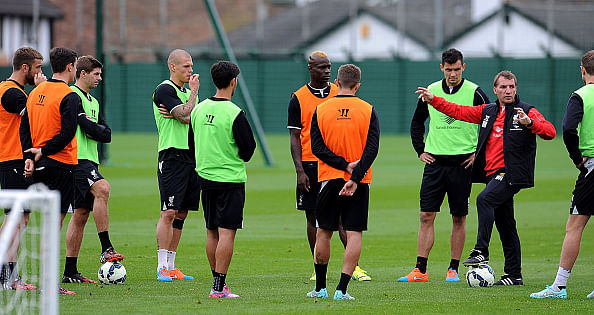
Brendan Rodgers talks to his players during a training session at Liverpool’s Melwood Training Ground
A common product of delving deep into clubs’ early season forms is the inference on which of them are seemingly in ‘crisis’ mode and which ones are close to one. There are certain trademarks of these ‘crisis’ clubs such as going from title contenders last season to mid-table and below at present in the current season, losing a top player to a rival and being in the Barclays Premier League more often than not.
Liverpool right now are the subject of many such inquests that are absolutely convinced that last year’s runners-up are going to squarely fall flat this season and fail to match up to their levels from 2013-14.
Tuesday night against lower league opposition Middlesbrough, Liverpool played out a hugely thrilling and tense penalty shootout that lasted an eternity and finally finished when Albert Adomah missed his kick to give the Merseyside team a 14-13 victory. That shootout win came on the back of a humbling 3-1 defeat at Upton Park against Sam Allardyce’s West Ham United, their third defeat in their first five games of the new league season.
More than their performances, Brendan Rodgers’ main task this time around is to manage expectations that have been set thanks to the team’s showing last time around. Managing expectations
The truth is Liverpool are not at the level where they can be regular title-contenders yet, on par with Chelsea and Manchester City. They were very, very good last season and were rightfully amongst the top two teams in England’s top division. Brendan Rodgers has a proven record of bringing about regular improvement in his teams, but last season was just a glorious coming together of all the good work, one that we may not see again. A number of things went right for them with regards to injuries, player performances and the lack of European football, especially with regards to the comparatively thin squad they had last term.
So taking that as the base, it’s easy to feel disappointed and throw brickbats at them for their showing so far. But it’s never easy to repeat success (yes, success does not necessarily mean winning trophies), even without the kind of change that Liverpool have gone through. And there is precedence to it; just think back to their superb 2008-09 campaign where they were top of the table for 9 weeks and kept up the chase on eventual champions Manchester United right until the end.
Besides the fact that Liverpool were involved in the UEFA Champions League that season, there were many parallels between that season and the one from last year. Then too they had a lethal striker who struck up a beautiful partnership with the midfield and Steven Gerrard had a fantastic season. The very next season?
They finished 7th with one of their key players, Xabi Alonso, having left for Real Madrid in the summer. So history shows us that it’s not easy to do repeats and three-peats which is why the efforts of Chelsea, Manchester United and Arsenal in the past decade were so admirable.
However, that said their fans and fans of the league are not going to be so forgiving for the expectations have been set now and that’s an added pressure that both Rodgers and his side have to deal with. Errors that may have been let off last season may be received with much more admonishment, and we’re already seeing it. Managing the loss of Luis Suarez
Kolo Toure seemed ever determined to get as much playing time as possible and did his best to give away a clumsy penalty in the dying minutes of regulation that pushed the aforementioned League Cup game against Middlesbrough into extra time. That pretty much sums up their defensive nightmares so far. Their defenders have more often than not been lost for position and were made to look good only by Tottenham Hotspur; that tells you something about where the London club are at the moment.
But defensive struggles aside, their attack has failed to kick into gear. Yes, that high-octane attack which scored just one goal lesser (101) than champions City last season and which could dismantle any side with ease when in rhythm. That forward line of theirs was one of the best on display amongst all 20 top flight teams and they were a thing of beauty when in full flow.
Yes, Luis Suarez has left for Barcelona and Liverpool are finding out exactly what Tottenham went through last season after Gareth Bale headed to Spain. It doesn’t matter how many quality players you bring in to replace that one big fish, they’re going to need time to settle and subsequently the team is going to go through a trough in that phase. To add, there’s the element of familiarity now with how Rodgers’ side are going to play which leaves teams better prepared from last time.
Suarez had a huge role in how well both Sturridge and Sterling played last season
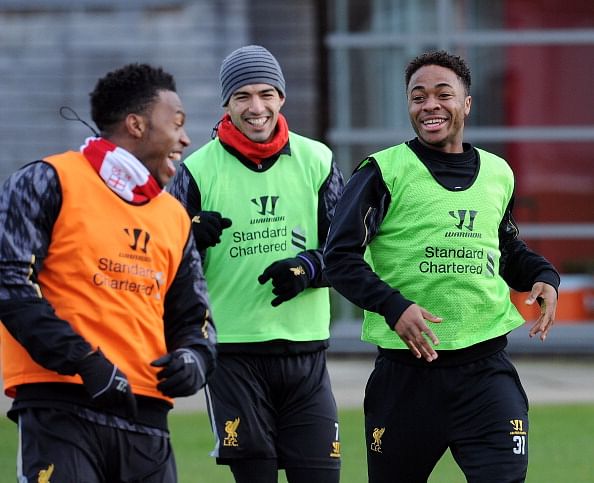
One particular aspect that will be of great interest as the season progresses is how Rodgers assimilates Mario Balotelli into the first-team (if at all) along with Daniel Sturridge and youngling Raheem Sterling. Last year, Rodgers had at his disposal one of the most fluid frontlines in the league with the excellent Phillipe Coutinho behind. It was a frontline that was full of runners and players who liked swapping the role of scorer and provider regularly, especially Suarez, who in the second striker’s role amplified Sturridge.
Amongst those three, Sterling and Suarez were most of the time never hesitant to pass, while Sturridge every so often would pull the trigger unnecessarily instead of moving the ball on. It didn’t affect them too badly because two of the front three were playing to plan and plus Sturridge played the furthest up field, so he could be allowed the indiscretions.
Now with Balotelli, that makes two people not always looking to pass and that’s a worry. Also, the Italian isn’t the most hard-working forward around and needs good service; a trait that’s come through while playing for his national side and City formerly. This puts the impetus on Sterling who suddenly is the next big thing for England (lost count of how many such ‘things’ have come and gone in the last decade) and supposedly THE man at Liverpool too. I think we’re conveniently forgetting that he is just 19 years old; the guy is a serious candidate for a quick burnout at this rate. Managing Raheem Sterling
There are increased demands now on Sterling for both England and Liverpool
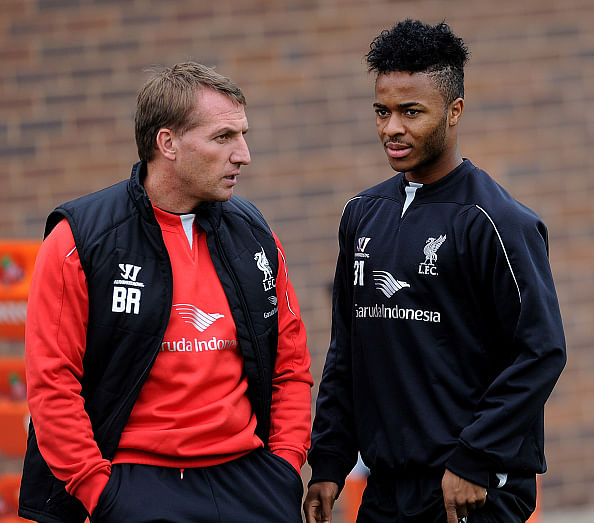
And that’s the final part of what Rodgers is up against this season. Sterling may be the golden boy of Liverpool and England right now, but many such promising youngsters in the land of hype, England, have tapered spectacularly after having won selection for the Three Lions. He needs to abstain from putting all the pressure of chance creation on Sterling if things get rough and needs to stick with his philosophy. He also needs to manage the youngster’s minutes with his side likely to be involved in European competition right through to ensure that fitness concerns don’t overreach and cause a downturn in his performances on the field.
The other task he has is to keep Sterling grounded; such sudden elevation can sometimes get in the way of good young players making it great. He is a fantastic player and it is disheartening to see when players of his ilk don’t come through on their enormous potential.
Burnout and overconfidence apart, other teams will soon start sniffing around if he continues to grow at his current rate (There are rumours already about Real Madrid’s interest, no surprise!). Warding off their advances and keeping his charge focused on the here and now is going to be integral.
That’s the combination of issues that Rodgers has on his hands at the moment as he looks to right the course of the Liverpudian ship that has hit one too many icebergs already this early in the season. He is one of the best young managers around and history suggests that he will eventually get it right, but even if he does he may not be able to match that second-place finish. That’s the reality that we should be ready to contend with.
However, if he does get it right, what he will be doing is setting the club up for a more consistent run at the top of the table and a scenario where it would be tough to keep them out of the title talk at the beginning of every season. A scenario where Liverpool would be better prepped to manage expectations.
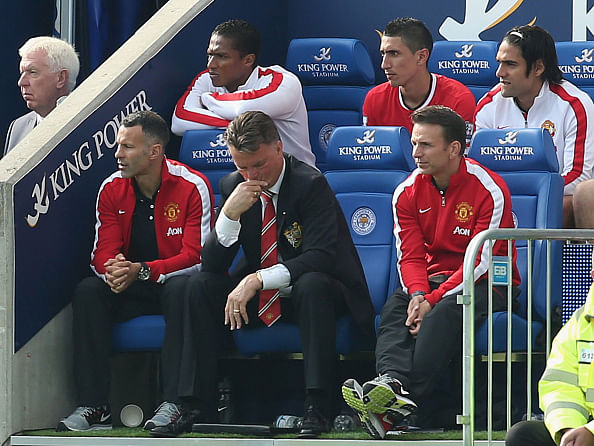
It was a chastening defeat for Louis van Gaal and Manchester United at the King Power Stadium against Leicester City on Sunday. The rather swift reversal of fortunes that saw United go from being on the right end of a 3-1 score line to the wrong end of a 5-3 verdict in the space of about 20 minutes left van Gaal at a loss for words at the conclusion.
Flummoxed was the Dutchman for he could not quite believe what had just transpired and how a promising evening had turned into one so sour. In an honest admission, he slammed his players for the 60-minute showing that they put up without diving into criticism of some of the refereeing decisions that did indeed cost his side.
Leicester reinforced their reputation as the ‘never say die’ team of the Premier League after yet another stirring comeback that brought a party-like atmosphere to the stadium during the game while United showed that there is still much work to be done at the once dominant club.
Much of the talk as expected swirled around the porous nature of United’s defence and top-heaviness and not without reason too. But, in their rather calamitous capitulation, a few deeper problems were revealed. United’s stars fail to ride through the tough times
In their first match last week against Queens Park Rangers (QPR) at home, their big-money line-up rode roughshod over Harry Redknapp’s visiting side. They were barely troubled for much of the match and in that luxury played with the freedom of a child with nothing in the world to worry about.
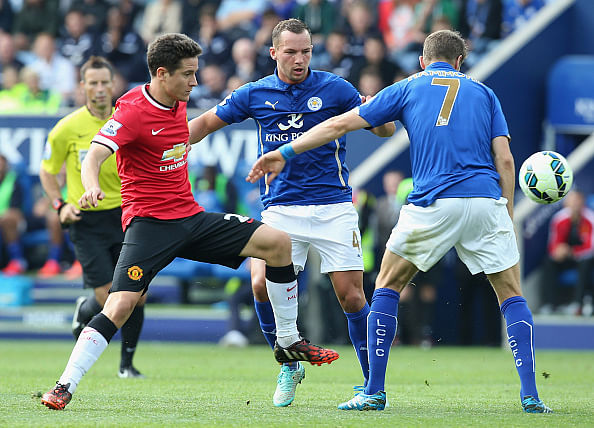
Following on from where they left off, the starry troupe sliced and diced its way to a quick 2-0 lead on Sunday before finding resistance forthcoming. Leicester reduced the arrears immediately following the restart, but it was still expected that United would have too much for the newly promoted side come the second half. And when United scored their third through Ander Herrera’s beautiful back-heel flick, the result looked a certainty.
Except that United hadn’t witnessed the last bit of resistance yet from the Foxes. They fought back again and caused their guests much unease just like after they’d conceded their first goal. A few seconds later, Leicester were back on level pegging and suddenly most of United’s outfield players resembled headless chickens. This really was the first big challenge for this new United side and they failed to show any taste for a fight, limping out in the end.
Ander Herrera and the midfield gave away possession needlessly too many times in the second half
Almost all of United’s new signings have cost big money, but not all of them are battle-hardened professionals with plenty of experience, especially Premier League experience. It’s a problem that Tottenham Hotspur continuously face with their numerous imports every season and something that Liverpool are encountering this season. Sometimes you have to get stuck in and grind out results; the current United lot, while all good individual players, failed to show that resolve.
Marcos Rojo got caught out numerous times while playing a misplaced forward pass instead of playing to the situation and Ander Herrera lost possession similarly quite a few times. Daley Blind tried to control proceedings but he was overburdened with the failings of the backline which left him with too many open spaces to cover.
Tyler Blackett is just learning the ropes with his call up to the first-team and it’s been a tough learning curve for him, but Chris Smalling even after considerable time at the club still does not know composure when dealing with a situation and added to the woes of his young colleague. Rafael has shown glimpses of his attacking brilliance and what he adds to the team going forward since his return. What he’s also shown is that his ability to shoot himself and his team in the foot is still very much intact.
United are not the first team to suddenly lose the plot nor will they be the last. However, not all teams cave in quite so spectacularly, sides have managed to stem the rot with strong leadership. And therein lies United’s other major problem this season. Wayne Rooney fails to deliver as captain
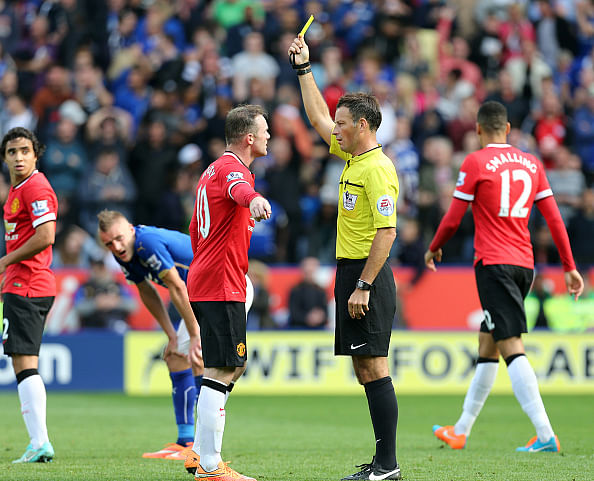
Wayne Rooney was petulant and failed to lift his side
On Sunday, Rooney had the perfect opportunity to show that van Gaal was right to make him captain by attempting to salvage his ship from wreckage. His crew were losing the plot in the face of wave after wave of Leicester pressure and it was as fine a time as any to step up and take charge of the situation. And he failed.
Oh Rooney was not passive; he was anything but. He was in referee Mark Clattenberg’s face after he awarded the penalty that led to Leicester’s second goal. He was constantly barking away at Clattenberg thereafter every time a decision did not go his team’s way. He was so irate and literally had steam spewing out of his ears after Blackett’s sending off as he ganged up on the referee once again with his teammates.
And after conceding the lead, he had a go at each of his mates that were around him, admonishing them with some choice words, but not really in a way that one would rally the troops. In between those moments he tried to shoot from way outside the box with defenders in his way, saw his passing fall off spectacularly, and had a go at trying to get himself sent off by making some silly lunging tackles. To put it simply, he lost his head.
In the past, United have had strong captains in Ryan Giggs, Patrice Evra, Nemanja Vidic, Rio Ferdinand and Edwin van der Sar to turn to for inspiration. They were all feisty characters, but they did not let the heat of the moment consume them, and more often than not managed to get the team regrouped, focused and led them out of tough situations. Route to consistency
Since United’s disastrous previous season, much of the attention has centred on the rebuilding of the squad and getting quality players to don the famous red shirt once again. But since Alex Ferguson’s departure, it is the confidence and morale of the team that has taken a severe beating and needs repairing the most. Skill can be purchased in the market, but they need to be backed up by a strong core and definitive leadership.
United’s players have the skill, but they need to learn to have the gumption for a fight. Rooney needs to leave his impish ways behind, not just because he is a senior player on the team, but because he is the captain for crying out loud. And van Gaal has to find a way to bed in some mental fortitude along with all of the tactical and strategic nous that he has been drip-feeding his new team since the start of the season. Only then can the league expect to see a consistently good Manchester United.
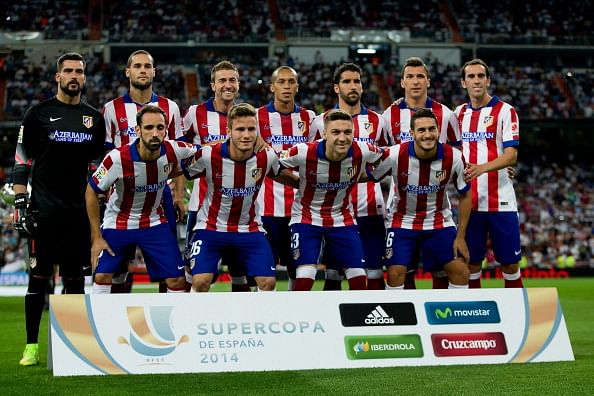
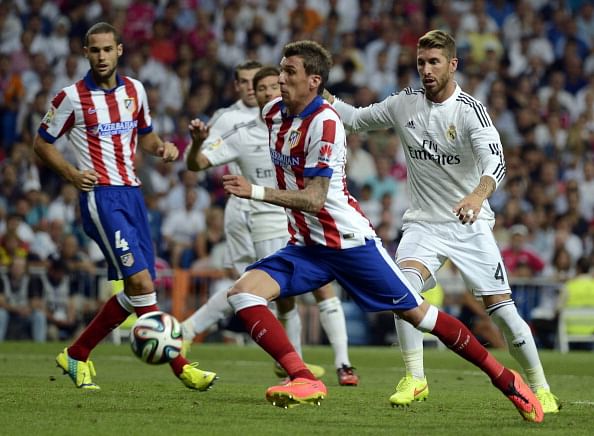
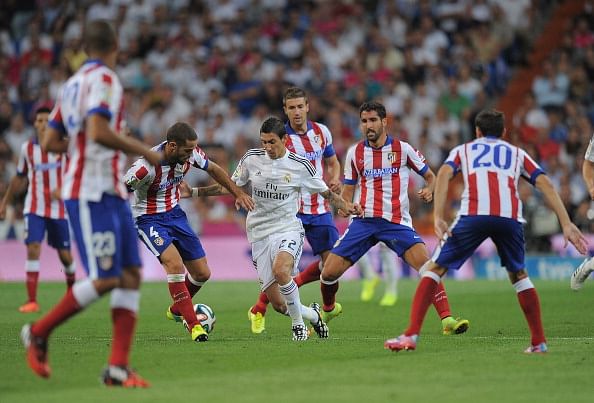
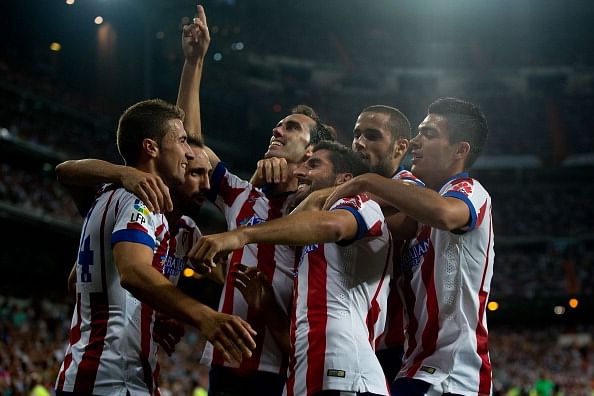
Atletico Madrid line up in the 1st leg of the Super Copa against Real Madrid at the Santiago Bernabeu
It’s always of great interest to follow the story of an underdog, what with their tales of courage and bravado in going up against stronger foes and being able to hold their own. The story of the underdog in sport occupies a special place, for it lends an added element of drama to their success.
Now Atletico Madrid are no longer underdogs, but they did start off as such a couple of years ago, before slowly but surely climbing the ladder and scaling the peak of the Spanish La Liga last year in a most memorable season. So there’s always that one question in the back of your head – can they do it again?
That’s a question that can never really be answered on the first day of the season, barring a feeble affirmative that merely tends to acknowledge the fact that, yes, they are contenders. But with all the goings on in the post-season primarily revolving around the departures of some of their star names, Atletico’s 2014-15 campaign holds much allure to see how they go. Atletico keep Real’s stars grounded
They finished their campaign last season in action against city rivals Real Madrid in the final of the UEFA Champions League, where they were usurped by their more famous opponents as they made their way to capturing the holy ‘La Decima’. Atleti began this season against the same opponents two nights ago, this time in the 1st leg of the Spanish Super Copa at the Santiago Bernabeu, and this one too finished with the exact same score line after 90 minutes as was the case that night in Lisbon – 1-1.
In finishing with a draw and an important away goal to boot, Diego Simeone’s side showed much of the same characteristics that defined their campaign the whole of last season – grit, guts and gumption. They contained Real for much of the game and despite conceding a late goal that threatened to undo all of the good work put in, managed to hit back quickly before time expired to set up a very interesting second leg at the Vicente Calderon tomorrow night. The New Boys Los Colchoneros did not have the marauding presence of Diego Costa up front to lead the attack, nor did they have the evergreen David Villa, who confounded critics and naysayers last season who claimed that the former Barcelona hitman was past his prime. Who they did field was their €22 million summer signing, Croatian international Mario Mandzukic.
Mario Mandzukic did his best at harrying Sergio Ramos and Pepe through the game
Mandzukic is not even close to being the UWM (Ultimate Windup Merchant) that Diego Costa is, but he ticks the boxes in all other departments as a physical front man perfectly suited to Simeone’s needs. He’s aggressive and helps with the high press, putting pressure on the centre-backs and constantly being a thorn in their flesh. He did that to great effect on Tuesday night, managing to unsettle Pepe and Sergio Ramos in the heart of Real’s defence.
As seen from his spells at Bayern Munich and Wolfsburg before, Mandzukic never ceases to run, plus with his expertise in heading the ball and at set pieces, he seems a perfect fit in the system. And if anything, Mandzukic is a proven performer who has been consistently delivering the goods the last few seasons for both club and country; Costa had one magnificent season, but can he deliver those on a regular basis? We will find out in a few seasons.
We did get to see the other striker too in the closing stages of the game – Mexican Raul Jimenez, another tall striker. Jimenez looks to be a good replacement for Adrian, having scored well for Club America in the Mexican league the last two years, and has been picked up while on an upward curve. He did look to play more as a second striker though, bringing the others into play and exchanging places with them.
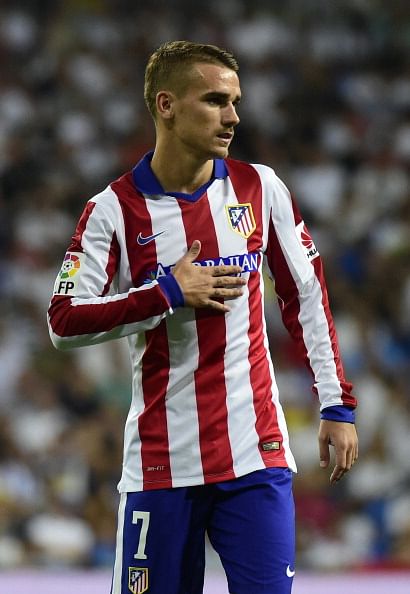
Antoine Griezmann had a good second half outing
Atletico’s most expensive summer signing, Antoine Griezmann, was also introduced on 57 minutes. The €30 million man, who had five impressive seasons at Real Sociedad, looked very impressive playing in a role akin tothe one David Silva plays for Manchester City. With his deft touch and eye for a pass, Atletico enjoyed a good spell of pressure post his introduction, and looked more dangerous going forward. It will be very interesting to see what Atletico can serve up when they have Arda Turan back, provided he’s still around at the end of the transfer window. The core remains strong
New players are like new seasonings that you’ve picked up at the supermarket because your old ones are exhausted. So while it is natural that attention seemingly goes to the new recruits, much of what Atletico will achieve this term depends on their core, one that they have kept reasonably intact, with Costa and Filipe Luis the only departures so far.
Atletico’s strong core continues to be the foundation of the team
For two seasons running now, Atletico have had the best defensive record, fuelled primarily by how well organized they are and possibly having the best back four amongst all teams. Luis has left, but the strong resolute trio of Diego Godin, Joao Miranda and Juanfran are very much intact and provided another excellent defensive display against European champions Real, managing to keep their offensive weapons quiet. And that defence has been the bedrock of Atletico’s means to success upon which they have built on these past few years; so as long as that end is as fit and firing as ever, they should continue to do well.
The other combative members of the core – midfielders Koke, Raul Garcia and Gabi – were all in attendance too and in their customary workmanlike approach augmented the efforts of their defence really well. Garcia is just a phenomenal bloke for he is such a favourite of Simeone, someone who works his socks off for the team when not in possession and can play as the supporting striker when they need some impetus up front.
It was his goal that drew parity as he did what he does best, be in the right place to put away a Koke corner after the Real defence failed to clear it leaving him with just a clueless and hapless Iker Casillas to beat. He’s been in good form, having scored in the friendlies against Wolfsburg and Cadiz as well, and the goal at the Bernabeu was his fourth in three games in the space of 10 days.
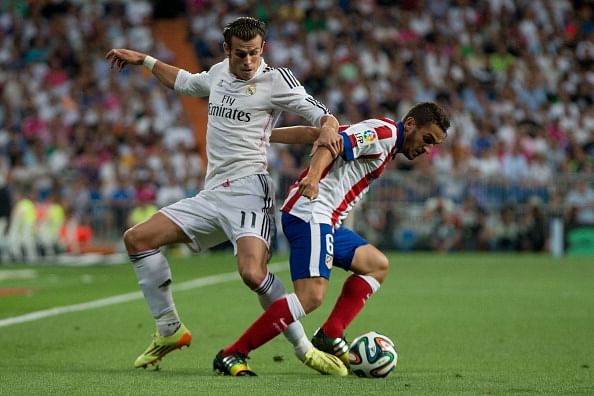
Koke dispossesses Gareth Bale
Koke continues to impress. His delivery from set pieces is very, very underrated and is a vital ingredient of how the team is set up as they look to take advantage of set pieces to get into scoring positions. The 22-year-old was the subject of widespread speculation even before last season could finish, with many claiming that he would be off along with the likes of Costa to a ‘bigger club’. But as he announced over the summer, Atletico is where his heart is, and he would like nothing more than to help this team get better and win more trophies.
An Atletico product through and through, Gabi leading by example is like the master conductor who brings it all together on the pitch, and he led his team as always with a verve and gusto that far outstripped that of his counterpart, Iker Casillas. Importantly Atletico’s midfield managed to keep tabs on Real’s engine room of Luka Modric, Xabi Alonso and Toni Kroos. A season of much promise for many reasons
The second leg of the Spanish Super Copa is tomorrow night at the Calderon. A year ago, Atletico lost the Cup to Barcelona despite not being beaten in either leg, thanks to away goals. They wouldn’t mind winning the same way this year.
As far as performances and integrating new units into the system go, Atletico seem prepared, you wouldn’t have expected any less from a side marshalled by a hard taskmaster like Simeone. There’s obviously no way that they are at 100%, but they’ve got the elements that served them well in the past up and running and chugging along nicely. They’ve done well in pre-season and came into the Super Copa clash unbeaten, always a healthy sign.
It may be surprising, and is possibly a fact that has been understated and looked over, but Atletico have spent €99 million on players this summer (yes, that is indeed true)! They have not come even close to that figure in previous seasons with last season’s figure being roughly 30% of that at €29 million!
It goes to show that Atletico are interested in maintaining their position at the top of the Spanish game and are not in it to be a short fuse. They have bought well in terms of players who would fit their style of play with no doubt an eye on how well endowed they are in certain hormonal capacities (refer Simeone’s famous statement at the end of last season).
Atletico still look to have a lot of fight left in them
They’ve been rebuking critics for some time now; last year it was argued that Champions League football would be a distraction and would hence strain a thin side thereby affecting league performances. But they won the league and made the finals of the Champions League, coming within a minute of doing the double.
It was argued even before last season came to a close that Atletico would suffer this term with the potential exits of their top men. While the losses have been sizeable, they haven’t been paralyzing. And from what we saw in the first game, the side bears a settled look about it.
More than anything else, this season promises to be a season of excitement. For we will get to see if Atletico can get back to that high level after a winning season, maintaining that level of intensity and effort. And also as an interesting sub-plot, we will get to see how Simeone goes as a manager and how his journey unfurls from here on in as one of the top managers in the game.
Until now, Atletico were the hunters, and Simeone found it very easy to train his pack and get them motivated for the challenge. Now, they are the hunted, and how they respond to this challenge should make for compelling viewing.
There’s a line on the front of their jerseys that says “Land of Fire”; that of course is the tagline for their chief shirt sponsors, the country of Azerbaijan, but it is something that also so aptly defines what this club has come to represent under Simeone’s stewardship. There is still much fire and bite left in this dog and that’s why its bark should still be heard come the end of season.
Mario Goetze’s goal in extra time clinched the 2014 FIFA World Cup for the Germans, netting them their fourth trophy, putting them level with Italy and just one behind Brazil.
For the many Brazilians inside the Maracana, there was satisfaction that their neighbours and arch rivals hadn’t managed to get their hands on the coveted trophy, an achievement that would have certainly rubbed salt into their wounds after having witnessed their own team getting dumped out of the tournament in acrimonious fashion.
Argentina had a fine run to the final. They started off slowly and barring the games against Bosnia and Herzegovina and Belgium, they were truly pushed to the limits in each of their games. But they held their own and managed to get the job done, getting over their opponents to eventually make it to the grand finale. The 2014 run to the final was a rather unconventional one for the Argentines. Unlike in the past, this campaign wasn’t highlighted by superb, silken attacking play that their opponents found too much to handle.
True, Argentina had in their ranks, and as captain, arguably the best player in the world in Lionel Messi. He did win the Golden Ball, which was FIFA’s way of pandering to popular opinion and ensuring their commercial interests. But Messi wasn’t even the best player on his team. While he did show his class in leading the way in the group stages, as the tournament progressed, Argentina became more effective than effervescent. Mascherano wasn’t captain but led from the front
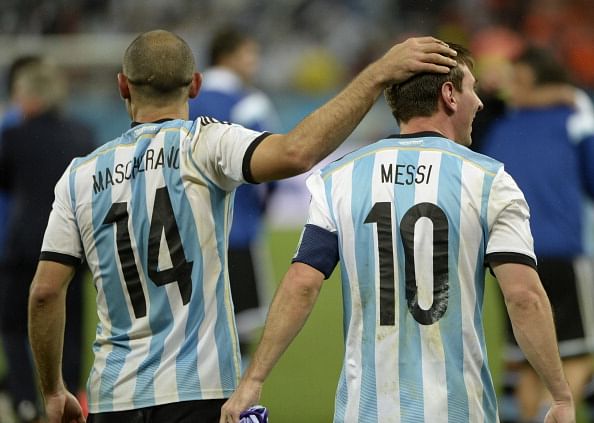
And the leader of this effective pack and Argentina’s MVP during the tournament was Javier Mascherano, who truly had a spectacular World Cup for the Albiceleste. Messi wore the armband, but Mascherano was the vocal leader on the pitch, marshaling the troops, and helping keep the Argentine unit tight and compact. He was, in fact, the incumbent before Alejandro Sabella handed the captaincy to Messi, so the midfielder was just continuing on in his leadership role sans the armband.
Having been witness to watching the midfield enforcer play centre-back for Barcelona the last few seasons, it was an absolute joy to watch Mascherano at this World Cup operating in his favoured deep-lying midfielder role. His marking, tackling and retrieval of the ball were all superb and his distribution once he obtained possession was fantastic, in a throwback to his Liverpool days and his initial years at Barcelona. Acting as the pivot, he helped protect Martin Demichelis, a pronounced liability at the back at club level the last season, and Ezequiel Garay, not the quickest of defenders.
He was crucial in keeping the Argentines organized and disciplined while defending, an aspect that their neighbours Brazil ended up paying a heavy price for not addressing. For long the shortcoming of South American teams, even the best of them, Mascherano ensured that it would not be their Achilles heel this time around.
Mascherano was amongst the leaders in tackles, balls recovered and distance covered among midfielders at Brazil 2014. And while it was his possibly game-saving tackle against Arjen Robben in the semi-finals that made people look up and take notice, efforts like those were what Mascherano routinely put out through the course of the tournament.
After conceding two goals against Nigeria in their final group game, Argentina went three full games without conceding another, only to be breached by Gӧtze’s superbly taken volley in the summit clash. And while he was excellent throughout the tournament, he reserved his finest showing for the semis and the final. While everybody spoke about how well Nigel de Jong man-marked Messi in the semi-finals, Mascherano’s equally lock-in defence against Robben and Wesley Sneijder was overlooked.
In fact, as the match wore on, and the Dutch began to enjoy possession and embarked on a late charge, it was Mascherano who the entire Argentine team suddenly looked up to. And in the team huddle before extra time and penalties, it was once again Mascherano, and not Messi, who was giving the team talk, motivating and inspiring his troops.
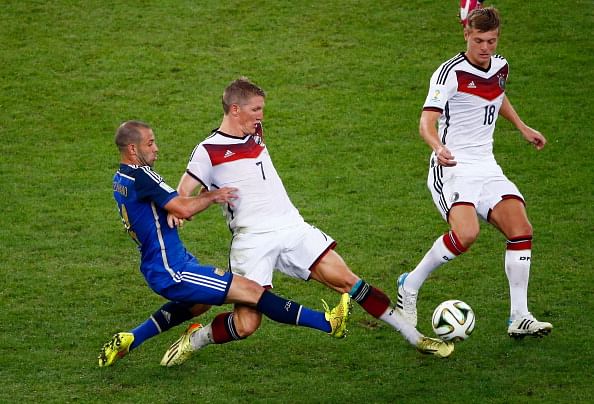
Javier Mascherano of Argentina challenges Bastian Schweinsteiger of Germany during the 2014 FIFA World Cup Final
The unsung hero – recognized by his opponents
Going into the final, Germany’s Bastian Schweinsteiger singled out Mascherano’s importance to the Argentine side calling him “the leader of a pack of wolves”. And Germany found it tough to get past that wolfpack in the final as Mascherano went toe-to-toe with perhaps the best midfield pairing in the competition in Schweinsteiger and Toni Kroos.
He may not be the big, bad wolf, but through his performances at Brazil 2014, the diminutive Argentine’s reputation as one of the best holding midfielders in the world has been restored. He led his side to their first final in 24 years, and they came close, really close.
But the loss in the final notwithstanding, when the dust settles around the 20th FIFA World Cup, and people begin to look back at the names that stood out, the names that shone the brightest, most of the talk may still revolve around Messi, but Mascherano’s huge contribution to the cause will not be lost on them.
Brazil national side fail to live up to the expectations of the home fans as Germany thrash them 7-1 in the semi-final.
This past Tuesday in Belo Horizonte, time seemed to stand still during the 90 minutes of football in the first semi-final between Brazil and Germany.
For 90 minutes, all those who watched went through emotions that you would associate more with being at the cinemas and amphitheatres. For 90 minutes, people’s thoughts were suspended, for from the outside looking in, it bore no evidence of a sporting contest, least of all a FIFA World Cup semi-final between two giants of the game.
While the rain came down hard as the match wore on, the tears came down harder on the cheeks of many Brazilian supporters in the stadium who just found it all a little too much to stomach. Overwhelmed they were and awash with misery at watching their heroes fall apart like a deck of cards.
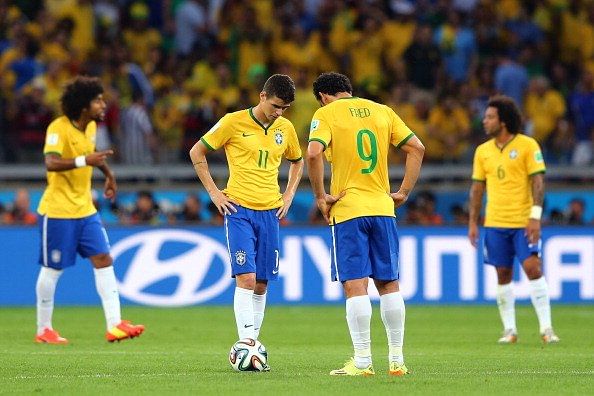
As the first goal went in, when Thomas Müller found himself completely unmarked to head home, the entire Brazilian team took a deep breath knowing that they now had to put up a masterful effort to come back in this one without their two best players. Hope, while having taken a hit, was still intact. When the second one went in, and in the manner in which it did, that hope was shattered. The young team out on the pitch began to see its World Cup dream slip away.
And in thinking about that dream slipping away, they let in a third, fourth and fifth. In a span of six extremely long minutes, Brazil’s players suddenly found their dream turned into a nightmare, a real live one, and one in which they were very much awake. Their thoughts must have shifted to the vultures that would circle around them after the match, the memories that would haunt them for years on end and a public that would be merciless and unforgiving during their entire lifetime for having brought on this shame to the country’s football and its people.
It was the day Brazil stood still and let time and Germany just waft past them. The scenes witnessed that evening were just some of the most poignant ones seen in recent times.
A modern day sporting tragedy
In an era far removed from Greek tragedies, Brazil’s national football team became the centrepiece in this modern day sporting tragedy, one that can claim to rival Greek tragedies of yore from Aeschylus, Sophocles and Euripides.
As much as word may be out that Germany were clearly far superior and that Brazil were destined to fail, let’s get things straight, events like Tuesday are freak results; they come along rarely. Brazil aren’t that bad and Germany aren’t that good, period. Five of the seven goals conceded were gifts presented to the Germans in an unexpected show of hospitality from the hosts, the nature of which were so welcoming that even a side like San Marino would have pumped in a few goals.
What we witnessed was amongst the most spectacular unravelling ever seen in recent times in sport. Brazil’s footballers just imploded on the pitch against the more seasoned Germans and the result wasn’t pretty.
Pressure can undo so many good things. When you play under pressure, you pretty much stop playing, focussing instead on how best not to mess things up. Brazil were under pressure right from the moment the tournament got underway and that is precisely why they’ve flattered to deceive right through.
A year ago, this team became overwhelming favourites to clinch their sixth World Cup after putting in a masterful run to win the Confederations Cup at home. It is not for nothing that the favourites going into a World Cup have never won; in Brazil’s case, the euphoria and the pressure was just so much more considering them being the hosts and considering the painful memories from 1950 that the country wanted this team to banish.
Brazil’s unconvincing road to the semis
A team cannot go from being world-beaters to being on the wrong end of a 7-1 score line in a jiffy. The truth is Brazil have hardly got out of third gear at this World Cup due to a combination of their own anxiety and how well their opponents have played. Unconvincing is the word that can best be described to sum up how they’ve performed right through, from their opener against Croatia right upto squeaking past Chile and holding off Colombia.
They sparked in fits and spurts and managed to get the job done in order to progress. But then, such an approach can only take you that far, and when you go up against an elite team such as Germany, you have got to be better prepared. Driven by a fear of failure all along, the focus has to been to somehow get the win, while sacrificing all else for the ultimate glory.
Trouble with that approach, sadly, is you tend to not have a fall back option. Brazil right through the tournament exhibited a distinct lack of a clear strategy or game plan. Hence, the reliance on Neymar; hence, the sweaty foreheads and palms when he went down after being kneed in the back by Colombia’s Juan Zuniga.
“We missed you skipper”
Without Neymar, they were going to struggle offensively, but Thiago Silva’s absence at the heart of the defence was always going to have more severe implications, though no one could have quite predicted the scale of damage that was eventually inflicted. Their captain has been immense for them in this tournament and in my opinion has been more crucial to the team than Neymar. I say so because, once you gloss over the goals and attractive play that the Samba boys displayed en route to the semi-final, their progress was more a grit-and-grind display, of overcoming opponents rather than overpowering them. And at the heart of it all was the man from PSG.
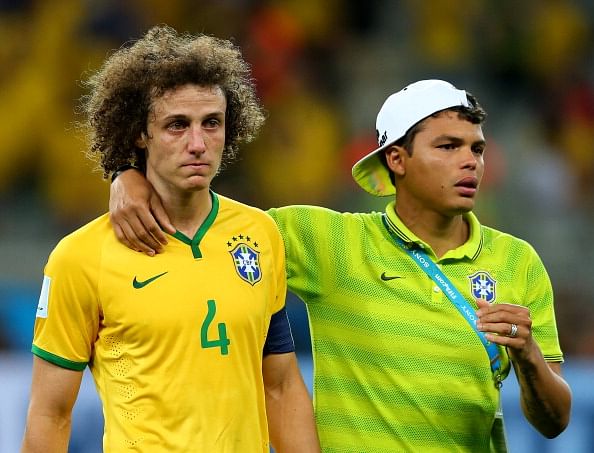
Brazil’s Thiago Silva (R) consoles David Luiz
Strong rear-guard action was required in every game that Brazil played – against Croatia, Mexico, Cameroon, Chile, Colombia – and Silva stepped up to the plate magnificently every single time. His marshalling of the defence was superb to watch as he kept his teammates focussed and was always proactive, shouting out instructions and keeping his team huddled together. His presence makes David Luiz play better and that recklessness in his game is hardly seen when Silva is around.
He wasn’t around on Tuesday in the semi-final, wasn’t around to rally his troops when they were shooting themselves in the foot, wasn’t around to bring about a sense of calm to the back four in particular and the team in general. For four of the seven goals conceded, Brazil even had numbers back, only they weren’t really marking anyone, just marking space. A fine leader of men, the only one perhaps in this team, he was sorely missed out on the pitch that evening.
Brazil didn’t lack talent, they lacked experience
This team that played as such an effective unit with so much cohesion and unity in winning the Confederations Cup also played with a great degree of freedom at that event. An uninhibited approach allowed them to play their games at their full potential knowing full well that the event was but a precursor, a warm up, to the big event a year away. Failure to win it would not be the end of the world. In 2014, at the showpiece event though, the stakes were much higher, and Brazil crumbled.
All those saying that is the worst ever generation of Brazilian players to ever play for the Selecao could not be farther from the truth. Brazil’s remarkable self-combustion came not due to a lack of talent, but due to a lack of maturity and experience. This squad was simply too young and too inexperienced to handle itself when backed into a corner.
Of the four semi-finalists this year, Brazil clearly was the odd man out, for every other team had a solid core of five to six veteran pros with plenty of experience behind them. Argentina’s entire team boasts of players that have now been playing for years in the top leagues in Europe and South America with plenty of caps under their belt; Germany has a strong veteran core of Philip Lahm, Bastian Schweinsteiger, Per Mertesacker and Miroslav Klose to look to for leadership and even their younger players have a World Cup under their belt already; the Netherlands likewise have Robin van Persie, Arjen Robben, Wesley Sneijder, Nigel de Jong and Dirk Kuyt. All of them big-match players, all of them seasoned professionals capable of handling themselves well in high-pressure situations.
Contrast that with Brazil and you find no one of note barring Julio Cesar and Dani Alves. Even their captain, Thiago Silva, is an amateur when compared to those leading the other three semi-finalists.
‘Big Phil’ fails to provide the major lift
This team is no doubt talented; the trouble is they have hardly been able to will themselves to play anywhere close to their best. That’s why the blame, entirely, must go to the coach, Luiz Felipe Scolari, for this acrimonious debacle.
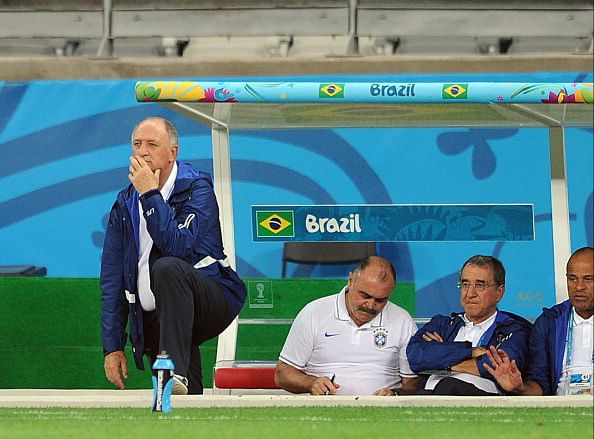
Brazil coach Luiz Felipe Scolari had no answers to Germany’s onslaught
Scolari’s missteps began from the day when the squad was announced. He opted for caution over flamboyance when he selected a gut of defensive-minded midfielders in the squad and left out players such as Lucas Moura. During the whole tournament, he seemed to be unable to influence the game during periods when his side were under pressure. His substitutions seemed to follow a preset order rather than being influenced by how the game was going. Tactically, he was outsmarted by almost every single opposing coach, including that of Cameroon. Perhaps the most shocking decision of all was him deciding to play Maicon in the right-back position against Germany. Who was he kidding?
Dani Alves may have been sub-par for much of the tournament and his benching in the quarter-final against Colombia may have been to send a strong message to him, but not playing your best right-back against a team like Germany is asking for trouble. Even more so when you’ve already been forced to include Dante in central defence thanks to Silva’s absence. Both Maicon and Dante let the team down massively. Maicon has been washed up for some time now; he is backup at AS Roma for a reason.
Road to redemption
There are some clear problems with this team, like the need for a good centre-forward. The other main issue they will have to address by the time the Copa America comes around and subsequently the next World Cup, is the right-back and the goalkeeper positions. Julio Cesar could be playing in his last World Cup and Alves may not be around too when the next one comes around.
This team is extremely young and culling the entire lot in favour of other alternatives would be too harsh a decision. Each of these players have exhibited considerable potential at club level and together as a team to be kept in the mix for upcoming tournaments. A knee-jerk reaction is the easy way out, but not the right one at this point. Ensuring continuity is a key part of squad building. Barring a coaching change, the players have to be given more time. They just have to look at the team that butchered them in the semi-final to understand that.
This German team’s road to the final began eight years ago, in similar conditions at home, where they fell to wily Italian team in the semis. That squad headed by Jürgen Klinnsmann and the subsequent one in 2010 bore much resemblance in that they all had a young core of players. With greater experience and maturity, they are now once more in the final, 12 years after they made the final in 2002 at Korea/Japan. And redemption is a great motivator to help inspire a bunch of players out of a funk after such a heavy defeat.
That road to redemption begins later tonight when they take on the Netherlands in their country’s capital in the third-place playoff. While no team really likes to play this particular match in a World Cup, for Brazil it provides an immediate opportunity to redeem themselves in the eyes of their country mates, and more importantly to help them believe in themselves once again.
It definitely is a game that Brazil need more than the Dutch, considering their rather narrow, gut-wrenching defeat to the Argentines in the second semi-final.
The original tragedies from the Greeks were aimed at depicting actions that were so complete and noble, that through trial and tribulation, the emotions of the audience were to be transformed from pity and fear to compassion and other pleasurable emotions resulting in a catharsis of the troubled soul. A similar renewal and restoration process lies in front of the current Selecao crop for they would like to wind up affairs at their home World Cup on a high and provide their fans with a sense of belief and hope that they can and will be back with a bang the next time around.
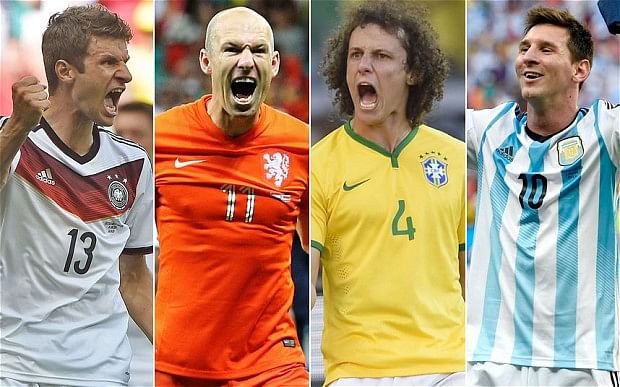
Two European and two South American teams have made it into the final four of the 2014 FIFA World Cup. Going into the final week of action, it is the hosts Brazil, their fierce rivals Argentina and European powerhouses Germany and the Netherlands who are still left standing with a chance to compete for the top prize.
For two of them in particular, the Germans and the Dutch, it is a repeat of what they managed to do at the last edition in South Africa. They have managed to make the semis at the World Cup finals for two successive editions now; quite an achievement.
As far as Germany are concerned, Die Mannschaft are the most consistent national team in football. Forget back-to-back semis, this is the fourth consecutive time that Germany have made it to the final four since the 2002 edition in Korea-Japan. The Germans don’t do upsets, they don’t do group stage eliminations, they don’t do hype. They just methodically go about conducting their business and get to the final week of competitions going down only to the eventual champion in most cases. Their presence in the latter stages is almost a given.
For the Dutch, after the disappointment of not qualifying in 2002 and the fractious exit in 2006 at the hands of Portugal, it marks a welcome return to a place where Dutch football believes it truly belongs – the journey from being merely a pretender to now being a contender.
Spain and Uruguay were guilty of relying a little too heavily on the same squad that earned them success back in 2010. Trouble was, some of those players were no longer at their peak and had slowed down over the years. As a result, players in form and performing well at club level were overlooked in favour of the established names. Spain may have brought in new players into the squad, but the starting eleven bore few changes to the core from the 2010 World Cup. The defending champions also failed to address their defensive woes and were forced to pay a heavy price.
Uruguay too relied too heavily on the old guard and that in turn increased their dependence on Luis Suarez. They suffered from a severe lack of mobility in their play, and their defeat in the opener actually forced Coach Oscar Tabarez’s hand to give the newer guys a run.
Germany’s squad is more mature now
One might argue that Germany have much the same players, just like Spain. True, but there is one key difference; Germany’s core is now actually in their prime. From the time of the 2008 Euros and the 2010 World Cup, these players are more mature and more experienced and have all tasted plenty of success playing for their respective clubs. Captain Philip Lahm and midfielder Bastian Schweinsteiger are now the seasoned pros in the setup with a wealth of experience behind them.
Germany have made it to their fourth consecutive World Cup semi-final
And while the squad might look the same, Joachim Loew has made minor tweaks in personnel as well as tactics. The Germans don’t ever single out one man to be the key guy in the team; it is almost always a team effort. Four years ago, this was Mesut Ӧzil’s team, but it no longer is. Toni Kroos has taken over that mantle now and with Thomas Müller playing up front, there is more dynamism in this German side.
Germany’s defence isn’t the greatest either, not when you have Jerome Boateng and Per Mertesacker playing together, or Holger Badstuber. As shown from Mertesacker’s improved performances at Arsenal, he needs a partner who is quick on the ground. And Germany have plugged that gap with Mats Hummels now in the mix. Germany look a more solid team with any combination of Boateng or Mertesacker with Hummels.
For the Dutch, it’s out with the old and in with the new
There’s never been any doubt about the talent in the Dutch ranks, but there was always that sense of disappointment about how they could never get their act together to win a major tournament. It has been a tumultuous journey for the Dutchmen the last four years from the highs of reaching the final in South Africa in 2010 to the lows of losing all three matches and being eliminated in the group stages of Euro 2012.
Since then, with Louis Van Gaal back in his second stint as Netherlands manager, the Dutch have begun the climb out of those dark hallways. They were the first team to qualify for the World Cup from Europe, scoring prolifically and without losing a single game. They too have learnt from past endeavours and changed elements of the team that cost them dear at recent tournaments.
They culled the entire defensive line; not one member from the defensive unit that went to South Africa has travelled to Brazil, and only Ron Vlaar survives from the squad that was dumped out acrimoniously at the Euros. In their places are young defenders picked out from the Dutch Eredivisie, confident in their stride, emboldened by success enjoyed domestically.
It’s back-to-back semi-finals for the Oranje.
Only five veteran players have been retained by Van Gaal – Robin van Persie (now the captain), Arjen Robben, Wesley Sneijder, Nigel De Jong and Dirk Kuyt.
The attacking trio of van Persie, Robben and Sneijder combine to make one of the top offensive threats going forward. In fact, barring Sneijder, the other two members of that trio have actually gotten better since the last World Cup and have enjoyed much success playing for their clubs; Van Gaal has made absolutely the right call to retain them to provide this otherwise young team with some veteran leadership. And while Sneijder’s stock may not have improved like the others, he is still one of the best midfielders in the world in delivering killer passes and from dead ball situations.
Dirk Kuyt is an absolute professional, and hence is a great footballer to have in the squad. To add, his versatility (he can play wing-back, full-back, midfield, winger, forward) gives the Dutch team options. De Jong provides the steel in midfield and is still a great asset to have for his ability to break up play and retrieve the football from the opposition.
And the young players chosen in the squad, extensively from the Eredivisie, have provided some much needed freshness and have come into the tournament on the backs of extremely successful seasons. Van Gaal has picked exclusively from the top two sides in the Dutch league last season – Ajax and Feyenoord – and PSV who finished fourth.
Goalkeeper Jasper Cillessen, defenders Daley Blind and Joel Veltman were all part of Ajax’s title winning team. Defenders Bruno Martins Indi, Stefan de Vrij, Daryl Janmaat and Terence Kongolo and midifielder Jordy Clasie formed a part of Feyenoord’s fine team that finished second. And forward Memphis Depay and midfielder Georginio Wijnaldum were chosen from PSV. The reliance on players from the local Dutch league who have played with and against their teammates has brought in that familiarity and has helped the team work better as a team.
And the importance of confidence cannot be overstated; Van Gaal has picked winners in his squad. With winning comes mental toughness and fortitude and these young Dutch youngsters displayed that in spades in tight games against Chile, Mexico and Costa Rica in the lead up to the semi-finals.
South American obstacles in the way
Germany and the Netherlands now have South American opposition standing in their way, two favourites nonetheless, in Brazil and Argentina respectively. It is not only a clash of continents, but also a clash of styles. Traditionally even the best of South American teams have come undone when they’ve gone up against strong European teams who outsmart them tactically and rely on their organization and strong game plan to counter the flair of the South Americans.
Just ask Argentina who were thumped by Germany in 2010 and edged out in 2006 before that. Ask Brazil who were outwitted in 2010 by the Dutch and in 2006 by France. The two teams will have a point to prove over the next two days.
However, the Germans and the Dutch are well equipped to cope with them as always. The familiarity of the local conditions and home support will be one huge advantage for the South Americans, but you can bet on the two European teams to provide more than just a stern challenge. If Brazil and Argentina are to have that dream final on Sunday at the Maracana they will have to overcome their stiffest tests of the tournament so far, for they are going up against two of the most well drilled sides in this year’s tournament.
All the preparations for crazy parties on the beaches in anticipation of a Brazil-Argentina clash should be put on hold for there is a very real possibility that the meeting of arch-rivals in the final could just be between two European neighbours instead of two South American ones.
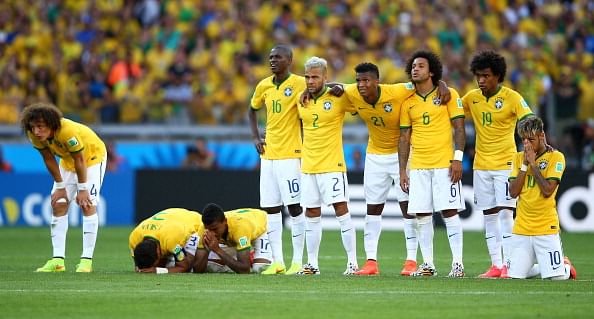
Brazil’s players line-up during the penalty shootout with (from left) Thiago Silva, Luiz Gustavo and Neymar in prayer
“If you ask me anything in my name, I will do it. - John 14:14”
The whole of Brazil seemed to have asked for the win yesterday!
It was a day that could have seen a huge backlash, not just against their team, but also the government, FIFA and the ongoing World Cup on the whole. In the end Brazil’s national football team, the Selecao, made it through to the quarter-finals of the 2014 FIFA World Cup, but only just.
The last time Brazil hosted a World Cup, they left the tournament embarrassed after having been upset by Uruguay at the Maracana and thus being devoid of championship glory. That was 64 years ago; there was almost a new painful memory for Brazilian fans to remember down the years at Belo Horizonte yesterday.
The venue apart, yesterday’s game mirrored the ‘Maracanazzo’ to a great degree; a potent South American foe standing in the home team’s way; an early goal for the home team to send their fans into a frenzy; an opponent that equalized and grew stronger as the match went on. Almost everything, except that Chile didn’t quite manage to turn it around completely and deliver the final knockout punch; and that was in no part down to Brazil picking up their level of play. Chile were just plain unlucky.
Brazil’s progress into the last eight came thanks to a more than generous helping of good fortune and the heroics of their goalkeeper, 34-year-old Julio Cesar, more than anything else. That and perhaps a powerful belief in prayer that delivered them away from a personal tragedy and a lifetime of scrutiny and grief that would have accompanied it.
In terms of drama, excitement, nervousness, anxiety and tension, this game helped kick-start the knockout phase on a rollicking note. This is what one expects as the tournament progresses – better teams, tighter matches – but sadly the Brazilian team came very under-prepared.
Coming into this clash, Brazil had sparked in fits and spurts through their group games to emerge from Group A as winners ahead of Mexico. They were a little lucky to emerge with all three points against Croatia, were frustrated in their game against the Mexicans where they were held to a goalless draw, before beating an insipid, and already eliminated, Cameroon side in the final game. While they didn’t lose a match, none of the games, barring the second half against Cameroon, were a breeze. Defensively, they looked tacky and vulnerable and going forward, they did score seven goals, but they struggled for rhythm and leaned heavily on young Neymar’s shoulders.
Chile had come through Group B as runners-up, pushing aside world champions Spain in the process. Their opening two victories against Australia and Spain were the result of a cohesive unit working diligently towards a well-prepared strategy and game plan. Their master class against Spain was particularly impressive. They failed to score and were beaten in their final game against the Netherlands, but they controlled a large portion of that game, and would have been kicking themselves for not getting a goal before the late Dutch charge.
Chile have had their campaign ended by Brazil every single time they have reached the knockout stage. Yesterday was a chance to put aside all that hurt from years past, and Chile were in many ways perfectly equipped to take Brazil out this time.
Luiz Felipe Scolari is a great motivator, very good at managing personnel and getting the best out of a talented bunch of players; what he’s not is tactically astute. And once his opposite number yesterday, Jorge Sampaoli, managed to break through Scolari’s Plan A, Brazil were in trouble. Chile stick the fork in Brazil’s plans
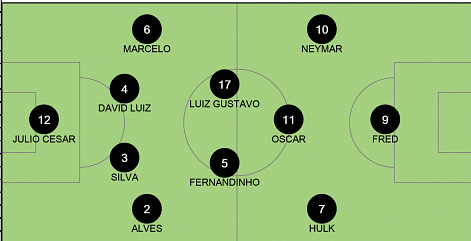
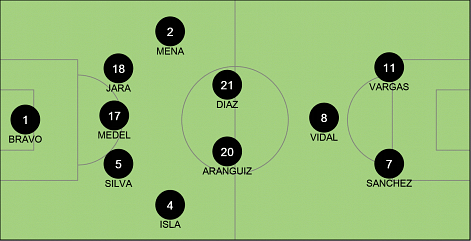
Brazil lined up in their usual 4-2-3-1 formation with Neymar, Oscar and Hulk supporting troubled striker Fred. Chile opted to go with what appeared to be a 3-4-1-2 with Francisco Silva, Gary Medel and Gonzalo Jara forming a three-man defensive net at the back.
Brazil’s starting line-up
A great deal of how well the current Brazilian team plays on a given day is determined by how well their full-backs play. Dani Alves and Marcelo were anything but impressive, and Chile’s 3-man backline was specifically in place to take advantage of this. Alves, in particular, probably had one of the worst games of his career.
Chile’s starting line-up
Brazil started off brightly, but Chile had anticipated just that and were prepared to take a few punches early on although they would have preferred not conceding a goal. Alves and Marcelo bombing forward with Hulk and Oscar going out wide to help the forwards, Brazil looked threatening. But Chile’s 3-man backline meant Mauricio Isla and Eugenio Mena played as wingbacks, and what they did is leave very little margin for error for Brazil’s full-backs in the eventuality of them conceding possession. And it worked; despite being on the front foot, Alves and Marcelo were dispossessed rather easily on a few possessions to set up quick counters where Chile wound up against just the two central defenders and either Luiz Gustavo or Fernandinho helping.
That early pattern of play seemed to make both of Brazil’s full-backs adopt a more cautious approach. With the full-backs now not being as aggressive, Chile ventured to establish control of the midfield with Isla and Mena now able to move a little forward themselves and press higher up the pitch. This also ended up severing Brazil’s frontline from the rest of the team, leaving Hulk, Neymar and Fred on their own up front. And Chile had the 3-man defensive cover capable of dealing with them.
Scolari plumped for Fernandinho instead of Paulinho to partner his defensive plug in Gustavo. But playing Fernandinho means a lack of creativity in an already workmanlike midfield and more pressure on the likes of Neymar and Hulk to create attacks. Paulinho may have been off-colour in the group games, but he provides a thrust from midfield which Fernandinho doesn’t and this played into Chile’s hands.
Getting nothing from their full-backs, Brazil tried to go through the middle, using their trickery and bag of skills. But they went up against a red Chilean wall, which repelled everything through the sheer numbers that they could get back to gridlock the home team. In the second half, there was one period of play, where Chile did this so effectively that Brazil couldn’t get past the halfway line.
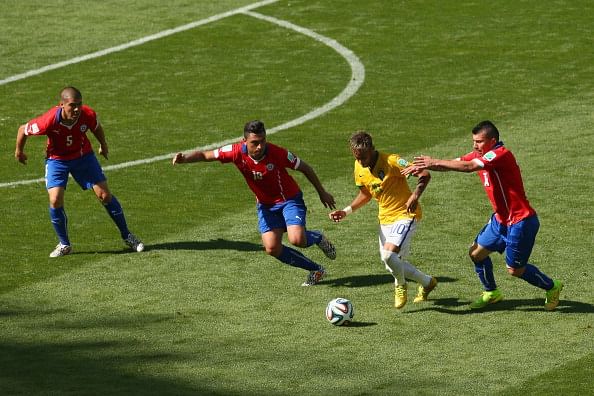
Neymar’s brilliantly taken goals were one reason why Brazil managed to come through Group A as winners. And Sampaoli was all too aware of this and entrusted Silva with keeping a close eye on Brazil’s boy-wonder. He wasn’t afforded space, and almost every single time he got the ball, there were about three Chilean defenders around him. The wingback system meant only one of Chile’s back three had to guard Neymar with either of the full-backs or central midfielders in Aranguiz or Diaz stepping in to help out Silva with Neymar.
With nothing going their way, the team discombobulated, their stars kept quiet, and their defence under attack, a sense of panic gripped the Selecao; the lack of tactical adjustments from Scolari only adding to it. Alexis and Diaz shine for Chile
For Chile, Marcelo Diaz in midfield had a brilliant game. His use of the ball was simply superb to watch, always picking out a player in space and being patient with the ball, drawing the Brazilian defence out, before playing the ball forward into Eduardo Vargas and Alexis Sanchez. Along with Charles Aranguiz, he put in a dominant midfield display to leave the Brazilians short-changed for offense.
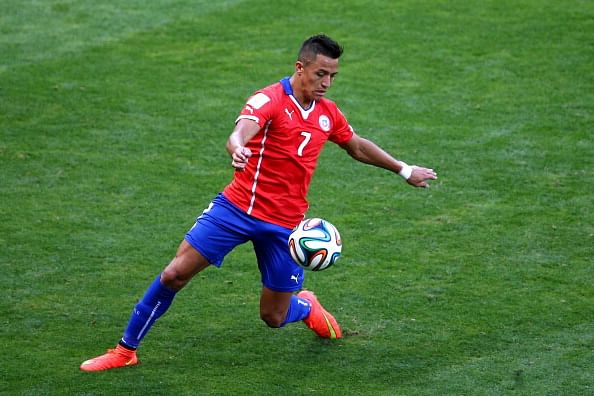
Alexis Sanchez was simply brilliant for Chile
Alexis had a phenomenal game, leading the Chilean line beautifully. He did everything the Brazilian forwards didn’t – held up the ball superbly bringing his other teammates into play, drew the defenders away to make space for his teammates to run into, and when needed went at the defenders and left them in a heap with his dribbling and ball control.
Chile executed their strategy superbly and what was even more remarkable was their composure in possession. They were constructing attacks wonderfully while Brazil were resigned to punting hopeful balls in the direction of Neymar and Hulk with a “Hail Mary” attached to it.
The high number of fouls and scrappy nature of the contest also played perfectly to Chile’s advantage with Brazil prevented from getting into any sort of rhythm.
Everything that Chile did well, Brazil didn’t. Where do you start? How about the centre-forward position? Brazil – No teammwork, no direction
Fred looks woefully out of touch and also extremely lethargic. He is clearly not the same player who was in rich form about the same time last year during the Confederations Cup. His replacement, Jo, didn’t exactly inspire any sort of confidence either. So the hosts have a major problem there.
In the second half, for about a 15-20 minute period after Jo’s introduction, all Brazil did was lump balls forward from defence to Jo’s head. Admittedly, the strategy was aimed at taking advantage of the visible lack of height in Chile’s back three. But Jo isn’t Miroslav Klose, to be able to get the ball down himself; and even if it was about getting knockdowns for the others to latch onto, they seemed to be forgetting that Brazil’s front three were up against Chile’s effectively 5-man backline with the wingbacks joining in. With such a mismatch, there was no way that strategy was going to pay off.
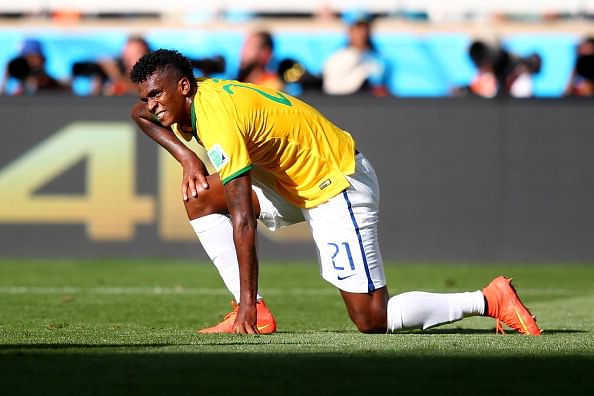
Brazil forward Jo was left visibly frustrated and tired by his team’s long ball approach
Also, another worrying element was how Jo, after the initial attempts, was pleading with his teammates not to put long balls in as it wasn’t getting them anywhere and more importantly, robbing Jo of energy which could have been better put to use. Even Scolari was imploring his team to stop this from the sidelines, but to no avail.
Brazil displayed no teamwork yesterday and often resembled a bunch of headless chickens just trying to force their way through with no real thought process to their play. Their passing and decision-making was poor, they lacked vision and once Plan A went out the window, they didn’t have a set strategy, and seemed to be clutching at straws.
Neymar may be the best player in the team, but too many times he tried to take on one too many defenders one-on-one and ended up getting dispossessed. Him and his teammates’ flicks, tricks, shimmies, back-heels, the lot weren’t coming off and they got frustrated. In trying to bamboozle their defenders, they forgot the basic elements, which was to keep it simple unlock a sound defence by moving the ball around. They lacked composure on the ball. They need to realize that as they go deeper into the tournament, they are not going to be able to beat teams with just their bag of tricks; that has been the reason strong European teams have been able to pick them apart so efficiently since time immemorial.
Brazil also lacked a dominant midfielder who could put his foot on the ball and set the tempo. That’s where Hernanes can be useful and he wasn’t employed yesterday. Another decision that could come back to haunt Scolari is the absence of Lucas Moura. The PSG man is a supremely gifted winger and has the ability to unlock defences when he plays out wide on the wing with his pace and crossing ability. He was present in the Confederations Cup, but is missing from the squad here. And apart from Willian, Brazil don’t have anyone who can play in that position. Spain didn’t call up Jesus Navas and look how it cost them! Brazil can expect more such tests ahead
Brazil were given a huge scare yesterday and the road only gets tougher for them from here. They cannot just rely on their talent-laden team to pull through for them without a more dynamic game plan and tactical adjustments in response to their opponents’ moves. Scolari had this to say after the game: “They’re a very organised team with a good tactical system and fine players. Every credit to Chile but this penalty shootout win says a lot about us and about our desire to progress. The players can have a break now and, as they recover, we’ll have a look at how we won, go through all the tricky situations we were in and a whole lot of other details. The idea is to build on this. When you win like this you come out stronger. We’re going to tell them that so they can appreciate what they’ve done.”
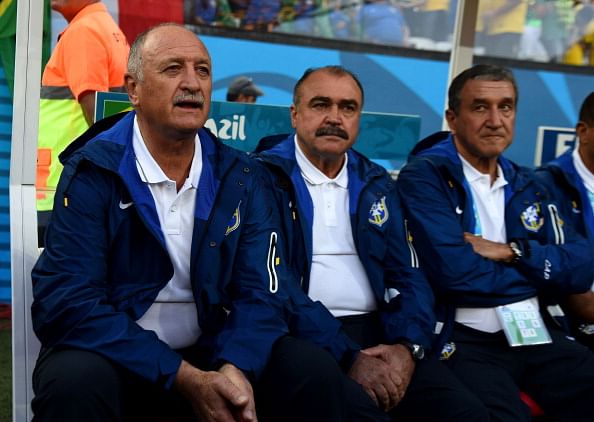
The experienced triumvirate of (from left) Scolari, Flavio Teixeira and Carlos Alberto Parreira have a job on their hands
When they rummage through their efforts of this game, they will find that they were hugely fortunate to come through and they that didn’t respond very favourably when backed into a corner. But yes, sometimes a tough win is what a team needs, and in a month-long tournament it is about peaking at the right time.
Their campaign for a sixth World Cup is currently riddled with many loopholes that need plugging. They have a very experienced coaching unit which should help them with that and an inspiring captain who did his best to rein his troops in while being perilously close to falling over the edge. Brazil, for sure, can only get better from here.
Chile have entertained us all during their stay and exit having taken Brazil all the way to the doors of their deepest and darkest fears and coming within a goalpost of knocking them out. Sampaoli and his men can take great pride in that once they recover from the emotional blow of the loss.