Showing posts with label Philip Lahm. Show all posts

Tuesday, October 14, 2014

From Barcelona to Bayern Munich: The evolution of Pep Guardiola’s intriguing formations

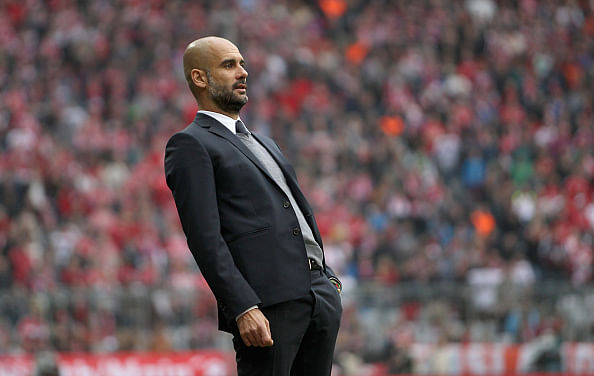
Pep Guardiola
"I give you my word that we will put in an effort. I don't know if we'll win, but we'll persist. Put on your seat belts, because we're going to have fun."

Two trophy-less seasons had passed at the Nou Camp when ‘Pep’ Guardiola was appointed manager of FC Barcelona ahead of the 2008/09 season; the above were his words during his presentation to the fans. He was tasked with resurrecting the fortunes of one of the most famous European clubs in football and bringing back the glory days to Catalonia.

Six full seasons on, he stands out as one of the best managers in world football, the reputation of both Barcelona and his own personal brand greatly enhanced.

The name Guardiola does not merely represent a man any more; it has come to represent a faith, a belief, a philosophy; one that has delivered success on a consistent basis at the highest level. Whether you love his tactics or hate them, there is no disputing the fact that ‘talking tactics’ and ‘formation fiddling’ just went up to a whole new level with his coaching in play. And if there’s one word that would aptly sum up all of Guardiola’s coaching adventures so far, it would be ‘dynamism’.

With Europe’s top leagues on hold due to the international break, it’s a good time to take a look at the evolution of Pep’s formations from Barcelona to Bayern Munich. For ever so quietly, away from the main stories making the rounds in the continent, Guardiola’s Bayern have made another impressive start and are looking the best amongst all the reigning league champions. That’s not all; Guardiola has thrown in another new tweak in the Bavarian giants’ strategy, which has been quite fascinating.

Pep’s Barcelona and the 4-3-3

Even before we get to talking about the actual formations, I think it is essential that we fully recognize Pep’s philosophy – the philosophy to build teams on the foundations of unison, work rate, patience, ball movement, zonal play, positional play and finally dynamism, both in formations as well as personnel. Each of Guardiola’s acquisitions was done with a specific goal in mind.

In his all-conquering first season, when Barcelona won the treble, Guardiola operated predominantly with a 4-3-3 formation. While many critics believe that all he did was put together a group of some of the most talented players around, that is not necessarily true. Guardiola had a plan and a reason for putting in each of the players that he inserted regularly into his line-ups.

Holding possession by moving the ball both laterally and forward with crisp, short passes was the principle that they religiously stuck to. And they would wait for their opportunities when the opposing defence would get unhinged to strike the final blow. This early version though played slightly quicker, largely due to the presence of forwards Thierry Henry, who played wide left, Samuel Eto’o, who played through the middle, and Lionel Messi, who started wide right.

Behind that trio was Sergio Busquets, promoted from the B team, in the holding role, with Xavi and Andres Iniesta to his right and left respectively. Eto’o at the time was at the height of his powers, while Messi had still not reached his magical peak yet. So utilizing the pace and power of Henry and Eto’o, while relying on Messi’s ability to dribble and draw defenders, was essential.

Xavi played behind the front three as the deep-lying playmaker and Busquets played the roles of anchor-man and Xavi’s wingman, always moving with him, protecting him from opposing defenders and acting as a foil to receive and spray passes. He was also the added cover for the backline, slotting in for one of the centre-backs, notably Gerard Pique, whenever he ventured forward.

Iniesta would venture further forward as the advanced playmaker, either going central to support the forward trio or taking up the space out wide vacated by Henry or Messi. This also required a very hard-working central striker and Eto’o did just that, sometimes falling back to receive the ball and actually allowing Henry and Messi to work as a front two.
Messi’s conversion into a striker opened up a world of possibilities for Barca
Subsequently, Guardiola converted Messi into a full-fledged striker from a winger, and Eto’o and Henry would depart. Zlatan Ibrahimovic was bought in as Guardiola wanted to find a different way of scoring goals, but that experiment didn’t go very well and he used him sparingly.

This was when the triangle offense really came into its own, as Barca’s players would move forward with the ball, triangulating their passing with almost geometric precision to unseat teams. Can you believe that 2008-09 was the last time that Messi scored less than 49 goals in all competitions?

David Villa would take up Henry’s role out wide on the left after the Frenchman’s departure, and Pedro would take up the wide right position. However, Pedro wasn’t a regular in the team and Guardiola would go quite a few games with Iniesta/Villa/Messi as the front three.
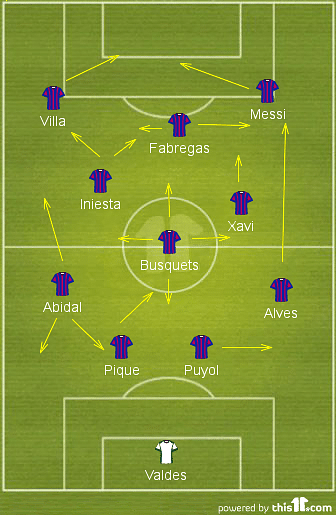
Fabregas playing as a false forward
Then came the acquisition of Cesc Fabregas and the introduction of the false nine concept. With Fabregas and also Alexis Sanchez in the side, Guardiola had a new level of freedom and dexterity with which to operate. Both Fabregas and Sanchez could play in a multitude of positions, which is why they were bought. Fabregas enabled Pep to play the striker-less formations, the conventional 4-4-2 with Messi and Pedro/Sanchez up front, and the 4-1-3-2 with him playing in a midfield three with Iniesta and Xavi and Pedro, and Sanchez either side of Messi up front.

Defensively, Alves would bomb forward on the right with Puyol covering for him. That would result in Abidal falling back into the left side of a back three, with Pique and Puyol. Also, the long balls were sparingly employed by Pep’s Barca sides as they lacked the height and physicality up front and also because their defenders were more comfortable playing the ball out on the ground as Pique continuously did. Pique’s forays forward also meant a covering job for Busquets to drop back and aid Puyol and Abidal.

Throughout his time at Barca, there were two players outside of Messi that were of utmost importance to make the formation work and make it dynamic – Alves and Abidal.

Alves was key in the attacking areas of the right flank. His intricate interchanges with Messi in the opposition half were among Barcelona’s biggest threats. When Messi moved into the middle as a false nine, Alves continued to play high up the pitch, importantly stretching the play, especially since both Villa and Pedro too were more inclined to move in from out wide.

Alves’ ability to go up and down so regularly and with such frightening results made up for the lack of a right winger or right midfielder. His forward menace also managed to keep the opposition left-back pinned down in his own half.
Eric Abidal (left) celebrates scoring a goal with Dani Alves (right) in a Copa del Rey match against Real Madrid at the Santigao Bernabeu in January 2012
Abidal was hugely important in compensating for Alves. He would push forward when necessary, but his ability to sense danger and drop deep to operate as an additional third centre-back when required were irreplaceable. He also covered for Busquets and Pique in their respective roles whenever Barca were in pursuit of a goal and pushed more bodies forward. Abidal was the guy who made the formation tick at the back with his amazing ability to play left-back, centre-back and defensive midfield to perfection.

All in all, Guardiola’s formula at Barca for much of his stay was built on the full-backs, dribbling centre-backs, the wide forwards who would dart in and the midfield duo of Iniesta and Xavi and later the concept of the ‘false forward’.

Bayern 1.0 – Beginnings with 4-1-4-1

German giants Bayern Munich came calling for Guardiola’s services and he agreed to take over the reins from the 2013-14 season onwards in what was a tough act to follow as his predecessor Jupp Heynckes signed off in some style leading the Bavarians to a historic treble with a team that was devastatingly destructive.

Bayern 1.0 saw Guardiola employ a 4-1-4-1 formation. This formation was built to explore Bayern’s depth in midfield especially around the ability of Toni Kroos to distribute, move up and down the middle of the pitch and also play as a playmaker. While at Barca, Guardiola had players of short stature at his disposal who were very good in possession; at Bayern he had more direct players in the likes of Thomas Müller, Arjen Robben and Franck Ribery and he tried to cater to their strengths by banking on the influential Kroos.
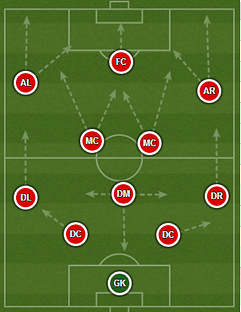
The 4-1-4-1
Philip Lahm, possibly the best right-back in the world was given a new role by Guardiola as a holding midfielder breaking up the erstwhile duo of Bastian Schweinsteiger and Javi Martinez that his predecessor used to telling effect. His need for a more mobile holding player with good passing range saw him make the shift and that meant Rafinha would take Lahm’s place at right-back.

However, the full-backs under this system were part of a mobile triumvirate that would move up and down with Lahm and would more often than not join up with the two central midfielders to make a four in the middle occupying the space vacated by the two wingers who’ve joined up in attack. The use of ‘false full-backs’ was made possible by the presence of Ribery and Robben, who provided the width with their forays out wide to reduce the necessity for advanced full-backs. In the absence of one or both, Alaba and Rafinha tended to play in a more traditional full-back role.

And it was that versatility that got them off to such a flying start last season, eventually helping them win the Bundesliga at a canter. Opposing teams simply could not handle the many different attacking formations in the form of an attacking double-pivot of either Götze/Robben, Götze/Müller or Müller/Robben. Also, unlike at Barca, this Guardiola team played a good number of good long balls because – a. their defenders weren’t the dribbly kind like Pique and b. the presence of aerially gifted players such as Müller and Mario Mandzukic.

The presence of multiple playmakers ensured that they could swap roles freely and the ones not on the ball could then run the channels effectively, complementarily opening up space for each other to operate in.
The overlying emphasis of this formation was to always have three central midfielders on the pitch at any point of time. That’s why Pep went out and bought Thiago Alcantara, not for old time’s sake. Lahm explained as much in an interview last year:

“Also, outwardly it appears as if we’ve changed our system, but if you look more closely we still have three central midfielders on the pitch. Whether there’s one No.6 [a primarily defensive holding midfielder] and two No.10s [offensive midfielders], or one No.6 and two No.8s [more creative holding midfielders] or maybe one No.8, one No.6 and one No.10 – there are three players in central midfield. To give you an example, last season Toni Kroos [a typical No.10] sometimes played in the No.6 position alongside Bastian Schweinsteiger. It’s open to debate whether or not you could have spoken of two No. 6 players in those moments. So each of the three players fills the position with his own identity and his characteristics. That is what counts.”
 
The attacking pivots also helped in pressing from the front and while not as intense and harrying as they were under Heynckes, Bayern were still very effective doing their version of the Barca press to dispossess opponents.
The difference in Guardiola’s triangle systems at Barca (above) and Bayern (below)
This formation was another continuation in the triangle system of Guardiola, except that instead of widening the pitch to stretch the defence like at Barca, here the system was about overloading the centre of the park with triangles formed all around the centremost midfielder, usually either Kroos, Lahm or Schweinsteiger.
And this system also kept up the bargain of tactical flexibility for Guardiola as it could morph into a 3-4-1-2, 4-4-2, 4-3-3, even a 2-4-4 at times if chasing a game.

The 4-1-4-1 for all its tactical nuances had some weaknesses. It involved the full-backs playing almost as midfielders and with Lahm’s solidity no longer present at right-back, it exposed Bayern, who played a high defensive line, to individual mistakes and long passes. And as brilliant a sweeper-keeper as Manuel Neuer is, he could not always save the day for them, especially against quality opposition.

When used ineffectively the overload of playmakers in the centre muddled the midfield and made their attack look toothless and the build-up slow. Also, they could almost never capitalize on quick counter-attacking opportunities.
Bayern wore a dejected look as they were taken apart by Real Madrid
All of this came to a head in their semi-final tie against Real Madrid in last year’s UEFA Champions League. Madrid were a side perfectly built to expose each and every flaw of this system and it was a matchup nightmare for the German side. A front six of Cristiano Ronaldo, Karim Benzema, Gareth Bale, Angel di Maria, Luka Modric and Xabi Alonso had too much pace, power, and on-ball ability to be contained by the 4-1-4-1. Ronaldo and Bale ran roughshod over the two ‘false full-backs’ and Benzema’s movement in combination with one of the two plus di Maria took the two centre-backs out of the equation as well.

Also a few players such as Mandzukic suffered as he was forced to make runs out wide and become a provider at times instead of a goal threat and that saw him lose his starting spot to a midfielder with Guardiola preferring to play Müller as the lone striker instead. Ribery and Robben were forced to make the unnatural shift to receiving the ball and quickly giving it back, instead of venturing forward to take on the defenders which took the destructive nature out of Bayern’s attacks.

Bayern 2.0 – A 3-4-3 

With all that had gone by and seeing the limitations that the 4-1-4-1 caused, Guardiola introduced a 3-4-3 system against Borussia Dortmund in the DFB Pokal final of last year to redeem himself after the chastening defeat to Madrid. And he has continued with it this season.
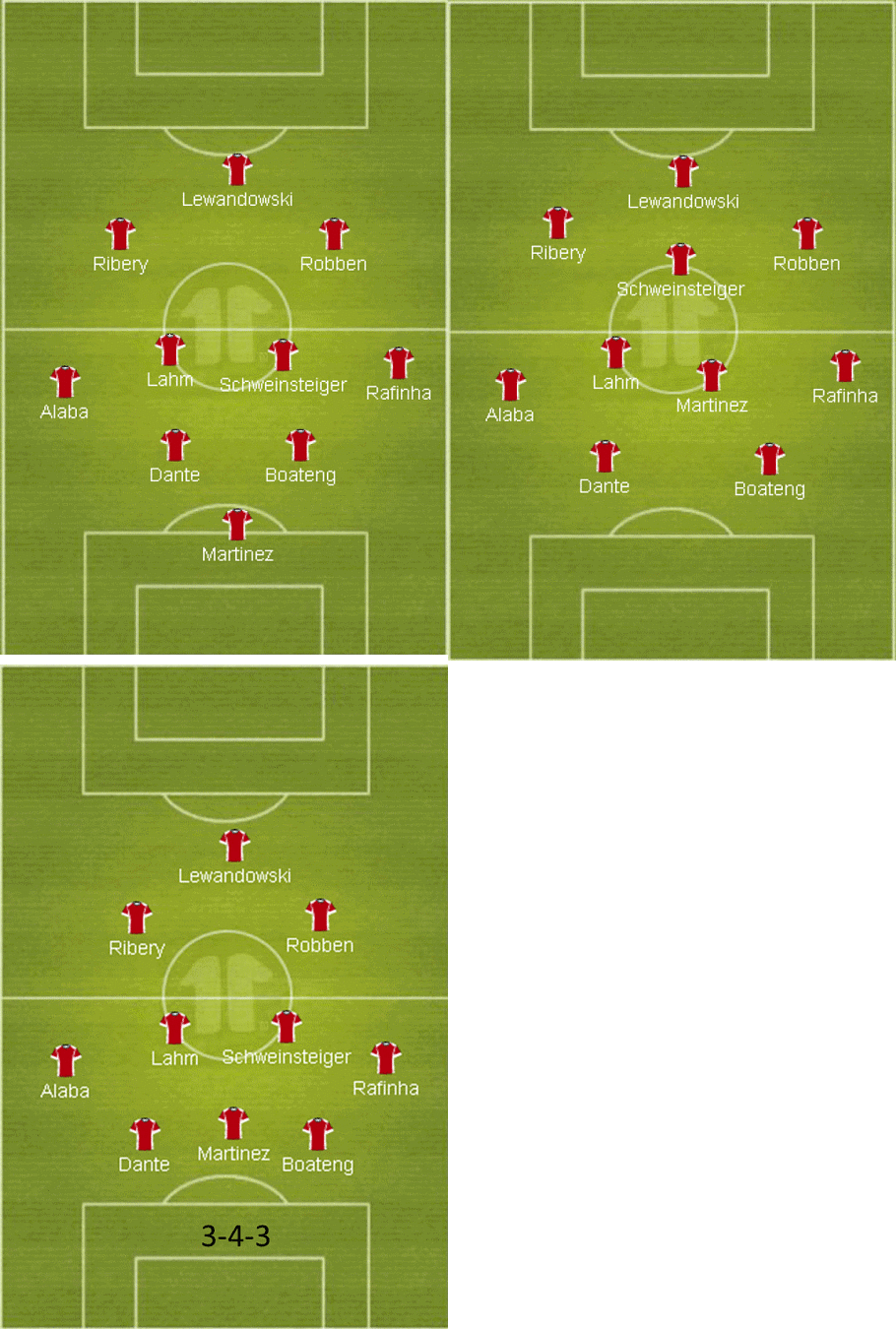
The backline movement in the 3-4-3
The 3-man backline sacrifices width for numerical superiority in dealing with opposing attackers while providing a man advantage in midfield.

In defence, it relies on the 3-man backline and the 4-man midfield, which includes the two wingbacks. And in attack, the formation moulds into a 3-4-1-2 or 3-4-2-1 using either one attacking midfielder (Götze/Kroos) behind two strikers (Mandzukic/Robben and Müller) or two attacking midfielders (Kroos/Müller, Kroos/Götze) and the lone striker (Robben/Müller/Mandzukic).

The 3-4-2-1 has been the one that Bayern have gone with more often and it is a very demanding formation. The two withdrawn strikers or attacking mids play a critical role as they alternate between shifting wide or tucking in behind the main striker. Due to only one striker up top and a lack of wingers, the role of the wingbacks becomes more important. Without their inputs, Bayern can't maintain their superiority when attacking. While being aggressive though, they have to remain disciplined, as they are the sole defensive cover on the wings. So even one slip-up can be costly.

However, the 3-man backline does provide an extra target against teams whose forwards press hard, like Dortmund. The extra man enables them to pass the ball out smoother. The central centre-back often functions as a key distributor, much like Pique did at Barca while the two guys either side of him push wide almost in a full-back-like position to use and cover the space.

Someone like Javi Martinez and Holger Badstuber, both of whom have played as defensive midfielders, can play centre-back better in this formation as it helps them break up play, even at the cost of leaving their position thanks to added protection from the sides and also helps in their distribution. If need be they can even step in to join the midfield to provide extra impetus in attack as the other two centre-backs would then converge to form a back-two.

Till now, Guardiola has used six different players in the full-back roles this season – Pierre Hoijberg, Juan Bernat, Philip Lahm, David Alaba, Rafinha and Sebastian Rode. Each of them offers him something different;  Bernat is more of a traditional full-back and more or less parks himself along the touchline; Alaba and Rafinha are capable of not just playing as full-backs, but also tucking into midfield while Rode and Hoijberg are more inclined to drop inwards as defensive midfielders.

Depending on what weakness a certain opponent has and what he wants to guard against regards his own team, Guardiola can pick his personnel. To top that, you have Lahm, who can play any of those positions on either side. And hence the dynamic fluidity of the wingbacks will be something to look forward to this season.

Tuesday, July 8, 2014

Astute planning and squad selection take Germany and Netherlands to the World Cup semi-finals again


And then there were four.

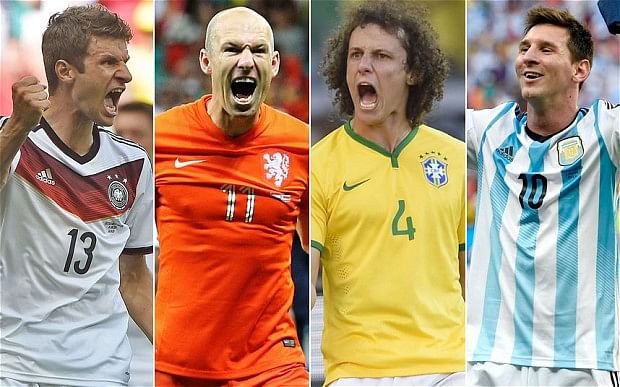
Two European and two South American teams have made it into the final four of the 2014 FIFA World Cup. Going into the final week of action, it is the hosts Brazil, their fierce rivals Argentina and European powerhouses Germany and the Netherlands who are still left standing with a chance to compete for the top prize.

For two of them in particular, the Germans and the Dutch, it is a repeat of what they managed to do at the last edition in South Africa. They have managed to make the semis at the World Cup finals for two successive editions now; quite an achievement.

As far as Germany are concerned, Die Mannschaft are the most consistent national team in football. Forget back-to-back semis, this is the fourth consecutive time that Germany have made it to the final four since the 2002 edition in Korea-Japan. The Germans don’t do upsets, they don’t do group stage eliminations, they don’t do hype. They just methodically go about conducting their business and get to the final week of competitions going down only to the eventual champion in most cases. Their presence in the latter stages is almost a given.

For the Dutch, after the disappointment of not qualifying in 2002 and the fractious exit in 2006 at the hands of Portugal, it marks a welcome return to a place where Dutch football believes it truly belongs – the journey from being merely a pretender to now being a contender.

In an earlier piece, I’d written about some of the mistakes that the other two semi-finalists from South Africa – Spain and Uruguay – were guilty of having made in their preparation for this year’s World Cup. Germany and the Netherlands are a good example of teams that have moved in the opposite direction and actually taken a progressive view to the tournament, thereby finding themselves rewarded with a semi-final spot yet again.

Spain and Uruguay were guilty of relying a little too heavily on the same squad that earned them success back in 2010. Trouble was, some of those players were no longer at their peak and had slowed down over the years. As a result, players in form and performing well at club level were overlooked in favour of the established names. Spain may have brought in new players into the squad, but the starting eleven bore few changes to the core from the 2010 World Cup. The defending champions also failed to address their defensive woes and were forced to pay a heavy price.

Uruguay too relied too heavily on the old guard and that in turn increased their dependence on Luis Suarez. They suffered from a severe lack of mobility in their play, and their defeat in the opener actually forced Coach Oscar Tabarez’s hand to give the newer guys a run.

Germany’s squad is more mature now


One might argue that Germany have much the same players, just like Spain. True, but there is one key difference; Germany’s core is now actually in their prime. From the time of the 2008 Euros and the 2010 World Cup, these players are more mature and more experienced and have all tasted plenty of success playing for their respective clubs. Captain Philip Lahm and midfielder Bastian Schweinsteiger are now the seasoned pros in the setup with a wealth of experience behind them.
Germany
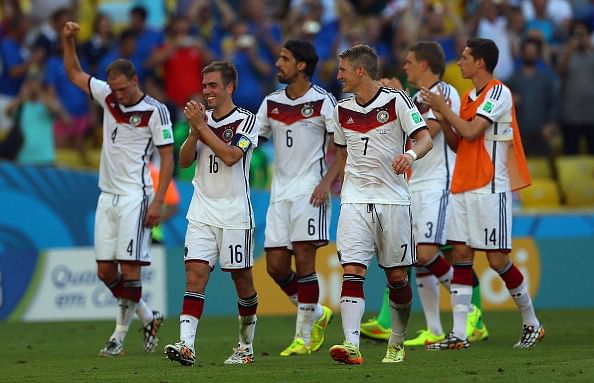
Germany have made it to their fourth consecutive World Cup semi-final
And while the squad might look the same, Joachim Loew has made minor tweaks in personnel as well as tactics. The Germans don’t ever single out one man to be the key guy in the team; it is almost always a team effort. Four years ago, this was Mesut Ӧzil’s team, but it no longer is. Toni Kroos has taken over that mantle now and with Thomas Müller playing up front, there is more dynamism in this German side.

Germany’s defence isn’t the greatest either, not when you have Jerome Boateng and Per Mertesacker playing together, or Holger Badstuber. As shown from Mertesacker’s improved performances at Arsenal, he needs a partner who is quick on the ground. And Germany have plugged that gap with Mats Hummels now in the mix. Germany look a more solid team with any combination of Boateng or Mertesacker with Hummels.

For the Dutch, it’s out with the old and in with the new


There’s never been any doubt about the talent in the Dutch ranks, but there was always that sense of disappointment about how they could never get their act together to win a major tournament. It has been a tumultuous journey for the Dutchmen the last four years from the highs of reaching the final in South Africa in 2010 to the lows of losing all three matches and being eliminated in the group stages of Euro 2012.

Since then, with Louis Van Gaal back in his second stint as Netherlands manager, the Dutch have begun the climb out of those dark hallways. They were the first team to qualify for the World Cup from Europe, scoring prolifically and without losing a single game. They too have learnt from past endeavours and changed elements of the team that cost them dear at recent tournaments.

They culled the entire defensive line; not one member from the defensive unit that went to South Africa has travelled to Brazil, and only Ron Vlaar survives from the squad that was dumped out acrimoniously at the Euros. In their places are young defenders picked out from the Dutch Eredivisie, confident in their stride, emboldened by success enjoyed domestically.
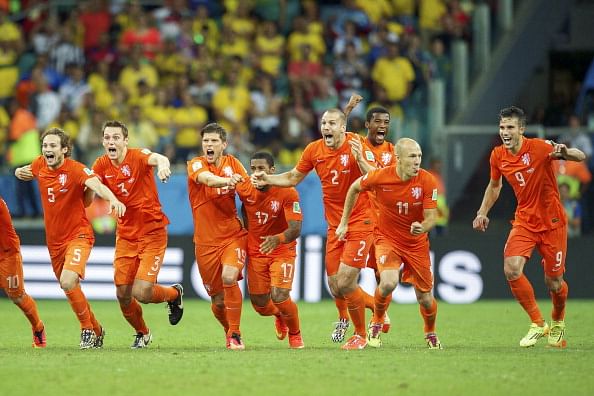
It’s back-to-back semi-finals for the Oranje.
Only five veteran players have been retained by Van Gaal – Robin van Persie (now the captain), Arjen Robben, Wesley Sneijder, Nigel De Jong and Dirk Kuyt.

The attacking trio of van Persie, Robben and Sneijder combine to make one of the top offensive threats going forward. In fact, barring Sneijder, the other two members of that trio have actually gotten better since the last World Cup and have enjoyed much success playing for their clubs; Van Gaal has made absolutely the right call to retain them to provide this otherwise young team with some veteran leadership. And while Sneijder’s stock may not have improved like the others, he is still one of the best midfielders in the world in delivering killer passes and from dead ball situations.

Dirk Kuyt is an absolute professional, and hence is a great footballer to have in the squad. To add, his versatility (he can play wing-back, full-back, midfield, winger, forward) gives the Dutch team options. De Jong provides the steel in midfield and is still a great asset to have for his ability to break up play and retrieve the football from the opposition.

And the young players chosen in the squad, extensively from the Eredivisie, have provided some much needed freshness and have come into the tournament on the backs of extremely successful seasons. Van Gaal has picked exclusively from the top two sides in the Dutch league last season – Ajax and Feyenoord – and PSV who finished fourth.

Goalkeeper Jasper Cillessen, defenders Daley Blind and Joel Veltman were all part of Ajax’s title winning team. Defenders Bruno Martins Indi, Stefan de Vrij, Daryl Janmaat and Terence Kongolo and midifielder Jordy Clasie formed a part of Feyenoord’s fine team that finished second. And forward Memphis Depay and midfielder Georginio Wijnaldum were chosen from PSV. The reliance on players from the local Dutch league who have played with and against their teammates has brought in that familiarity and has helped the team work better as a team.

And the importance of confidence cannot be overstated; Van Gaal has picked winners in his squad. With winning comes mental toughness and fortitude and these young Dutch youngsters displayed that in spades in tight games against Chile, Mexico and Costa Rica in the lead up to the semi-finals.

South American obstacles in the way


Germany and the Netherlands now have South American opposition standing in their way, two favourites nonetheless, in Brazil and Argentina respectively. It is not only a clash of continents, but also a clash of styles. Traditionally even the best of South American teams have come undone when they’ve gone up against strong European teams who outsmart them tactically and rely on their organization and strong game plan to counter the flair of the South Americans.

Just ask Argentina who were thumped by Germany in 2010 and edged out in 2006 before that. Ask Brazil who were outwitted in 2010 by the Dutch and in 2006 by France. The two teams will have a point to prove over the next two days.

However, the Germans and the Dutch are well equipped to cope with them as always. The familiarity of the local conditions and home support will be one huge advantage for the South Americans, but you can bet on the two European teams to provide more than just a stern challenge. If Brazil and Argentina are to have that dream final on Sunday at the Maracana they will have to overcome their stiffest tests of the tournament so far, for they are going up against two of the most well drilled sides in this year’s tournament.

All the preparations for crazy parties on the beaches in anticipation of a Brazil-Argentina clash should be put on hold for there is a very real possibility that the meeting of arch-rivals in the final could just be between two European neighbours instead of two South American ones.

Thursday, April 25, 2013

The Bayern Juggernaut rolls on

Jupp Heynckes, the 67 year old manager of Bayern Munich had this to say after his team's decimation of Barcelona on Tuesday night: ""We've been playing extraordinary football all season. It was not a really big surprise to me that we scored four goals. We have played to a high level all season."

THE BEATING
The beating that Barcelona received at the hands of Heynckes' team was a first; it was the first time any team had suffered a 4-0 defeat in the semi-finals of the UEFA Champions League. For a lot of Barca fans as well as other football aficionados not entirely attuned to the exploits of Bayern Munich this season, the result was a shocker. But, as Heynckes so gleefully pointed out, they have been playing "extraordinary football" all season and this result was if anything, a strong reinforcement of that very fact.

“They were physically very strong,’’ said Xavi. “In fact they were superior. We didn't create chances. It’s a dreadful result. No excuses.’’ added Xavi afterwards. “They have been the better team and we congratulate them.” This is an uncharacteristic line towed by Barca and Xavi, where upon previous exits to Chelsea and Inter Milan, the Spanish midfielder had taken the moral high ground saying the opposition did not play football the right way and that they attempted to play a 'dirty' game.

Tuesday's beating though was different. There was a sense amongst almost all Barca players that they had just been taken to the cleaners by a far superior footballing unit. Lionel Messi too agreed: “Bayern were the better team, in everything,’’ said Barcelona’s No 10, who had clearly not recovered from a recent hamstring problem. “They’re stronger, scored twice from set-pieces, every second ball was for them.’’

Gerard Pique, never one to shy away from giving his thoughts was candid, “They thrashed us, the referee didn't have an influence. It is almost impossible for us, but we have to show some face in the return-leg. They were quicker, stronger and better.”

THE BAYERN BEAST
Bayern were Runners-Up to Chelsea in last year's edition of the Champions League. In all fairness, it was a game that they dominated, but somehow contrived to lose in front of their home supporters. That disappointment has only added to their desire to conquer all and sundry that appear before them this term. In making the semi-finals this year, Barcelona had achieved a rare distinction of making 6 consecutive semi-final appearances. It is in a way a fair reflection of the dominance that the team from Catalonia has exerted on this competition.


The German club have not been far behind; Heynckes has led Bayern to two of the last three finals, and a third in four years, looks an inevitability after Tuesday's demolition job. The sourness from their inability to cross the final hurdle on a couple of occasions still lingers and Heynckes pointed it out after the game - "Falling short of success in the past two years has only made them hungrier to win this year. The tactical awareness of this team is top notch as well, just like their willingness to run and fight for one another. Today's (Tuesday's) game was a perfect example of that."
This is a team that has been built carefully by Heynckes, who will be stepping down at the end of the year. After being outgunned to the Bundesliga title the last two years by Borussia Dortmund, Bayern addressed key areas of the squad in the summer. In central defence, Jerome Boateng and Holger Badstuber, were being exposed against more physical teams and pacy forwards. Dante, the tall bushy-haired Brazilian defender, was bought from Borussia Monchengladbach for about €4 million to help solve matters. The second piece of the puzzle was securing the services of Javi Martinez from Athletic Bilbao for a record transfer fee of €40 million. Mario Mandzukic after his stellar season last year for Wolfsburg, was poached for €13 million and the Swiss international Xherdan Shaqiri was purchased from FC Basel for €9 million to beef up the attack.

The addition of these players has helped address some of the shortcomings from previous seasons. Bayern have conceded only 14 goals in 30 Bundesliga games, an average of 0.46 goals per game, the best out of any leading side in the respective leagues - Barcelona have conceded 33 from 32 games (1.03), PSG 20 from 33 (0.60), Juventus 20 from 33 (0.60), Manchester United 35 from 34 (1.03), Ajax 31 from 31 (1.00).

They are also pressing the ball a lot better thereby allowing teams very little time on the ball. Xavi, Andres Iniesta and Lionel Messi constantly found themselves shackled and harassed by a player in a red shirt and the various channels that Barca constantly use were expertly cut out. ”You have got to analyse how an opponent plays, where they run, how they attack. Then find something you can hold against that. And I did that, I had a PowerPoint presentation, you could see all the runs they do. Defensively we were very strong, we worked very hard. Barcelona couldn't really do anything, they had one and a half chances.“, added Heynckes complimenting his team on their superlative effort.

The Bavarian giants have lost just 3 games all season, 1 in the league and 2 in the Champions League. Bayer Leverkusen are the only ones who have managed to upstage the Red Army of Munich domestically, while BATE Borisov and Arsenal registered unexpected convincing wins over them in Europe. Those results were merely an aberration in a season where the word 'thumping' has followed quite a few of Bayern's footballing encounters. Tuesday night was the 14th instance where Bayern had scored 4 or more goals in a match in all competitions. Over the weekend, they destroyed Hannover 6-1, even after the title had been well wrapped up and with several first-team regulars not playing! (Just to add, Hannover are 11th in the German league and not a bottom club). In 8 of those games, they've hit 5 or more - Stuttgart (6-1), Fortuna Dusseldorf (5-0), Hannover (5-0, 6-1), Werder Bremen (6-1), Hamburg (9-2), Wolfsburg (6-1), Lille (6-1) have all been at the receiving end of those maulings.

One striking feature of their play this season has been the spread of goals as well as the areas of attack. Of all their forward forays, 35% have come through the left flank, 39% through the right flank and 26% through the middle. In the Bundesliga, Mario Mandzukic is their top scorer with 15 goals while Thomas Muller has chipped in with 12 and the remainder of their 89 goals in total have come from others. Last year most of the goals were shared by Mario Gomez, who had 26 himself, and Ribery/Robben.
In the assist category, Franck Ribery, Muller and Philip Lahm are the joint top assisters in the Bundesliga with 10 each. Muller who bagged a double against Barca is their leading man in the Champions League with 7 and Bayern before Tuesday boasted one of the best attacks in this year's edition with 22 goals, second only to Real Madrid with 23.

The big picture hence shows a team that holds no dependence on any one player and hence Barca had an uphill task from the very first minute as they were going up against a superior team with strength and depth in all areas of the pitch and a team that has meticulously stuck to a system all year.


THE YOUNG BREED

Bayern's superb squad has been assembled with an excellent blend of marquee signings and young players who have come through from the Youth team. In fact, one of the features of Heynckes' current tenure has been his blooding of youngsters such as David Alaba, Thomas Muller and Toni Kroos who have made the transition from the youth team to being seasoned internationals amongst the best in the world.
The core of Bayern's team is made up of their own, players promoted through their academy. Both captain and vice-captain, Philip Lahm and Bastian Schweinsteiger, are Bayern through and through, having joined the club as teenagers. Defenders David Alaba, who has been a revelation the last 2 seasons, along with Holger Badstuber also made the progression up from junior ranks.So have midfielders Thomas Muller and Toni Kroos. This composition has helped in the excellent team chemistry that these players share much like Barcelona do with their core having played with each other so often. And all these players are first-teamers occupying key positions for the Bundesliga giants.
With the likes of dangerous wingers such Arjen Robben and Franck Ribery also in the squad, this is a team that is as dangerous as they come and one that makes for a heady concoction of talent.


THE BRAINS
The contribution of Jupp Heynckes to the Bayern project should not be undermined. The former Monchengladbach striker, is a master tactician when it comes to coaching and is one of the most decorated German coaches of all time. As evidenced from the transcripts above, his preparation for games is meticulous and is as animated as they come on the touchlines. Nicknamed 'Osram', for the way that his face tends to redden when under pressure or when agitated during a game, Heynckes in 34 years of management has authored many a success story in Germany as well as Spain.

In his first stint with Bayern Munich (1987-1991), he won two back-to-back Bundesliga titles. He moved on to Athletic Bilbao in 1992 and in his second season there led the Basques to a UEFA Cup (erstwhile Europa League) spot by finishing 5th in the league. He returned to Spain with Tenerife in 1995 and led them to a UEFA Cup spot in the very first season. Following his success with Tenerife, Spanish giants Real Madrid came calling in June 1997 and that would be where he would celebrate his greatest triumph till date.
In the 1997-98 season,  he delivered the Champions League trophy to the 'Los Blancos'. That win in Amsterdam, where they beat Juventus by a solitary goal, broke a 32 year barren run without Europe's premier trophy for Real. However, as has come to be with fickle owners, the German's contract was terminated at the end of the season due to Madrid finishing 4th in La Liga, 11 points behind champions Barcelona.

After not so successful short stints at a host of clubs, 'Osram' returned to the Allianz for a third stint (had a brief spell as caretaker manager after Juergen Klinsmann's sacking in April 2009) with the Bavarian club, which has so far been a successful run. A 22nd Bundesliga title has been wrapped up, reclaimed from Dortmund, in record time even; the title has never been won this early ever.
Heynckes' teams are well known for their discipline and commitment to team ethic. They are very well drilled and are very efficient in picking teams apart with ruthless elan. To an extent, the wily German coach has been  a little disappointed at the way Guardiola was appointed to succeed him even before the end of the season and he has expressed his willingness to leave with his head held high having delivered a historic treble to the club.

THE BAVARIAN SUPREMACY
Bayern before the game announced the addition of Dortmund's talented attacking midfielder Mario Goetze to  their ranks from next season, and there are rumors rife that his teammate and prolific striker Robert Lewandowski is poised to join him. Bayern's ambitions stretch far beyond any amount of success that comes their way this term; they are building for domination of the European club scene in years to come.
That spells bad news for Bayern's opponents, as not only are they going up against a very, very talented team with the wherewithal to bully opponents into submission, as Barcelona found out, but also a group of players smarting from the heartbreaks of recent seasons, and an incumbent manager determined to leave with a bar set at  a near stratospheric level for his successor to match.