Showing posts with label Brazil. Show all posts

Saturday, July 12, 2014

FIFA World Cup 2014: The day Brazil stood still

Brazil national side fail to live up to the expectations of the home fans as Germany thrash them 7-1 in the semi-final.
This past Tuesday in Belo Horizonte, time seemed to stand still during the 90 minutes of football in the first semi-final between Brazil and Germany.

For 90 minutes, all those who watched went through emotions that you would associate more with being at the cinemas and amphitheatres. For 90 minutes, people’s thoughts were suspended, for from the outside looking in, it bore no evidence of a sporting contest, least of all a FIFA World Cup semi-final between two giants of the game.

While the rain came down hard as the match wore on, the tears came down harder on the cheeks of many Brazilian supporters in the stadium who just found it all a little too much to stomach. Overwhelmed they were and awash with misery at watching their heroes fall apart like a deck of cards.

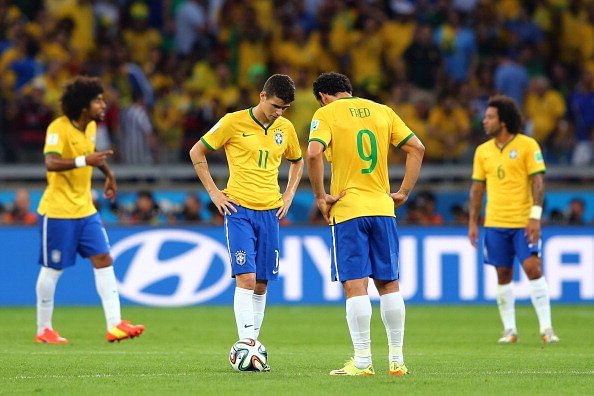
As the first goal went in, when Thomas Müller found himself completely unmarked to head home, the entire Brazilian team took a deep breath knowing that they now had to put up a masterful effort to come back in this one without their two best players. Hope, while having taken a hit, was still intact. When the second one went in, and in the manner in which it did, that hope was shattered. The young team out on the pitch began to see its World Cup dream slip away.

And in thinking about that dream slipping away, they let in a third, fourth and fifth. In a span of six extremely long minutes, Brazil’s players suddenly found their dream turned into a nightmare, a real live one, and one in which they were very much awake. Their thoughts must have shifted to the vultures that would circle around them after the match, the memories that would haunt them for years on end and a public that would be merciless and unforgiving during their entire lifetime for having brought on this shame to the country’s football and its people.

It was the day Brazil stood still and let time and Germany just waft past them. The scenes witnessed that evening were just some of the most poignant ones seen in recent times.

A modern day sporting tragedy

In an era far removed from Greek tragedies, Brazil’s national football team became the centrepiece in this modern day sporting tragedy, one that can claim to rival Greek tragedies of yore from Aeschylus, Sophocles and Euripides.

As much as word may be out that Germany were clearly far superior and that Brazil were destined to fail, let’s get things straight, events like Tuesday are freak results; they come along rarely. Brazil aren’t that bad and Germany aren’t that good, period. Five of the seven goals conceded were gifts presented to the Germans in an unexpected show of hospitality from the hosts, the nature of which were so welcoming that even a side like San Marino would have pumped in a few goals.

What we witnessed was amongst the most spectacular unravelling ever seen in recent times in sport. Brazil’s footballers just imploded on the pitch against the more seasoned Germans and the result wasn’t pretty.
Pressure can undo so many good things. When you play under pressure, you pretty much stop playing, focussing instead on how best not to mess things up. Brazil were under pressure right from the moment the tournament got underway and that is precisely why they’ve flattered to deceive right through.

A year ago, this team became overwhelming favourites to clinch their sixth World Cup after putting in a masterful run to win the Confederations Cup at home. It is not for nothing that the favourites going into a World Cup have never won; in Brazil’s case, the euphoria and the pressure was just so much more considering them being the hosts and considering the painful memories from 1950 that the country wanted this team to banish.

Brazil’s unconvincing road to the semis

A team cannot go from being world-beaters to being on the wrong end of a 7-1 score line in a jiffy. The truth is Brazil have hardly got out of third gear at this World Cup due to a combination of their own anxiety and how well their opponents have played. Unconvincing is the word that can best be described to sum up how they’ve performed right through, from their opener against Croatia right upto squeaking past Chile and holding off Colombia.

They sparked in fits and spurts and managed to get the job done in order to progress. But then, such an approach can only take you that far, and when you go up against an elite team such as Germany, you have got to be better prepared. Driven by a fear of failure all along, the focus has to been to somehow get the win, while sacrificing all else for the ultimate glory.

Trouble with that approach, sadly, is you tend to not have a fall back option. Brazil right through the tournament exhibited a distinct lack of a clear strategy or game plan. Hence, the reliance on Neymar; hence, the sweaty foreheads and palms when he went down after being kneed in the back by Colombia’s Juan Zuniga.

“We missed you skipper”

Without Neymar, they were going to struggle offensively, but Thiago Silva’s absence at the heart of the defence was always going to have more severe implications, though no one could have quite predicted the scale of damage that was eventually inflicted. Their captain has been immense for them in this tournament and in my opinion has been more crucial to the team than Neymar. I say so because, once you gloss over the goals and attractive play that the Samba boys displayed en route to the semi-final, their progress was more a grit-and-grind display, of overcoming opponents rather than overpowering them. And at the heart of it all was the man from PSG.
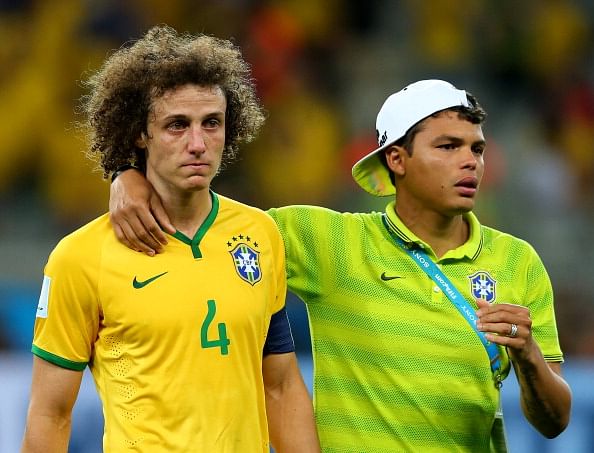
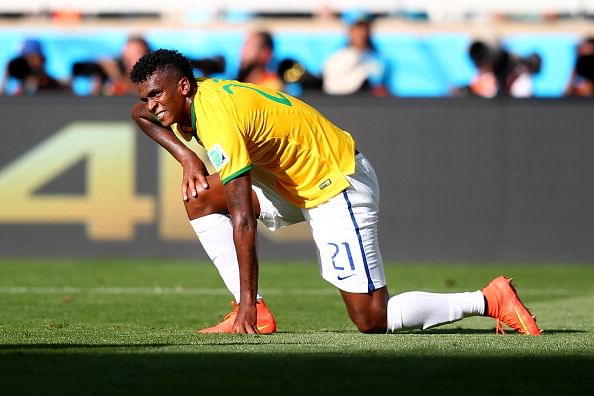
Brazil’s Thiago Silva (R) consoles David Luiz
Strong rear-guard action was required in every game that Brazil played – against Croatia, Mexico, Cameroon, Chile, Colombia – and Silva stepped up to the plate magnificently every single time. His marshalling of the defence was superb to watch as he kept his teammates focussed and was always proactive, shouting out instructions and keeping his team huddled together. His presence makes David Luiz play better and that recklessness in his game is hardly seen when Silva is around.

He wasn’t around on Tuesday in the semi-final, wasn’t around to rally his troops when they were shooting themselves in the foot, wasn’t around to bring about a sense of calm to the back four in particular and the team in general. For four of the seven goals conceded, Brazil even had numbers back, only they weren’t really marking anyone, just marking space. A fine leader of men, the only one perhaps in this team, he was sorely missed out on the pitch that evening.

Brazil didn’t lack talent, they lacked experience

This team that played as such an effective unit with so much cohesion and unity in winning the Confederations Cup also played with a great degree of freedom at that event. An uninhibited approach allowed them to play their games at their full potential knowing full well that the event was but a precursor, a warm up, to the big event a year away. Failure to win it would not be the end of the world. In 2014, at the showpiece event though, the stakes were much higher, and Brazil crumbled.

All those saying that is the worst ever generation of Brazilian players to ever play for the Selecao could not be farther from the truth. Brazil’s remarkable self-combustion came not due to a lack of talent, but due to a lack of maturity and experience. This squad was simply too young and too inexperienced to handle itself when backed into a corner.

Of the four semi-finalists this year, Brazil clearly was the odd man out, for every other team had a solid core of five to six veteran pros with plenty of experience behind them. Argentina’s entire team boasts of players that have now been playing for years in the top leagues in Europe and South America with plenty of caps under their belt; Germany has a strong veteran core of Philip Lahm, Bastian Schweinsteiger, Per Mertesacker and Miroslav Klose to look to for leadership and even their younger players have a World Cup under their belt already; the Netherlands likewise have Robin van Persie, Arjen Robben, Wesley Sneijder, Nigel de Jong and Dirk Kuyt. All of them big-match players, all of them seasoned professionals capable of handling themselves well in high-pressure situations.

Contrast that with Brazil and you find no one of note barring Julio Cesar and Dani Alves. Even their captain, Thiago Silva, is an amateur when compared to those leading the other three semi-finalists.

‘Big Phil’ fails to provide the major lift

This team is no doubt talented; the trouble is they have hardly been able to will themselves to play anywhere close to their best. That’s why the blame, entirely, must go to the coach, Luiz Felipe Scolari, for this acrimonious debacle.
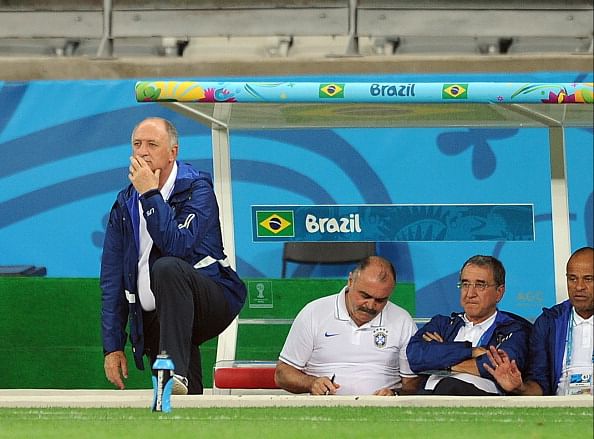
Brazil coach Luiz Felipe Scolari had no answers to Germany’s onslaught
Scolari’s missteps began from the day when the squad was announced. He opted for caution over flamboyance when he selected a gut of defensive-minded midfielders in the squad and left out players such as Lucas Moura. During the whole tournament, he seemed to be unable to influence the game during periods when his side were under pressure. His substitutions seemed to follow a preset order rather than being influenced by how the game was going. Tactically, he was outsmarted by almost every single opposing coach, including that of Cameroon. Perhaps the most shocking decision of all was him deciding to play Maicon in the right-back position against Germany. Who was he kidding?

Dani Alves may have been sub-par for much of the tournament and his benching in the quarter-final against Colombia may have been to send a strong message to him, but not playing your best right-back against a team like Germany is asking for trouble. Even more so when you’ve already been forced to include Dante in central defence thanks to Silva’s absence. Both Maicon and Dante let the team down massively. Maicon has been washed up for some time now; he is backup at AS Roma for a reason.

Road to redemption

There are some clear problems with this team, like the need for a good centre-forward. The other main issue they will have to address by the time the Copa America comes around and subsequently the next World Cup, is the right-back and the goalkeeper positions. Julio Cesar could be playing in his last World Cup and Alves may not be around too when the next one comes around.

This team is extremely young and culling the entire lot in favour of other alternatives would be too harsh a decision. Each of these players have exhibited considerable potential at club level and together as a team to be kept in the mix for upcoming tournaments. A knee-jerk reaction is the easy way out, but not the right one at this point. Ensuring continuity is a key part of squad building. Barring a coaching change, the players have to be given more time. They just have to look at the team that butchered them in the semi-final to understand that.

This German team’s road to the final began eight years ago, in similar conditions at home, where they fell to wily Italian team in the semis. That squad headed by Jürgen Klinnsmann and the subsequent one in 2010 bore much resemblance in that they all had a young core of players. With greater experience and maturity, they are now once more in the final, 12 years after they made the final in 2002 at Korea/Japan. And redemption is a great motivator to help inspire a bunch of players out of a funk after such a heavy defeat.
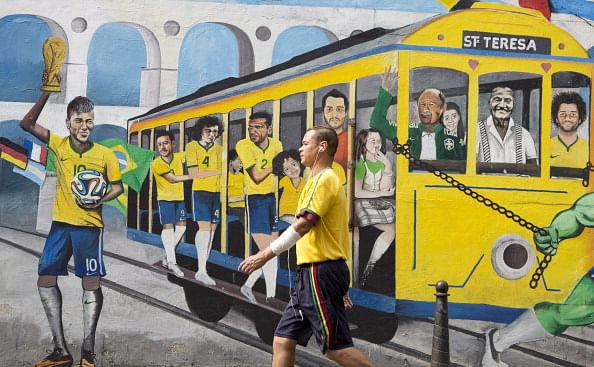
That road to redemption begins later tonight when they take on the Netherlands in their country’s capital in the third-place playoff. While no team really likes to play this particular match in a World Cup, for Brazil it provides an immediate opportunity to redeem themselves in the eyes of their country mates, and more importantly to help them believe in themselves once again.

It definitely is a game that Brazil need more than the Dutch, considering their rather narrow, gut-wrenching defeat to the Argentines in the second semi-final.

The original tragedies from the Greeks were aimed at depicting actions that were so complete and noble, that through trial and tribulation, the emotions of the audience were to be transformed from pity and fear to compassion and other pleasurable emotions resulting in a catharsis of the troubled soul. A similar renewal and restoration process lies in front of the current Selecao crop for they would like to wind up affairs at their home World Cup on a high and provide their fans with a sense of belief and hope that they can and will be back with a bang the next time around.

Monday, June 30, 2014

FIFA World Cup 2014: Directionless Brazil owe much to good fortune after escaping Chilean trap

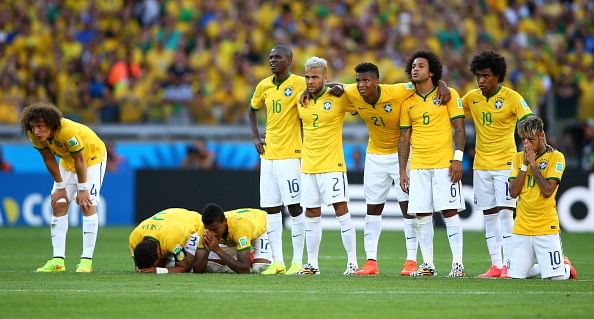
Brazil’s players line-up during the penalty shootout with (from left) Thiago Silva, Luiz Gustavo and Neymar in prayer 
“If you ask me anything in my name, I will do it.  - John 14:14”

The whole of Brazil seemed to have asked for the win yesterday!

It was a day that could have seen a huge backlash, not just against their team, but also the government, FIFA and the ongoing World Cup on the whole. In the end Brazil’s national football team, the Selecao, made it through to the quarter-finals of the 2014 FIFA World Cup, but only just.

The last time Brazil hosted a World Cup, they left the tournament embarrassed after having been upset by Uruguay at the Maracana and thus being devoid of championship glory. That was 64 years ago; there was almost a new painful memory for Brazilian fans to remember down the years at Belo Horizonte yesterday.

The venue apart, yesterday’s game mirrored the ‘Maracanazzo’ to a great degree; a potent South American foe standing in the home team’s way; an early goal for the home team to send their fans into a frenzy; an opponent that equalized and grew stronger as the match went on. Almost everything, except that Chile didn’t quite manage to turn it around completely and deliver the final knockout punch; and that was in no part down to Brazil picking up their level of play. Chile were just plain unlucky.

Brazil’s progress into the last eight came thanks to a more than generous helping of good fortune and the heroics of their goalkeeper, 34-year-old Julio Cesar, more than anything else. That and perhaps a powerful belief in prayer that delivered them away from a personal tragedy and a lifetime of scrutiny and grief that would have accompanied it.

In terms of drama, excitement, nervousness, anxiety and tension, this game helped kick-start the knockout phase on a rollicking note. This is what one expects as the tournament progresses – better teams, tighter matches – but sadly the Brazilian team came very under-prepared.

Coming into this clash, Brazil had sparked in fits and spurts through their group games to emerge from Group A as winners ahead of Mexico. They were a little lucky to emerge with all three points against Croatia, were frustrated in their game against the Mexicans where they were held to a goalless draw, before beating an insipid, and already eliminated, Cameroon side in the final game. While they didn’t lose a match, none of the games, barring the second half against Cameroon, were a breeze. Defensively, they looked tacky and vulnerable and going forward, they did score seven goals, but they struggled for rhythm and leaned heavily on young Neymar’s shoulders.

Chile had come through Group B as runners-up, pushing aside world champions Spain in the process. Their opening two victories against Australia and Spain were the result of a cohesive unit working diligently towards a well-prepared strategy and game plan. Their master class against Spain was particularly impressive. They failed to score and were beaten in their final game against the Netherlands, but they controlled a large portion of that game, and would have been kicking themselves for not getting a goal before the late Dutch charge.

Chile have had their campaign ended by Brazil every single time they have reached the knockout stage. Yesterday was a chance to put aside all that hurt from years past, and Chile were in many ways perfectly equipped to take Brazil out this time.

Luiz Felipe Scolari is a great motivator, very good at managing personnel and getting the best out of a talented bunch of players; what he’s not is tactically astute. And once his opposite number yesterday, Jorge Sampaoli, managed to break through Scolari’s Plan A, Brazil were in trouble.

Chile stick the fork in Brazil’s plans

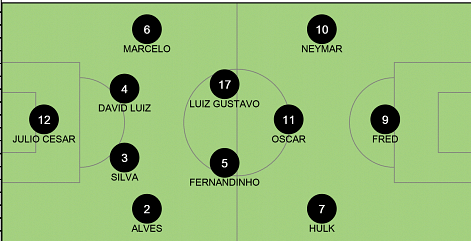
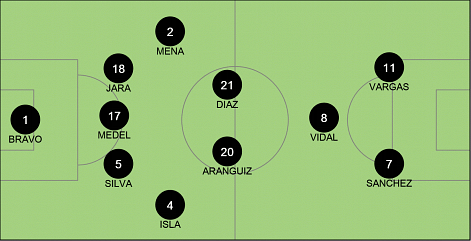
Brazil lined up in their usual 4-2-3-1 formation with Neymar, Oscar and Hulk supporting troubled striker Fred. Chile opted to go with what appeared to be a 3-4-1-2 with Francisco Silva, Gary Medel and Gonzalo Jara forming a three-man defensive net at the back.
Brazil’s starting line-up
A great deal of how well the current Brazilian team plays on a given day is determined by how well their full-backs play. Dani Alves and Marcelo were anything but impressive, and Chile’s 3-man backline was specifically in place to take advantage of this. Alves, in particular, probably had one of the worst games of his career.
Chile’s starting line-up
Brazil started off brightly, but Chile had anticipated just that and were prepared to take a few punches early on although they would have preferred not conceding a goal. Alves and Marcelo bombing forward with Hulk and Oscar going out wide to help the forwards, Brazil looked threatening. But Chile’s 3-man backline meant Mauricio Isla and Eugenio Mena played as wingbacks, and what they did is leave very little margin for error for Brazil’s full-backs in the eventuality of them conceding possession. And it worked; despite being on the front foot, Alves and Marcelo were dispossessed rather easily on a few possessions to set up quick counters where Chile wound up against just the two central defenders and either Luiz Gustavo or Fernandinho helping.

That early pattern of play seemed to make both of Brazil’s full-backs adopt a more cautious approach. With the full-backs now not being as aggressive, Chile ventured to establish control of the midfield with Isla and Mena now able to move a little forward themselves and press higher up the pitch. This also ended up severing Brazil’s frontline from the rest of the team, leaving Hulk, Neymar and Fred on their own up front. And Chile had the 3-man defensive cover capable of dealing with them.
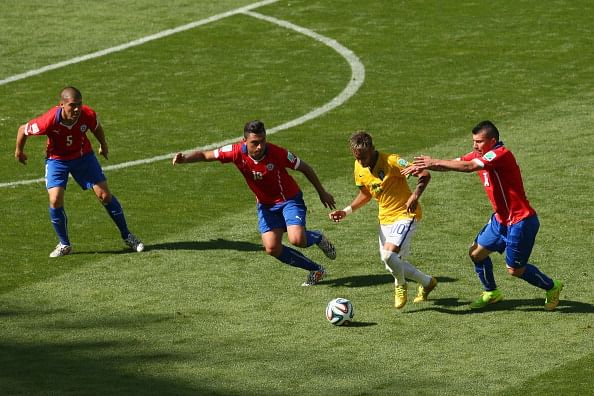
Chile kept a lid on Neymar by almost always having three defenders on him
Scolari plumped for Fernandinho instead of Paulinho to partner his defensive plug in Gustavo. But playing Fernandinho means a lack of creativity in an already workmanlike midfield and more pressure on the likes of Neymar and Hulk to create attacks. Paulinho may have been off-colour in the group games, but he provides a thrust from midfield which Fernandinho doesn’t and this played into Chile’s hands.

Getting nothing from their full-backs, Brazil tried to go through the middle, using their trickery and bag of skills. But they went up against a red Chilean wall, which repelled everything through the sheer numbers that they could get back to gridlock the home team. In the second half, there was one period of play, where Chile did this so effectively that Brazil couldn’t get past the halfway line.

Neymar’s brilliantly taken goals were one reason why Brazil managed to come through Group A as winners. And Sampaoli was all too aware of this and entrusted Silva with keeping a close eye on Brazil’s boy-wonder. He wasn’t afforded space, and almost every single time he got the ball, there were about three Chilean defenders around him. The wingback system meant only one of Chile’s back three had to guard Neymar with either of the full-backs or central midfielders in Aranguiz or Diaz stepping in to help out Silva with Neymar.

With nothing going their way, the team discombobulated, their stars kept quiet, and their defence under attack, a sense of panic gripped the Selecao; the lack of tactical adjustments from Scolari only adding to it.

Alexis and Diaz shine for Chile

For Chile, Marcelo Diaz in midfield had a brilliant game. His use of the ball was simply superb to watch, always picking out a player in space and being patient with the ball, drawing the Brazilian defence out, before playing the ball forward into Eduardo Vargas and Alexis Sanchez. Along with Charles Aranguiz, he put in a dominant midfield display to leave the Brazilians short-changed for offense.
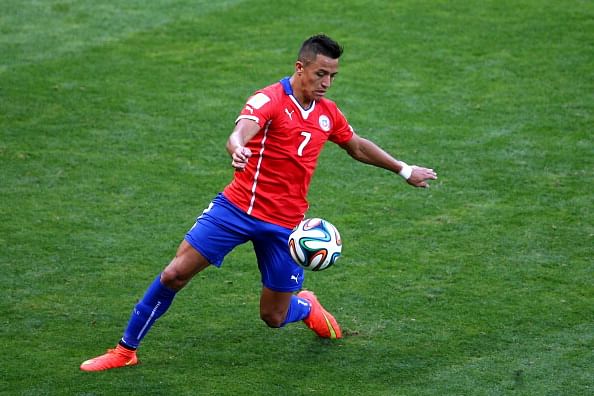
Alexis Sanchez was simply brilliant for Chile
Alexis had a phenomenal game, leading the Chilean line beautifully. He did everything the Brazilian forwards didn’t – held up the ball superbly bringing his other teammates into play, drew the defenders away to make space for his teammates to run into, and when needed went at the defenders and left them in a heap with his dribbling and ball control.

Chile executed their strategy superbly and what was even more remarkable was their composure in possession. They were constructing attacks wonderfully while Brazil were resigned to punting hopeful balls in the direction of Neymar and Hulk with a “Hail Mary” attached to it.

The high number of fouls and scrappy nature of the contest also played perfectly to Chile’s advantage with Brazil prevented from getting into any sort of rhythm.

Everything that Chile did well, Brazil didn’t. Where do you start? How about the centre-forward position?

Brazil – No teammwork, no direction

Fred looks woefully out of touch and also extremely lethargic. He is clearly not the same player who was in rich form about the same time last year during the Confederations Cup. His replacement, Jo, didn’t exactly inspire any sort of confidence either. So the hosts have a major problem there.

In the second half, for about a 15-20 minute period after Jo’s introduction, all Brazil did was lump balls forward from defence to Jo’s head. Admittedly, the strategy was aimed at taking advantage of the visible lack of height in Chile’s back three. But Jo isn’t Miroslav Klose, to be able to get the ball down himself; and even if it was about getting knockdowns for the others to latch onto, they seemed to be forgetting that Brazil’s front three were up against Chile’s effectively 5-man backline with the wingbacks joining in. With such a mismatch, there was no way that strategy was going to pay off.
Brazil forward Jo was left visibly frustrated and tired by his team’s long ball approach
Also, another worrying element was how Jo, after the initial attempts, was pleading with his teammates not to put long balls in as it wasn’t getting them anywhere and more importantly, robbing Jo of energy which could have been better put to use. Even Scolari was imploring his team to stop this from the sidelines, but to no avail.

Brazil displayed no teamwork yesterday and often resembled a bunch of headless chickens just trying to force their way through with no real thought process to their play. Their passing and decision-making was poor, they lacked vision and once Plan A went out the window, they didn’t have a set strategy, and seemed to be clutching at straws.

Neymar may be the best player in the team, but too many times he tried to take on one too many defenders one-on-one and ended up getting dispossessed. Him and his teammates’ flicks, tricks, shimmies, back-heels, the lot weren’t coming off and they got frustrated. In trying to bamboozle their defenders, they forgot the basic elements, which was to keep it simple unlock a sound defence by moving the ball around. They lacked composure on the ball. They need to realize that as they go deeper into the tournament, they are not going to be able to beat teams with just their bag of tricks; that has been the reason strong European teams have been able to pick them apart so efficiently since time immemorial.

Brazil also lacked a dominant midfielder who could put his foot on the ball and set the tempo. That’s where Hernanes can be useful and he wasn’t employed yesterday. Another decision that could come back to haunt Scolari is the absence of Lucas Moura. The PSG man is a supremely gifted winger and has the ability to unlock defences when he plays out wide on the wing with his pace and crossing ability. He was present in the Confederations Cup, but is missing from the squad here. And apart from Willian, Brazil don’t have anyone who can play in that position. Spain didn’t call up Jesus Navas and look how it cost them!

Brazil can expect more such tests ahead

Brazil were given a huge scare yesterday and the road only gets tougher for them from here. They cannot just rely on their talent-laden team to pull through for them without a more dynamic game plan and tactical adjustments in response to their opponents’ moves. Scolari had this to say after the game:

“They’re a very organised team with a good tactical system and fine players. Every credit to Chile but this penalty shootout win says a lot about us and about our desire to progress. The players can have a break now and, as they recover, we’ll have a look at how we won, go through all the tricky situations we were in and a whole lot of other details. The idea is to build on this. When you win like this you come out stronger. We’re going to tell them that so they can appreciate what they’ve done.”
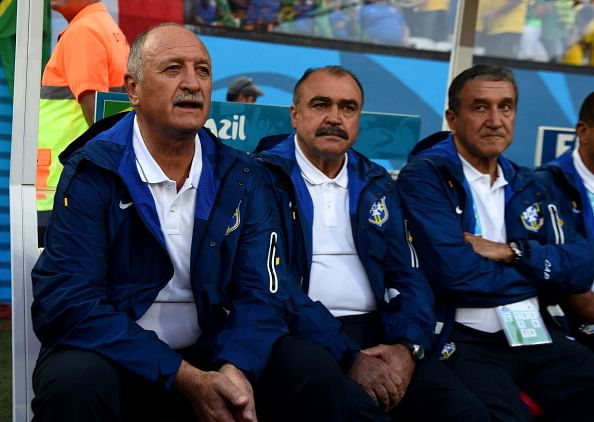
The experienced triumvirate of (from left) Scolari, Flavio Teixeira and Carlos Alberto Parreira have a job on their hands 
When they rummage through their efforts of this game, they will find that they were hugely fortunate to come through and they that didn’t respond very favourably when backed into a corner. But yes, sometimes a tough win is what a team needs, and in a month-long tournament it is about peaking at the right time.

Their campaign for a sixth World Cup is currently riddled with many loopholes that need plugging. They have a very experienced coaching unit which should help them with that and an inspiring captain who did his best to rein his troops in while being perilously close to falling over the edge. Brazil, for sure, can only get better from here.

Chile have entertained us all during their stay and exit having taken Brazil all the way to the doors of their deepest and darkest fears and coming within a goalpost of knocking them out. Sampaoli and his men can take great pride in that once they recover from the emotional blow of the loss. 

Saturday, June 15, 2013

CONFEDERATIONS CUP 2013: PLAYERS TO WATCH (Part I)

The Confederations Cup 2013 is here and Brazil gets ready for a glimpse of the football that will be in full swing next year. Part I of a look at the players to watch out for through the tournament.

BRAZIL
Neymar, Barcelona (Forward)
He has the tricks, the multi-million dollar sponsorship deals, the recent big money move to Barcelona along with the media buzz and hype; but all of that will count for nothing if the ‘most marketable athlete in the world’ falls flat in the famed Yellow shirt of Brazil.

This year will mark the beginning of a new and more challenging phase for Neymar; he will turn out for Barcelona next season after his €57 million transfer, a new environment and one where the level of football is obviously a huge step up from the Brasileirao. And then, there’s the pressure of delivering the World Cup for football crazy Brazil after the disappointments of the two previous editions.

There is no questioning the talent of Barcelona’s newest acquisition; however the terms ‘overrated’, ‘over-hyped’ and the like have been aimed at his feet in the last year or so after his failure to replicate his brilliant form for the national side. His performances at the last Copa America and the London Olympics didn’t help matters either. There are some elite teams in the fray in the Confed Cup and the tournament presents him with the chance to show everyone that he can cut it at the highest level.

Hernanes, Lazio (Attacking Midfielder)
The Lazio man will be a key component for the Brazilians as he is the one true playmaker in the side. While Oscar is very good in moving forward with the ball and initiating the neat 1-2’s, it is Hernanes who will be key to Brazil having good possession. He is good with both feet and has the ability to spray the ball out wide to stretch the play. He also has a good and powerful shot on him. He has struck up a nice partnership with Miroslav Klose at Lazio and will be looking to develop a similar understanding with Fred and Neymar.

David Luiz, Chelsea (Centre-back)
Coach Luiz Felipe Scolari has partnered Luiz with captain Thiago Silva in most of the friendlies. Luiz has great skill on the ball, but his defensive capabilities have been found wanting at times with the odd mistake often seen from the bushy-haired defender. He will come up against some of the best attacks in the world at this event and how he fares could determine whether he starts the World Cup on the field or on the bench. It’s also an opportunity for him to show new Chelsea boss Jose Mourinho, who we hear is not entirely convinced about the Brazilian, his ability to hold his own in that position.

JAPAN
Keisuke Honda, CSKA Moscow (Attacking Midfielder)
Japan became the first nation to qualify for Brazil 2014 after Honda converted an injury time penalty against Australia to earn a 1-1 draw for his team. He has had an injury-riddled season, but is one of the main stars in this Japanese team. He plays in that central attacking midfielder’s role and sometimes even behind the main striker. Honda is a great dribbler and very good from set piece situations, especially his superb free-kicks. He has 14 goals in 42 appearances for Japan with 5 of them coming in the qualification campaign for next year’s World Cup.

Shinji Okazaki, Vfb Stuttgart (Forward)
The Japanese front man has been in good form for the ‘Blue Samurais’ in 2013 with 4 goals from 5 games; he has 8 overall in the World Cup 2014 qualifiers. Okazaki is a prolific goal scorer at national level with 33 goals in his 63 appearances overall. He picked up a runners-up medal in the DFB Pokal Cup where Stuttgart were beaten 3-2 by Bayern Munich.

Yasuhito Endo, Gamba Osaka (Central midfielder)
Endo is one of the most long standing icons of Japanese football. Now 33, he is been around on the international scene for almost 12 years. Widely revered as one of the most creative players of his generation, Endo has exceptional passing ability and is great with free-kicks. Along with Honda, the duo will pose a threat to all opponents from set pieces. Also, as a veteran in the game, he brings a calming influence to the Japanese team.

MEXICO
Giovanni Dos Santos, Mallorca (Attacking midfielder/Winger)
It feels like Dos Santos has been around forever, yet he’s only 24. Ever since his triumph at the U-17 World Cup in 2005, Dos Santos has been something of a ‘golden boy’ for Mexico with many expecting him to emerge as a real superstar. That hasn’t happened, partially down to his club hopping; the last 4 seasons he has played for a different club each time.

He is a vet at the international stage with 62 caps already to his name in which he has scored 14 times. He was a member of the Gold medal winning team at last year’s London Olympics where they beat Brazil in the final. In the 2010 World Cup, he finished 2nd in the votes for the ‘Young Player of the Tournament’ award behind Germany’s Thomas Müller.

Mallorca have been relegated from the La Liga and the tournament will serve as an important platform for Dos Santos to try and resuscitate his career by drawing the attention of some of the big clubs.

Javier Hernandez, Manchester United (Forward)
‘Chicharito’ played in the shadows of Robin Van Persie and Wayne Rooney during the 2012-13 season and yet managed 10 goals and 5 assists for Man United in 22 appearances (only 9 of which were starts). Overall, he had 18 goals from 36 appearances, a goal every other game. For Mexico, he has an even better scoring average with 32 goals from 47 caps, 0.69 goals a game.

All of which point to the inescapable fact that the 25 year old is a proven goal scorer, something that his national side will be relying on as they look to go deep in this year’s Confederations Cup.

Andres Guardado, Valencia (Winger)
Key player for Valencia last term after his move from Deportivo La Coruna, Guardado predominantly plays as the left winger and is adept at taking on full backs and whipping in crosses. He has already represented Mexico in 2 World Cups as well as the 2007 Copa America.

ITALY
Mario Balotelli, AC Milan (Forward)
Following his move to Milan from Manchester City, there was a breath of fresh air for Mario as he guided Milan to 3rd spot in Serie A clinching Champions League football in the process. After ending his fractious stay at City, Balotelli has had a wonderful second half of 2012-13 as he scored 12 goals in his 13 appearances for Milan.

He did have that memorable semi-final performance against Germany in the Euros last year, but save for that, his performances have been nothing spectacular. For all his talent, he is yet to display that consistency and there is still that little bit of immaturity from him on the field.

Former Brazil striker Ronaldo, recently had some words of advice for Mario asking him not to throw away his talent like Adriano did. Balotelli, in all likelihood, will be leading the line for Italy at next summer’s World Cup. Like Neymar and Dos Santos above, he needs to show us that he’s worth the hype.

Riccardo Montolivo, AC Milan (Midfielder)
Like Michael Carrick for Manchester United, Montolivo will not blow you away with any great stats. But his importance to Milan and Italy are unquestionable. Montolivo primarily operates as a deep lying playmaker, but can move into a more attacking role when the situation calls for it.

He has great passing range and good ability on the ball and is viewed as the successor to Andrea Pirlo in the heart of Italy’s midfield. He has had a great season with Milan after he moved there last summer following 7 seasons at Fiorentina. Italy will look to him to set up their attacking rhythm. And like Carrick, he is a very neat interceptor which helps his side break up the play of opponents.

The Trio of Andre Barzagli, Giorgio Chiellini and Leonardo Bonucci, Juventus (Centre-backs)
Sumptuous goals, dribbles, stepovers, cute backheels all make for great viewing. So does the art of defending as exemplified by this famed trio. It does help when you play with each other so often as these 3 do for both club and country.

Watching Bonucci, Chiellini and Barzagli go about their defensive duties is a joy to behold. The organization and synchronization of their play is simply outstanding. Their positional play is so wonderful that it feels like they have an almost telepathic understanding of where the other is. The way they get their tackles and interceptions in, then recycle the ball and release it forward is like clockwork. Apart from the final, where 
Spain literally picked them apart, the Italian defence stood firm against all and sundry.

The Azzuri will look forward to more of the same from its 3 defensive specialists.

Tuesday, March 26, 2013

The World Cup that almost didn't happen


Brazil will host the 2014 FIFA world cup next year in what promises to be a carnival of football.  While the national team prepares for the competition with a series of friendly games, the latest of which sees them take on Russia at Stamford Bridge tonight.

This will be the second time that the country will stage football’s premier competition.  In 1950, the third edition of the tournament was held in Brazil.  Uruguay upstaged the Selecao to lift the trophy, their second overall.  However, it was a tournament that almost never happened.

World war two had ensured the cessation of sporting activity around the globe.  After Italy had triumphed in 1938 the war had put paid to the 1942 cup originally scheduled to be held in Brazil.  1946 also did not see the light of day as Europe continued to be embroiled in war.  So after a gap of 12 years, the competition resumed when FIFA awarded the rights to Brazil.  Most of Europe was still recovering from the effects of the war and was in no position to conduct a tournament of that scale.

This edition saw many firsts; it was the first world cup to be called the Jules Rimet trophy some to mark the 25th anniversary of Rimet’s presidency.  It was also the first time that a round robin format was used.  The 16 teams were divided into four groups and the winner from each group made it into the final four where they competed against each other in another round robin scrap.
2-time defending champions Italy, winners in 1934 and 1938, had lost a lot of their players in an air disaster during the war. FIFA however, were very interested in persuading the Italians to come as a top draw attraction. The Italian federation, though initially hesitant, finally agreed to send its players by boat rather than air due to financial constraints. Along with Brazil as hosts, the 2 teams received automatic qualification. Germany and Japan were barred from competing in the qualifying program as they remained under occupation post the war. Germany had also undergone partition and the football federations of the newly formed nations had not been formed.

TOURNAMENT OF WITHDRAWALS
A lot of teams refused to participate particularly the countries behind the then Iron Hand group, such as the erstwhile USSR, 1934 finalists Hungary and 1938 finalists Czechoslovakia. In South America, Argentina, Ecuador and Peru withdrew after the qualifying round of games. In Argentina’s case, it was down to a dispute with the Brazilian football federation (CBF). Due to this, the remaining South American teams automatically qualified and hence Chile, Uruguay, Paraguay and Bolivia all made it through.
Philippines, Burma and Indonesia withdrew from the Asian region and that meant India qualified by default. Austria and Belgium also pulled their teams out citing inexperience and unpreparedness as reasons. This opened the door for Switzerland and Turkey to qualify without even playing their last round of matches.
England finished top of the British qualification group while Scotland finished behind them. The Scots however did not make the trip to Brazil in controversial circumstances owing to a commitment made by their Federation Chairman George Graham. Graham before the start of the qualification process had insisted that Scotland would take part in the World Cup only if they finished as winners of their home qualifying set up. After the Scots finished second, England captain Billy Wright spoke to his Scottish counterpart George Young to try and convince Graham to change his mind, but he refused to wilt and his decision saw the Scots being denied an opportunity to compete.

Turkey, who had got a free ride into the Cup pulled out on account of financial reasons and the cost of travelling to South America. To cover for the slots left vacant by the withdrawal of Turkey and Scotland, FIFA invited France and Portugal to take part. Portugal declined, but the French accepted and were included in the draw for the 1950 World Cup.

After the draw was completed and the four pools identified, the Indian Football association, the AIFF, decided against sending its team to the World Cup citing travel expenses, lack of preparation and team selection issues, though FIFA had agreed to bear a major part of the travel expenses. India had played barefoot in the 1948 Olympics leading to FIFA subsequently banning barefoot play. The then Indian captain Shailen Manna though claimed that the reasons offered by the AIFF were a screen meant to cover up the real reasons behind the association’s backing out.

France also pulled out due to the amount of travel that they would have to undertake during their group matches bearing in mind the financial and logistical difficulties involved. And since their withdrawal came late, there wasn't enough time to call in replacements. Hence, the tournament began with just 13 teams instead of the intended 16.

HOW IT PROGRESSED
The first round saw the teams split into 4 pools of 4 teams each. The number was ultimately reduced to 13 due to the various pull-outs. The increased number of games under the new format was meant to generate more revenue in an attempt to recover significant investments made on stadiums and facilities by the Brazilian authorities. England came into the competition as one of the favorites but were dumped out early as they were shocked 1-0 by the USA and also lost to Spain by an identical score line. Defending champions Italy, suffered their first ever World Cup loss when they were beaten by Sweden 3-2. As a result, they too failed to progress into the final knock-out.
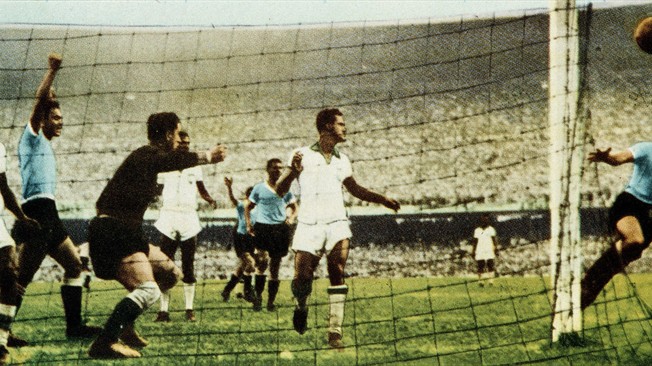
Powerhouses Brazil along with Spain, Sweden and inaugural champions of the 1930 World Cup Uruguay progressed to the final four. Brazil were the favorites to take home the cup, and the feeling was amplified after they thumped Sweden 7-1 and Spain 6-1. They went into their final game needing just a draw to win the World Cup on home soil. On July 16 at the iconic 'Estadio do Maracana' in front of a massive capacity crowd of an estimated 205,000, they faced Uruguay in the final match of the tournament. The hosts even took the lead 2 minutes into the second half and it looked like going to plan and the home crowd were ready for a grand celebration. Then came the equalizer and more was to follow as with 11 minutes left Alcides Ghiggia scored a second for the Uruguayans which turned out to be the game winner. Unbridled joy turned to despair for the Brazilian players and the fans as things went pear shaped after starting so well. This match when the mighty ‘Selecao’ were upset came to be known as the ‘Maracanazo’ (in Portuguese, roughly translates to ‘the Maracana Blow’). The word since is a slang for when an underdog team upsets the Brazilian national team or when a small club upsets one of the ‘Big Four’ of  Vasco da Gama, Flamengo, Fluminense and Botafogo.

Football had been brought back on the world stage and sport was instrumental in reviving nations and international ties post the casualties of war. The first World Cup after the war, the ‘Campeonato Mundial de Futebol’, was a sporting success, but it was a World Cup that almost wasn't.

Thursday, March 21, 2013

Brazil vs Italy: A meeting of old foes

It is international break time again. And it's a period that often causes much agitation to many a football manager. Players get time out to either put their feet up, do punditry, jet off AWOL and issue 'come and get me' pleas. Some players do however get the chance to represent their countries in friendlies and qualifiers.

Brazil continue their World Tour with a friendly against Italy tonight in Geneva. Brazil being the hosts of next year's FIFA World Cup have to resort to such games to give their players much playing time as they are exempted from playing their regional qualifiers. The Italians meanwhile play only one qualifier as compared to the other teams.
The 2 countries are the most successful nations at the World Cup with a combined 9 trophies between them. Brazil won their 5th crown in 2002 at Korea/Japan while Italy last lifted the trophy in the subsequent edition in 2006 in Germany.

Since then, Spain have come to be the dominant team in world football and few teams have managed to knock them off the perch. With a World Cup and 2 European championships, the Spaniards' dominance has been total. Other teams from the continent such as Germany and Netherlands have also seen a revival. Brazil and South American football have been pushed to the fringes a bit and on the world stage their flair has been countered by the clinical efficiency of the continental game. Uruguay, South America's sole representative in the semis of the 2010 World Cup in South Africa and their success to a good degree can be attributed to the fact that they now play a European type of game.

The current Brazilian crop is one that is looking for an identity. As always, there is never shortage of prodigious talent from the Selecao. The star of the lot is Neymar, the preening 21 year old striker from Sao Paulo. The man billed as the 'most marketable sports star in the world' has been the subject of much transfer talk for a few years now as he's linked to a move to Barcelona or Real Madrid. Giving him company are a host of other youngsters such as Oscar from Chelsea, Lucas Moura from PSG and also Danilo, David Luiz and Leandro Damiao. Thiago Silva and Hulk, both only 26, are the veteran faces in the team but Silva is missing from the game due to an injury. Dante and David Luiz, are likely to don the defensive responsibilities for Brazil in his absence. Luiz Felipe Scolari was brought in at the end of last year for his 2nd stint as Manger of the Selecao as the Federation lost faith in Mano Menezes. In their last outing which was Scolari's first game in charge, they were beaten 2-1 by England at Wembley quite comfortably on a night when only Neymar and Oscar showed some signs of fight. They are on a rebuilding phase and every match provides a window for Scolari to test players in order to come up with the best possible squad going into the World Cup at home. Ronaldinho was recalled for the England game but his poor showing sees him axed and Kaka has been given a call-up.

Italy finished Runner-Up only to Spain in last year's European Championships. Cesare Prandelli's Italy are a well established team with a set squad. They do play more attacking football unlike teams of the past. However, they are still a very solid unit defensively marshaled by the excellent trio of Giorgio Chiellini, Leonardo Bonucci and Andrea Barzagli. The evergreen Andrea Pirlo leads the midfield pack ably assisted by Claudio Marchisio and Daniele de Rossi. This is one area of the pitch where the advantage is clearly with the Italians. Mario Balotelli has been on a roll for AC Milan in Serie A since sealing a move to the Rossoneri from Manchester City in the January transfer window. He has scored 8 goals in 7 games and was a key player in Italy's run to the finals, especially in the semis where his power packed performance put paid to Germany's hopes. Italy are top of their qualifying group, a healthy 4 point lead.

The two teams last met in the Confederations Cup in 2009 with Brazil winning on the night 3-0. Brazil had defeated Italy on penalties in the finals of the 1994 World Cup when led by Dunga they lifted their 4th title.
Italy will travel to Brazil again later in the year for the latest edition of the same tournament.

Likely XI's
Brazil: Julio Cesar,  Dani Alves, Dante, David Luiz, Filipe Luis, Fernando, Hernanes, Hulk, Oscar, Neymar, Fred


Italy: Buffon; Maggio, Bonucci, Barzagli, De Sciglio; De Rossi, Pirlo, Marchisio; Giaccherini; Osvaldo, Balotelli.