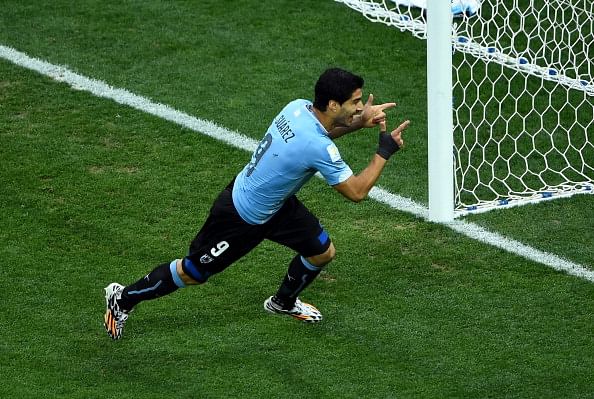
Luis Suarez in celebration after he scored the winner for Uruguay against England
For yet another FIFA World Cup, England’s campaign came crashing down rather prematurely, much earlier than it probably ever has in history, after Costa Rica’s impressive win over Italy yesterday. While that result might have officially consigned the English to an early flight back home, in all fairness it was over two nights ago, when their campaign was shot down by the man they call El Pistolero.
Luis Suarez, forced to watch his team’s painful opening round defeat to the Costa Ricans from the bench, was back in the mix of things, starting for Uruguay in this massive game against England. From his reactions following Uruguay’s unravelling against Costa Rica, you could make out that he wanted in. He wanted to be a part of the action, wanted to be able to help out his side in the middle, instead of being a passive onlooker from the sidelines.
For the game against England, Uruguay coach Oscar Tabarez was always going to pick Suarez. If he ever had the slightest doubts about whether to include his star man in the team to face the English earlier, those doubts were certainly dispelled after the opening game shock. Uruguay had to respond and they needed their talismanic striker for without him they had looked very pedestrian in their loss to the Costa Ricans.
England manager Roy Hodgson stated after the game that he felt that his team controlled Suarez reasonably well. He could not have been more delusional.Suarez was just one man, but his heralded a return of confidence for a squad of 23 and an entire South American nation. Many English ‘pundits’ and analysts said one man’s return would cause no significant upswing in Uruguay’s fortunes. But they were forgetting, that the “one man” in question was Suarez.
Sure, Suarez did not put in a performance that ripped the spine out of England’s footballers. He did not run roughshod over Hodgson’s team. He did not single-handedly will his Uruguayan team to victory. He did not make England’s defenders tremble at the knees with his pace and movement and trickery. But what he did do is have THE most telling contribution in a match that was decided on fine margins. And that is what you ultimately expect from a star player, reportedly still a week away from being back to 100% after his knee surgery.
Bang… bang…
Two clear goal scoring opportunities… two goals…
Three points for Uruguay and England’s chances of progress up in smoke.
It was Suarez’s talent that left its stamp on the game. He was, by a long shot, the single, most talented player on the pitch out of all the players who stepped onto the field that night in Sao Paulo. Suarez is right up there with Cristiano Ronaldo and Lionel Messi amongst the best attackers in the world. And for Uruguay, just as for Liverpool, he has become a key cog, one without which their effectiveness takes quite a beating. He was the top scorer in the CONMEBOL qualifying section, his 11 goals a large part of why Uruguay made it to Brazil 2014 in the first place.
And the emotion of the moment flooded through for Suarez as he realized that he had made it back and made it good for his team, the ultimate service rendered and all the faith in him repaid.
The effect that his presence had on his teammates was there for everyone to see too. Along with the much needed personnel change that Tabarez commissioned, Uruguay played with renewed energy, and above all, belief, that if they kept their end of the bargain in their respective roles, their star striker would provide the finishing touches that would lead them to a much needed bounce-back victory.
Uruguay did not do a drastic Jekyll to Hyde transformation with Suarez’s return, but they did play more solidly and strove to eliminate some of the mistakes they made in their opener. Overall, there was a collective spirit that seemed to be coursing through the team inspired by their lead striker’s return to the fold and a desperation brought about by their earlier unexpected loss. Alvaro Pereira, though foolish to ignore his doctor’s advice and get back to playing after a concussion, exemplified that with a burning desire to be there for his team.
England knew what they were going to deal with; many in their team have been sparring with Suarez for more than three seasons now in the English Premier League to not know. Suarez was definitely going to have an impact on this game in some way, and there was nothing they could do about it. Well, apart from affording him even more help with defensive lapses that once again helped them shoot themselves in the foot.
When you prepare to go head to head with one of the best players in the world, albeit even if not at full tilt, you simply cannot afford the kind of glaring defensive errors we saw from England to creep into your game.
A lack of pace and anticipation in England’s backline was exposed in both goals they conceded. From their failure to put Edinson Cavani under more pressure even when they had the three on two numbers advantage for the first, to Gary Cahill simply failing to anticipate the trajectory and path the ball would take after it flicked off Steven Gerrard’s head for the second, the Three Lions displayed a lack of basic defensive nous when faced up against one of the premier attackers in world football. And it cost them dear.
What was also glaring was the absence of that one true superstar on their side who could have such a telling impact on the game. And no, Wayne Rooney no longer fits in that category. These are questions for England to probe as they will now look forward to qualification for Euro 2016.
Suarez and his Uruguayan teammates are overjoyed after beating England as they hoist the striker on their shoulders in celebration
As for unfinished business in Group D, Uruguay still look a side well off the pace from the team that marched to finish fourth at the last edition in South Africa. There is more bite to them going forward with Suarez in the team, but they will need another strong-willed and solid performance in their do or die final round clash against the more seasoned Italians in Natal.
But in Luis Suarez, they have a player who they can fully bank on for providing them with a decisive advantage when the situation calls for it. They have in their ranks a top, top player who is amongst the best in the game at the moment. And in situations like this, in the biggest games, on the biggest of stages, Suarez’s presence provides Uruguay with the much needed reassurance and that most important of four letter words – HOPE – of progressing deeper at these 2014 World Cup finals.
Uruguay move to the shootout in Natal with their sharpshooter’s barrels still smoking from his twin strikes that sunk England.
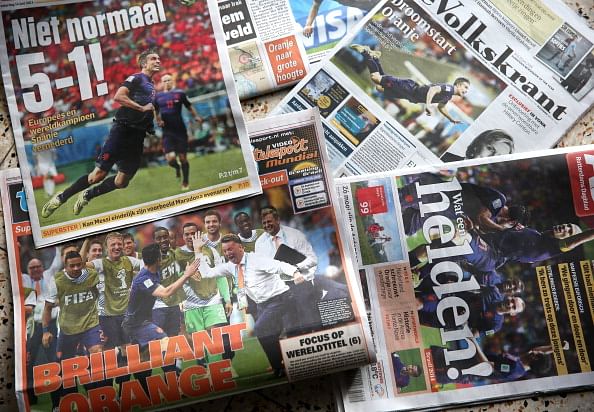
A few newspaper headlines after Spain’s heavy loss to the Dutch in their opening game
The word out on the streets (not just those in Brazil) is that World Cup 2014 is turning out to be the best ever in the history of the event. We’re just six days in and there have already been so many memorable moments that it has outshone some of its predecessors. There has been the notable emphasis on attack by almost all teams, with caution being thrown to the wind and teams not settling for comfortable draws early on, England not lumping long balls forward for a change...
That in turn has led to a glut of goals, the key fuel that keeps interest levels going at such a massive event, especially when fans have to stay up long into the night in most parts of the world. But, over and above those, there have been the upsets, the results that send audiences into a frenzy and those that initiate arguments and counter-arguments that run for days after the actual result. And unfortunately for Spain and Uruguay, they have been the victims of those upsets at Brazil 2014.
How did this happen? Both of the results were inconceivable before the tournament began. However, a closer look suggests that perhaps we shouldn’t be so surprised at what transpired in Salvador and Fortaleza last week. Perhaps Spain’s drubbing at the hands of the Dutch and Uruguay’s insipid display against a spirited Costa Rica side was in the works even before they stepped onto the pitch?
Spain and Uruguay were two of the final four at the last edition in South Africa in 2010; Spain the victors while Uruguay finished a very impressive fourth. But both these teams seem to have overlooked a key aspect in their preparations for this World Cup, something that the other two from the final four in South Africa (Netherlands and Germany) seem to have taken note of and duly addressed.
Both of these teams have carried with them excess baggage from the previous World Cup and it is hurting them. Spain
World and European champions Spain were spoilt for choice in terms of talent, not just in picking a 23-man squad, but also a provisional 30-man squad for that matter. The squad has some visible new faces, but the team that took to the field against the Netherlands resembled much the same to the one from four years ago.
There were four notable changes from the team that started the final at the previous edition – Diego Costa was employed as the lone striker up front in place of David Villa, Jordi Alba took up the left-back role, previously donned by the ultra-solid Joan Capdevila, David Silva came into the starting line-up in place of Pedro Rodriguez and Sergio Ramos moved to centre-back, from his erstwhile right-back position, taking over from Carles Puyol.
The old adage is to not fix something that isn’t broke, but while the Spanish squad and system wasn’t exactly broken, there were some tweaks that were necessary. One important thing to always look at is the stage at which a particular player’s career lifecycle lies.
Xavi and Xabi Alonso together in midfield was problem number one for Spain. While Xavi’s short-passing keeps things ticking over and Alonso’s ranging aerials open the game up when it becomes congested in midfield, the duo together are slow and as such, liable to be neutralized by a midfield high on energy and industry. Xavi is into the twilight years of a very successful career and Alonso too cannot hold a midfield on his own.
Diego Costa, after his fantastic season and allegiance switch to Spain, was going to be the first-choice striker. Plus, he offered something different from their previous two forward line leaders in good heading ability along with a knack for hassling opposing defenders.
However, Costa hasn’t exactly had the best of time in the last one-and-a-half months or so prior to the tournament, with the injury he suffered and the resultant rustiness. He looked very off the pace against the Dutch despite winning the penalty for Spain’s goal. But playing him was the right thing to do; what wasn’t was picking able alternatives.
Villa showed this season that he still has plenty of game left in him, but he is the kind of striker known more for his runs behind the defence and predatory instincts. Torres, a favourite of Coach Vicente Del Bosque, expectedly made the plane to Brazil, but in terms of his career graph, he is a player who has fallen way off the charts; his glaring miss during the game, further evidence of this.
Fernando Llorente, picked for South Africa, was overlooked this time, largely due to his marginalized role at Juventus. But he should have ideally made the trip for he offers something different to Torres and Villa.
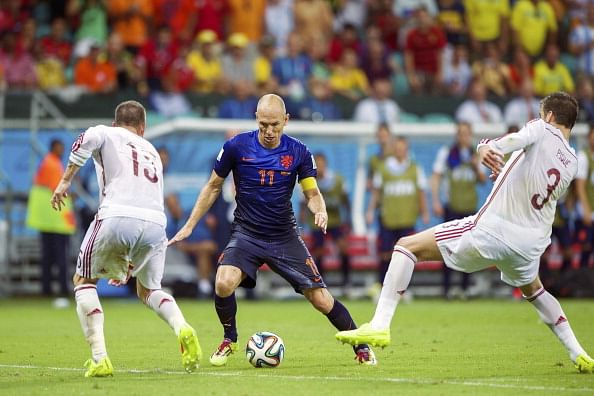
Arjen Robben (centre) of the Netherlands attacking with the ball, watched by Spain defenders Sergio Ramos (left) and Gerard Pique
In defence, the combination of Sergio Ramos and Gerard Pique at the back was run ragged by the Dutch offense. Pique is a defender who gets more credit than necessary; while he may be good in the air and at set pieces, he struggles mightily against pacy forwards for he can’t keep up with them in foot-speed. He has the turning radius of a truck which allows attackers to twist him one way and then the other, eventually putting him off balance and leaving him out of position. And him going up against one of the world’s premier attackers in Arjen Robben was always going to yield only one result – disaster.
Watching Robben go at him was like watching a hot knife cut through butter, like a nightmarish re-run for Spanish fans of when Bayern Munich dismantled Barcelona, when Robben had put Pique to the sword as in Salvador. Having seen how this particular matchup played out in the past, it was surprising that Del Bosque didn’t opt for more cover, perhaps with the use of Javi Martinez.
Ramos to his credit was often found making some last ditch interceptions, without which, the score-line could have been worse for the champs. But Ramos too in the past couple of seasons has been undone when the opponents have attacked him with high pace and a bullish centre forward. Jürgen Klopp’s Borussia Dortmund, twice in two seasons, took Ramos’ Real Madrid defence to the cleaners. But the difference lay in that Ramos had Pepe, a mobile central defensive partner, to help him out at Real, which isn’t the case at national level.
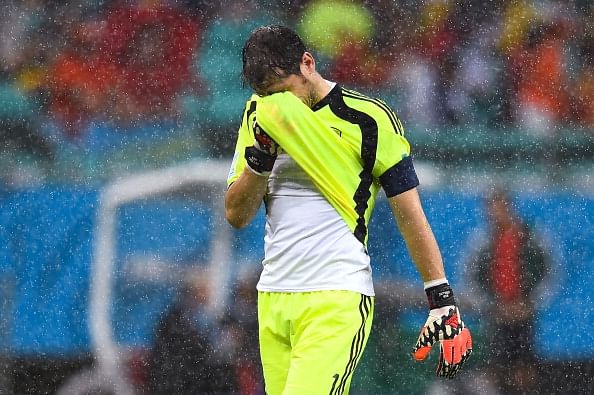
The decline has continued with captain and keeper Iker Casillas as well, one noticed by Jose Mourinho, enough to convince him to drop Casillas. For all the ire that he earned at the hands of the Spanish press for that, he must feel vindicated now.
Spain keeper Iker Casillas after his calamitous error led to Robin van Persie’s second goal
To go with that, Spain’s phenomenal run in world football also coincided with a successful period for Barcelona domestically and in Europe, a team whose players have come to form the core of the Spanish side. But since their second Euro success, the Catalan giants have found their dominance challenged and a system to combat their effective “tiki-taka” has been unearthed by more than one manager.
And that system has been beaten with the use of a directness in attack coupled with pace and shackling of the midfield engine room, where Xavi, Iniesta and Sergio Busquets operate; the very same elements that Louis Van Gaal employed with his Dutch side. Spain’s midfield quartet are no longer the all-conquering force that they used to be and with the defeats they’ve suffered in the last few years, so has their confidence. Uruguay
Shifting the spotlight to South America and a very similar situation prevails with Uruguay. The squad almost resembles a carbon copy of the one that travelled to South Africa four years ago with a few exceptions. Oscar Tabarez and the Uruguayans have again erred along the same lines, much like Spain have. Diego Forlan is no longer the force he once was; going into the 2010 edition, Forlan was at the peak of his powers, amongst the top forwards in the game, plundering and setting up goals for Atletico Madrid. And he led the line beautifully for the South Americans, proving to be a key cog in their fourth place finish.
He is now 35 years old, and while age doesn’t necessarily always diminish a player’s capabilities, as exemplified by the peerless Andrea Pirlo, in Forlan’s case it has. He now plays for Cerezo Osaka and is nowhere near the levels he was at previously.
Luis Suarez watched on from the bench as Uruguay lost their opener 1-3 to Costa Rica in Fortaleza
Edinson Cavani found himself isolated and frustrated with a lack of service from his midfield and the second striker in Forlan. The midfield that started the game, as Tabarez played a 4-4-2, comprised of Arevalo Rios, Walter Gargano, Cristian Rodriguez and Christian Stuani, and they were utterly listless, offering hardly any incisiveness in attack.
And with forwards who struggled to create openings by themselves, the absence of Luis Suarez was all the more debilitating. In their previous campaign, despite the three-pronged attack up front it was the solidity of their midfield and defence that propelled a good portion of their success, as Cavani and Suarez at the time had still not peaked.
Their midfield was held together by the veteran Diego Perez while Alvaro Pereira provided some much needed thrust with his runs from midfield. And in defence, the two Diegos – Godin and Lugano – were watertight. Lugano, another one who is now 35, is no longer the rock in defence he once was and while Godin is right up there among the top three central defenders in the world, his captain and partner in that area makes far too many mistakes these days.
These problems just didn’t explode in their faces in the first match against Costa Rica. They plagued the team right through its qualification campaign, one of the reasons why they struggled before eventually finishing fifth and making it through the playoffs. Uruguay relied heavily on Suarez’s proficiency in front of goal and the striker’s 11 goals (he was top-scorer in the CONMEBOL qualifiers) got his team into fifth place.
Another key stat was that while Uruguay scored 25 goals, they conceded an equal number, making for a goal difference of zero; the lowest among all qualifiers from South America.
Oscar Tabarez has some tough decisions to make
No one knows why Tabarez didn’t employ either of Alvaro Pereira or Gaston Ramirez in the opener against Costa Rica. Was he resting his key players ahead of the clashes against England and Italy? If that was the case, was Tabarez underestimating the Costa Ricans? The most damning stat from that game was that a defender had the most number of passes (67); that happened to be their left-back Martin Caceres, who to his credit, was the most hardworking player on the day for the South American giants and did his best to spark his team’s attack. Maxi Pereira had the second-highest (65) indicating Uruguay’s reliance on their full-backs when in possession. There are still two games to go – Chile and England loom
While things didn’t exactly go right for these two teams, there is still time for them to set it right. Spain take on Chile in their second game later tonight, in what is a must-win encounter, with Chile having won their opener. It is a rematch from the last World Cup where the two teams met in the group stage with Spain coming out 2-1 winners. The defending champions have the personnel necessary to give their team a different look.
Del Bosque might consider switching to his forward-less line-up that worked so well at the Euros, employing Cesc Fabregas as the advanced man. Also Juanfran for Azpilicueta at right-back may be a move worth considering for the Atletico Madrid man is sounder defensively and is a smart operator in being able to bomb forward in support of his teammates. Also, the younger Koke to partner Xabi Alonso in midfield while withdrawing Xavi, is a move that could be on the cards as Del Bosque has not shied away from making changes in the past.
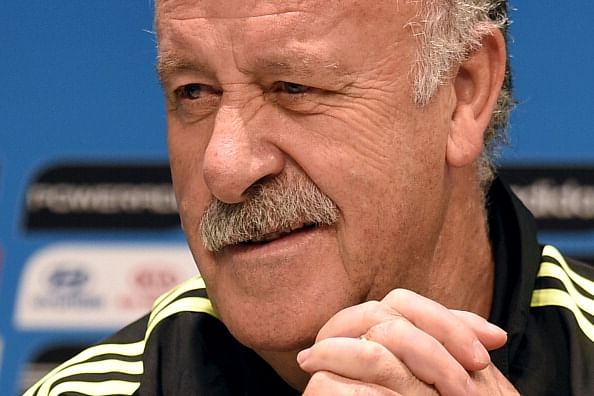
Spain coach Vicente Del Bosque has not been afraid to change things up in the past
For Uruguay, Suarez in all likelihood will take to the field against England tomorrow night and that should give his compatriots a huge shot in the arm along with some much needed motivation. Elsewhere, Tabarez has to consider making a change in his midfield too. Either of Stuani or Rodriguez will make way for Suarez, but the coach might as well replace the remaining one also with someone like Ramirez or Alvaro Pereira.
It has been one loss only for both these teams; just three points surrendered. Both have two matches remaining to right their ship in time before the opportunity to get to the knockout rounds slips away from their grasp. They have made similar mistakes to past champions in France (2002) and Italy (2010) in failing to refresh their squads and believing that continuity will ensure success.
However, they must not continue with that beaten path but rather make smart adjustments because otherwise they will suffer the same fate as France and Italy and be heading home by the time the Round of 16 comes along. They will both face opponents playing a brand of football suited to exploiting their weaknesses, but with the right adjustments, they can overcome the challenge.
All of the footballing world’s eyes will be on them to see if they can do just that and pick themselves up from the early punches that they have taken at Brazil 2014. Two nations in particular will watch on with expectant eyes.
In the second part of a look at the players to whom the tournament
will be an important one, we examine the teams from Group B of the
Confederations Cup.
SPAIN
Iker Casillas, Real Madrid (Goalkeeper)
After being hung out to dry by Jose Mourinho for the
majority of the season at Real Madrid, Casillas will be hungry to get back
between the posts. We should perhaps not fault him for being a little rusty in
the initial games from the elongated period of time spent warming the benches.
Captaining the national team to yet another success could well prove to be the
shot in the arm that provides Casillas a boost to his confidence.
Gerard Pique, Barcelona (Centre-back)
It has been a season of torment for the Barcelona stopper.
After reports emerged from Spain that the club had placed Pique under
surveillance for his rather ‘generous’ spending ways and his relationship with
music star Shakira, his game on the field too has been well short over the last
few months. Pique is very good in the air and with the ball at his feet, but he
has been exposed time and time again by pacy, athletic forwards. He will need a
big tournament in Brazil to restore some of his reputation; if it goes south he
could find himself vacating that starting spot to someone else.
Fernando Torres, Chelsea/Roberto Soldado, Valencia/David
Villa, Spain (Forwards)
This is the one area, where coach Vicente del Bosque and
Spain are yet to arrive at a conclusion. Villa, Spain’s leading goal scorer of
all time was the undoubted top dog in the team before his injury happened and
the Barcelona striker has not been in the same lethal form since. ‘El Guaje’
has also been surrounded by talk of a move to the Premier League which could
materialize now that Barca have also added Neymar to their ranks. The move
could be good as it would get him more playing time with the World Cup around
the corner.
Torres has had a revival under Rafa Benitez and though not
quite striking fear into opponents as he used to, managed to put in a good
account of himself with a return of 22 goals for the season, double that of
last year. He also had an excellent Euro 2012 chipping in with 3 goals and 1
assist in Spain’s defence of their continental crown.
Soldado meanwhile continues to do what he does best – score
goals, lots and lots of goals. He finished with 30 goals from 46 appearances
for Valencia, a better return than either of the two above. Just for the
record, his last goal scoring record for the last 5 seasons goes like this – 13,
20, 25, 27, 30! How is this guy not starting for ‘La Furia Roja’ you wonder? A
technically proficient striker more than capable of the spectacular, this
tournament could prove to be Soldado’s big break.
A fully fit Villa still remains Del Bosque’s first choice
and at times he has even played a striker-less starting XI preferring to keep
Torres and Soldado on the bench. It will be interesting to see how Del Bosque
goes about sorting out this position ahead of the World Cup.
URUGUAY
Luis Suarez, Liverpool (Forward)
It’s been a while since we’ve seen Liverpool’s talented
striker Luis Suarez on the pitch. All of the blame for that does lie at the
Uruguayan’s unsavoury attempt at sinking his teeth into Branislav Ivanovic of
Chelsea. Since then, Liverpool have again finished behind Everton and out of
European competition, Suarez has made all sorts of noises back home about a
move away from Anfield with Real Madrid seemingly on his mind.
But, come Sunday night, all of that will go to the back
burner and the only thing that will matter is how he turns up for his national
side through the tournament. If he showcases any of the form that kept him atop
the goal-scorers’ standings until his ban, we will be in for quite a treat.
Suarez already has 8 goals for his country in the 10 qualifiers that he’s
played in. Edinson Cavani, in comparison, has played all 12 qualifiers yet
scored only 3 times.
Diego Godin, Atletico Madrid (Centre-back)
While Radamel Falcao grabbed all the headlines with his goal
scoring exploits, as strikers generally do, Diego Godin was the bedrock of
Atletico’s stingy defence that propelled them to a 3rd place finish
in La Liga. Under Diego Simeone, Atletico have added some defensive ruggedness
to their team which has been as important to their fortunes as the potency of
Falcao up top.
Godin was one of the players of the season for Atleti
alongside Falcao and amongst the top defenders in the league. He made 35
appearances (all start) and was the most used player behind keeper Thibaut Courtois.
Marshalled by Godin, Atletico had the meanest defence in La Liga conceding just
31 goals, under a goal a game – a fantastic effort. Also, Atletico as a team
have been very good at defending set pieces and at aerial duels, which comes as
no surprise.
The Saints dished out £12 million to acquire the services of
Ramirez, one of the most promising young talents around. In his first season in
England he built up a nice combination with Ricky Lambert and Adam Lallana which
saw Southampton play some attractive attacking football.
He is very good with his dribble and likes to play those
short passes amongst his teammates to open up space. It is early days yet at
the national level for Ramirez, he’s made 7 appearances in the qualifying
campaign, but with his talent and ability one reckons he will become a regular
feature in the sky blue shirt of Uruguay in the coming years.
NIGERIA
Vincent Enyeama, LOSC Lille (Goalkeeper)
A veteran of the national side, Enyeama has been playing for
the Super Eagles since 2002. Inspite of signing for Lille in 2011, he spent
last season on loan in Israel with Maccabi Tel Aviv. He captained Nigeria to
the 2013 African Cup of Nations title. Enyeama is rated amongst the best shot
stoppers in football.
Ahmed Musa, CSKA Moscow (Forward)
20-year old Musa currently plays for CSKA in the Russian
league. He often plays as a winger or a second striker and is a hot prospect
amongst the emerging group of African footballers. He found the net 15 times
for his club side last season and has 5 at the international level so far.
Efe Ambrose, Celtic (Centre-back)
We saw a lot of Ambrose in the UEFA Champions League this
season as Celtic progressed to the last 16. He had a nightmare game in the 1st
leg at home against Juventus which his side ended up losing 3-0 effectively
sealing the tie. However, one has to consider that Ambrose had just got off the
flight a mere 24 hours before that game after winning the African Cup of
Nations with Nigeria.
In the 2 games against Barcelona in the group stages, he was
impressive in the rear guard action that Celtic put up. That performance earned
him a place in the UEFA Champions League Team of the Week. He was also named in
the African Cup of Nations Team of the Tournament.
TAHITI
In all honesty, I don’t think I can pick the three players
to watch out for!
Only 1 of the 23 man squad is not from the Tahitian Division
Federale. Tahiti won an international tournament for the first time when they
lifted the OFC Nations Cup in 2012, thereby booking their tickets for this year’s
Confederations Cup.
They will be led by defender Nicolas Vallar. Keeper Xavier
Samin and defenders Teheivarii Ludivion and Vincent Simon are amongst the most
experienced members of the travelling group.
Brazil will host the 2014 FIFA world cup next year in what
promises to be a carnival of football. While
the national team prepares for the competition with a series of friendly games,
the latest of which sees them take on Russia at Stamford Bridge tonight.
This will be the second time that the country will stage
football’s premier competition. In 1950,
the third edition of the tournament was held in Brazil. Uruguay upstaged the Selecao to lift the
trophy, their second overall. However, it
was a tournament that almost never happened.
World war two had ensured the cessation of sporting activity
around the globe. After Italy had
triumphed in 1938 the war had put paid to the 1942 cup originally scheduled to
be held in Brazil. 1946 also did not see
the light of day as Europe continued to be embroiled in war. So after a gap of 12 years, the competition resumed
when FIFA awarded the rights to Brazil.
Most of Europe was still recovering from the effects of the war and was
in no position to conduct a tournament of that scale.
This edition saw many firsts; it was the first world cup to
be called the Jules Rimet trophy some to mark the 25th anniversary
of Rimet’s presidency. It was also the
first time that a round robin format was used.
The 16 teams were divided into four groups and the winner from each group
made it into the final four where they competed against each other in another
round robin scrap.
2-time defending champions Italy, winners in 1934 and 1938,
had lost a lot of their players in an air disaster during the war. FIFA
however, were very interested in persuading the Italians to come as a top draw
attraction. The Italian federation, though initially hesitant, finally agreed
to send its players by boat rather than air due to financial constraints. Along
with Brazil as hosts, the 2 teams received automatic qualification. Germany and
Japan were barred from competing in the qualifying program as they remained
under occupation post the war. Germany had also undergone partition and the
football federations of the newly formed nations had not been formed.
TOURNAMENT OF WITHDRAWALS
A lot of teams refused to participate particularly the
countries behind the then Iron Hand group, such as the erstwhile USSR, 1934
finalists Hungary and 1938 finalists Czechoslovakia. In South America,
Argentina, Ecuador and Peru withdrew after the qualifying round of games. In
Argentina’s case, it was down to a dispute with the Brazilian football
federation (CBF). Due to this, the remaining South American teams automatically
qualified and hence Chile, Uruguay, Paraguay and Bolivia all made it through.
Philippines, Burma and Indonesia withdrew from the Asian
region and that meant India qualified by default. Austria and Belgium also
pulled their teams out citing inexperience and unpreparedness as reasons. This
opened the door for Switzerland and Turkey to qualify without even playing
their last round of matches.
England finished top of the British qualification group
while Scotland finished behind them. The Scots however did not make the trip to
Brazil in controversial circumstances owing to a commitment made by their
Federation Chairman George Graham. Graham before the start of the qualification
process had insisted that Scotland would take part in the World Cup only if
they finished as winners of their home qualifying set up. After the Scots
finished second, England captain Billy Wright spoke to his Scottish counterpart
George Young to try and convince Graham to change his mind, but he refused to
wilt and his decision saw the Scots being denied an opportunity to compete.
Turkey, who had got a free ride into the Cup pulled out on
account of financial reasons and the cost of travelling to South America. To
cover for the slots left vacant by the withdrawal of Turkey and Scotland, FIFA
invited France and Portugal to take part. Portugal declined, but the French
accepted and were included in the draw for the 1950 World Cup.
After the draw was completed and the four pools identified,
the Indian Football association, the AIFF, decided against sending its team to
the World Cup citing travel expenses, lack of preparation and team selection
issues, though FIFA had agreed to bear a major part of the travel expenses.
India had played barefoot in the 1948 Olympics leading to FIFA subsequently
banning barefoot play. The then Indian captain Shailen Manna though claimed
that the reasons offered by the AIFF were a screen meant to cover up the real
reasons behind the association’s backing out.
France also pulled out due to the amount of travel that they
would have to undertake during their group matches bearing in mind the
financial and logistical difficulties involved. And since their withdrawal came
late, there wasn't enough time to call in replacements. Hence, the tournament
began with just 13 teams instead of the intended 16.
HOW IT PROGRESSED
The first round saw the teams split into 4 pools of 4 teams
each. The number was ultimately reduced to 13 due to the various pull-outs. The
increased number of games under the new format was meant to generate more
revenue in an attempt to recover significant investments made on stadiums and
facilities by the Brazilian authorities. England came into the competition as
one of the favorites but were dumped out early as they were shocked 1-0 by the
USA and also lost to Spain by an identical score line. Defending champions
Italy, suffered their first ever World Cup loss when they were beaten by Sweden
3-2. As a result, they too failed to progress into the final knock-out.
Powerhouses Brazil along with Spain, Sweden and inaugural
champions of the 1930 World Cup Uruguay progressed to the final four. Brazil
were the favorites to take home the cup, and the feeling was amplified after
they thumped Sweden 7-1 and Spain 6-1. They went into their final game needing
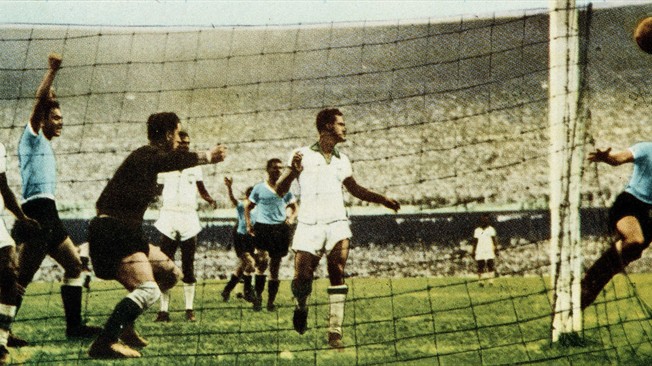
just a draw to win the World Cup on home soil. On July 16 at the iconic 'Estadio do
Maracana' in front of a massive capacity crowd of an estimated 205,000, they
faced Uruguay in the final match of the tournament. The hosts even took the
lead 2 minutes into the second half and it looked like going to plan and the
home crowd were ready for a grand celebration. Then came the equalizer and more
was to follow as with 11 minutes left Alcides Ghiggia scored a second for the
Uruguayans which turned out to be the game winner. Unbridled joy turned to
despair for the Brazilian players and the fans as things went pear shaped after
starting so well. This match when the mighty ‘Selecao’ were upset came to be known
as the ‘Maracanazo’ (in Portuguese, roughly translates to ‘the Maracana Blow’).
The word since is a slang for when an underdog team upsets the Brazilian
national team or when a small club upsets one of the ‘Big Four’ of Vasco da Gama, Flamengo, Fluminense and
Botafogo.
Football had been brought back on the world stage and sport
was instrumental in reviving nations and international ties post the casualties
of war. The first World Cup after the war, the ‘Campeonato Mundial de Futebol’,
was a sporting success, but it was a World Cup that almost wasn't.
Messi and Higuain turn on the style for Argentina, Colombia crush Bolivia
Lionel Messi scored a penalty and set up 2 assists for Real Madrid striker Gonzalo Higuain as Argentina brushed aside Venezuela 3-0 at home. Argentina move to 23 points from their 10 games and are top of the qualifying group, 4 points ahead of Colombia. The match was largely a one-sided affair with Argentina's goalkeeper Sergio Romero hardly called into action.
Five different players found the back of the net as Colombia routed Bolivia 5-0. Midfielder Macnelly Torres put the hosts ahead midway through the first half. Defender Carlos Valdez, strikers Teofilo Gutierrez and Radamel Falcao, and substitute full back Pablo Armero completed the rout. Falcao's goal was his 6th of the campaign. The win takes Colombia to 19 points and they look to be Argentina's main competition in the race for the top spot.
Uruguay were thwarted by a late equalizer for Paraguay from substitute Edgar Benitez. Uruguay have struggled during the qualification campaign since their fine run in the last World Cup. Luis Suarez had just put his side ahead 4 minutes before the equalizer in what appeared to be a game winner at the time. However, Uruguay captain Diego Lugano's mistake proved costly as Benitez stole in and grabbed the equalizer beating Fernando Muslera in goal. Uruguay have 13 points from 10 games while Paraguay are still bottom of the 8 nation group with 8 points.
CONMEBOL Results Peru 1-0 Chile Argentina 3-0 Venezuela Uruguay 1-1 Paraguay Colombia 5-0 Bolivia
Honduras peg back Mexico, USA edge Costa Rica in snowy conditions
Honduras fought back from a 2-0 deficit to force a draw against Mexico to take them to the top of the CONCACAF standings with 4 points from two games. Mexico have 2 points from their two games ahead of the clash with USA in Mexico City on Tuesday night. Manchester United striker Javier Hernandez scored twice to put the Mexicans on top. But, Carlo Costly inspired the Hondurans' fightback with a brace of his own.
Clint Dempsey's effort for the solitary goal of the night saw the USA beat Costa Rica 1-0 in a match played in the midst of a heavy snow storm at the foothills of the Rocky Mountains. USA now have 3 points from 2 games and are second behind Honduras.
CONCACAF Results Honduras 2-2 Mexico USA 1-0 Costa Rica