Right through Atletico Madrid’s title-winning season last year in the Spanish La Liga, Diego Costa was front and centre as far as their attacking ambitions went. He scored 36 goals in all competitions including 8 in Europe as Los Colchoneros also made their way to the showpiece final of the UEFA Champions League against Real Madrid in Lisbon.
Even before the Spanish season could end, there were murmurings that Chelsea were reportedly lining up a bid for Costa in an attempt to get over their weakness in the striking department (read Fernando Torres and Demba Ba). And he did eventually make his way across the English Channel from Atletico after the Blues met his £32 million release clause.
Considered by many to be the missing piece of Chelsea’s jigsaw in their quest for glory, Costa has been a revelation so far having racked up 10 goals already, all of them in the Premier League. He seems to be a perfect fit for Jose Mourinho and his team in every way and he has the fans plush with excitement at the possibilities this current season holds for them.
So much so that he is already being compared to another striker who plied his trade at Stamford Bridge for many, many years, one of a similar mould, a club legend who guided Chelsea to possibly their greatest night ever two years ago in the summer of 2012.
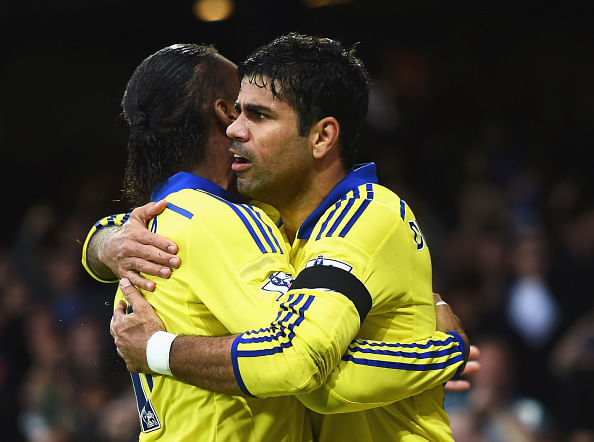
Didier Drogba spent 9 seasons at Chelsea before signing off on an absolute high as a Champions League winner after that magical night in Munich. In that time he established himself as one of the top true centre-forwards of the decade and made it a habit of manhandling opposition defences. He’s back this year for a second stint, revelling in almost a god-like status amongst the Chelsea faithful who never get tired of chanting his name when he’s on the pitch.
Drogba probably sees a lot of himself in Costa and with good reason. Their styles of play are very identical, both tough, physical players very good in the air and at muscling defenders around. They make sure that the opposition’s centre-backs have their hands full whenever they’re around. Their ability to keep possession under pressure with their backs to goal is another trait that the two share.
So far this season, barring the game at Goodison Park, when Costa’s been on the pitch, Drogba hasn’t and vice-versa. And that looks to be the definitive pattern as far as Chelsea are concerned despite some sections of fans wanting to see the two marauders play in tandem more. The truth is, it just wouldn’t help Chelsea any better if they did, not under Mourinho. Trademarks of Mourinho teams
Over the years, from Benfica and FC Porto to Chelsea to Inter Milan to Real Madrid and back to Chelsea again, Mourinho’s teams have borne some common trademarks. Almost all of his teams have players who are strong, powerful, organised and disciplined. Amongst other things, all of these teams also had a strong, powerful centre-forward in the mould of Costa and Drogba in their ranks.
The other is defence. Mourinho builds his teams on strong defences, and that’s not necessarily a negative thing as some people may make it out to be. He knows that good defences win championships and he has been consistent with that approach throughout his career. And as he builds his sides up from the back, the midfielders and forwards are an extension of that style in the forward areas of the pitch.
Diego Milito was the lone forward for Jose at Inter Milan
There are certain requirements that Mourinho has of these centre-forwards. He uses them as focal points, and hence the necessity for them to be physically strong and be able to hold their own against opposing centre-backs. As a focal point, the forwards are the target of long diagonals from defence and midfield and that’s where ability in the air comes into play.
The other aspect of their role as a focal point is to help relieve pressure when they are under attack by holding up possession in forward areas, thereby a) helping to keep opposition defences who push up at bay, and b) allowing his teammates time to get back into their positions since his teams traditionally defend deep. Drogba’s excellence at this was one of the reasons that helped Chelsea grind out results in tough situations.
Set pieces is another long-running element. Every time Chelsea win a corner or a free-kick, the opposition is immediately on their heels for they know the danger that they pose with the likes of powerful headers such as John Terry, Gary Cahill, Branislav Ivanovic, Nemanja Matic and, of course Costa, at their disposal. Not only is the centre-forward integral in attacking set pieces, but also in defending them as we’ve seen countless times when Drogba and Costa have headed away the threat. Five midfielders
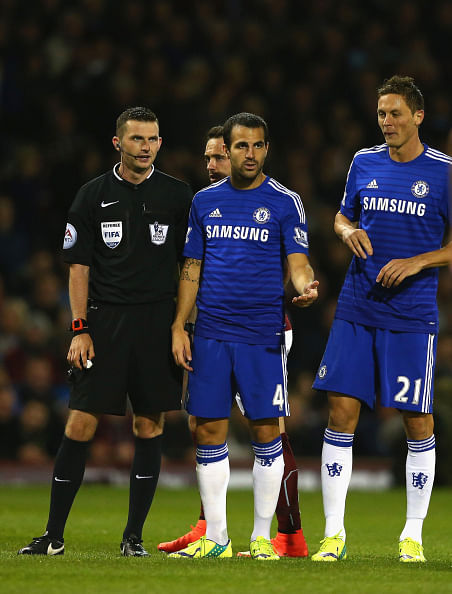
Cesc Fabregas (left) and Nemanja Matic play the double-pivot in midfieldWhen he feels the need for added protection, he brings on John Obi Mikel or Ramires to go alongside Matic, pushing Fabregas further forward while shifting Oscar wide right.
Retaining control of that central zone whether in possession or not is one of the keys to Mourinho’s strategy and that’s why playing the extra forward is not an option save as a desperation move when in need of a goal.
The presence of a physical centre-forward usually means that he will not be as quick as some of the other forward players (unless you’re Cristiano Ronaldo) and that’s another reason Mourinho never plays two such identical players together for then his team’s quickness takes a hit.
‘The Special One’ is a big fan of the counter-attack and it is the quick players who help him make that transition from defence to attack in a flash. Why get Drogba then?
Drogba was sensational in the fact that most of the time he required the attention of both centre-backs, consequently helping in dragging them out of position so that the others would have space to run into.
Costa’s been doing something similar so far, in continuation from his body of work while with Atletico. With both opposition centre-backs already being engaged by just one player, Mourinho gains a huge tactical advantage, negating the need for another front man.
Which actually brings us to the acquisition of Drogba. While many considered the move to be nothing more than a goodwill placebo, Mourinho actually got in a suitable back-up for Costa, one who knows the system inside out and who comes with a wealth of experience behind him.
The frugal minutes is a given, but then again, it suits a veteran perfectly. Which is why you’re more likely to see Loic Remy being thrown on in support of Costa when Chelsea are gunning for a goal than Drogba. Remy is the supplement, Drogba is back-up.
“Look, if I have a triangle in midfield—Claude Makelele behind and two others just in front—I will always have an advantage against a pure 4-4-2 where the central midfielders are side by side.
because I will always have an extra man. It starts with Makelele, who is between the lines. If nobody comes to him he can see the whole pitch and has time. If he gets closed down it means one of the two other central midfielders is open.
If they are closed down and the other team’s wingers come inside to help, it means there is space now for us on the flank, either for our own wingers or for our full-backs.
There is nothing a pure 4-4-2 can do to stop things.” – A quote from Mourinho during his first stint as Chelsea manager
In short there’s another term for when you play two such centre-forwards, it’s called 4-4-2 – the system he exploited and annihilated when he first arrived in England.
Fantasies are one thing and while it certainly would be quite a sight to witness Costa and Drogba making life hell for defenders at the same time, the reality is that Mourinho’s machinations will not allow for it. Jose doesn’t do 4-4-2!
They say a moment of brilliance can decide close games, but so can some horrific blunders, moments of madness that tend to change the game for the worse.
Along with its collection of heroes, the game throws up its fair share of villains who did their best to help their team in a losing cause or at worst leave a bad taste in the mouth with their actions.
Here are this week’s candidates: Andre Marriner and Robert Madley
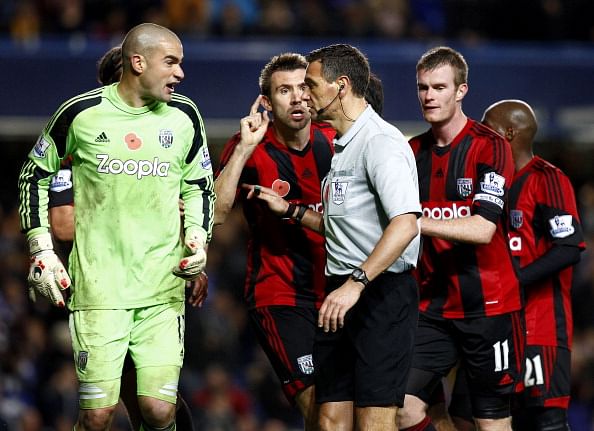
West Brom pair Boaz Myhill and Gareth McAuley appeal to referee Andre Marriner after he awards a late penalty to Chelsea during the Barclays Premier League match between Chelsea and West Bromwich Albion at Stamford Bridge on November 09, 2013 in London, England.
The two gentlemen Andre Mariner and Robert Madley were put on the spot, quite literally, as another week of Premier League action came to a close with two games being talked about for the referees and the decisions they made.
On Saturday, Mariner awarded the controversial last gasp penalty when he deemed that Ramires had been fouled in the box. West Brom were on the verge of a famous win at Stamford Bridge leading 2-1, before the penalty incident and Eden Hazard stepped up to slot home and keep intact Jose Mourinho’s record of never having lost a league game at home as Chelsea manager.
On Sunday, Madley was in the spotlight for similar reasons when he acted equally late in the game to award a rather harsh penalty to Stoke City when the ball brushed the hands of Wayne Routledge on its way out.
In Chelsea’s case, it was a clear dive from Ramires, who went down under the challenge of a normal shoulder dash. It was a harsh decision on West Brom, as even after conceding the second goal, Chelsea really had not looked very threatening.
The other game was in a very similar situation. An entertaining game at the Liberty Stadium had seen Swansea fight back from going a goal down to lead 3-2 going into the final minutes thanks to Wilfried Bony’s well taken double. The ball did brush Routledge’s hand, but he did not have his arms up in an unnatural position and the contact was merely the consequence of the winger being in the way of the shot.
Charlie Adam converted the spot kick and Swansea were denied the full three points, just like West Brom. Manuel Pellegrini
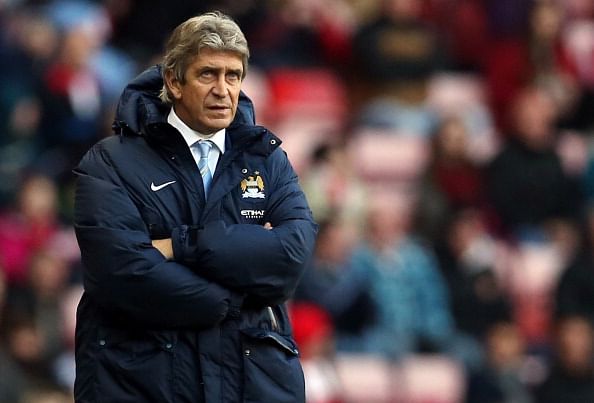
Manchester City’s Chilean manager Manuel Pellegrini looks on from the touchline during the English Premier League football match between Sunderland and Manchester City at Stadium of Light in Sunderland, northeast England on November 10, 2013. Sunderland won 1-0
City have been woeful away from home this term; they have won just one of their five games, drawn another and lost three.
The pattern is getting a little worrisome for City fans as they see their team resplendent at home, putting away opponents with minimal fuss, yet the same sort of magic has not been replicated away.
Manuel Pellegrini will be asked some serious questions after his team selection left plenty of room for introspection. He fielded a back-four which has never played together before in Aleksandr Kolarov, Micah Richards, Joleon Lescott and Martin Demichelis.
He left out experienced heads Pablo Zabaleta and Matija Nastasic and played Javi Garcia in midfield ahead of Fernandinho. Did he think that Sunderland, being bottom of the table, afforded him that opportunity? Was it a case of complacency from City’s manager?
If yes, it did come back to bite them, especially so in the absence of their most creative player, David Silva, through injury.
Against Aston Villa, where they lost 2-3 at Villa Park, Garcia was played at centre-back ahead of Lescott.
Some of Pellegrini’s decisions have been baffling and a fair share of criticism for their away form could be apportioned to the Chilean. Ramires
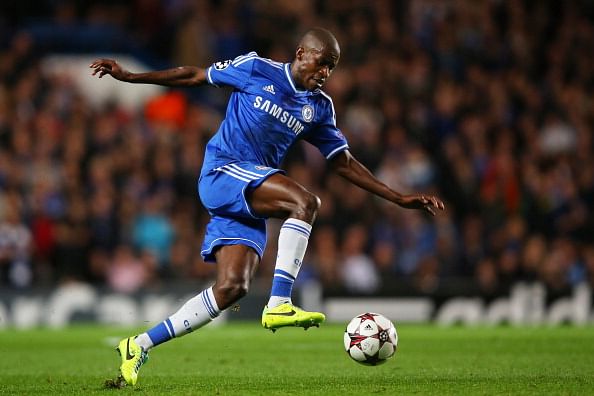
Ramires of Chelsea runs with the ball during the UEFA Champions League Group E match between Chelsea and FC Schalke 04 at Stamford Bridge on November 6, 2013 in London, England
Chelsea’s Brazilian midfielder Ramires hit the headlines for his Ashley Young-esque dive on Saturday that earned his side a crucial last gasp penalty which was converted by Hazard to help them draw the game.
It was a blatant dive from the Brazilian and as much as Jose Mourinho ranted on about it being a knock-down penalty, he’s not fooling anyone.
The video replays clearly show that Ramires goes down under the most minimalist of shoulder brushes from Steven Reid.
The referee was at fault for not spotting the act from Ramires, but it was an ugly incident that Chelsea and the Brazilian could have done without. Juanfran
Atletico Madrid were held by Villareal to a 1-1 draw in an exciting clash at the El Madrigal. And the result meant that the one point lead to league leaders Barcelona is now three points.
Atletico had quite fortuitously taken the lead with an own goal, but Diego Simeone’s side returned the favour when Juanfran put through his own net with about 15 minutes to go to give the game a 1-1 ending.
Real Madrid also closed the gap to their city rivals with a thumping 5-1 win over Sociedad. Borussia Dortmund
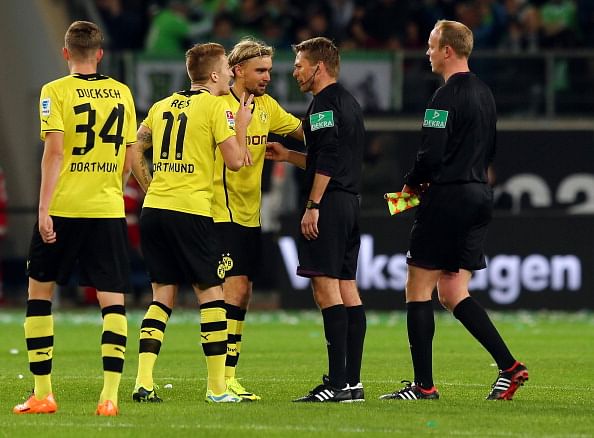
Marco Reus (#11) of Dortmund argues with referee Jochen Drees (R) after the Bundesliga match between VfL Wolfsburg and Borussia Dortmund at Volkswagen Arena on November 9, 2013 in Wolfsburg, Germany.
Having lost their midweek game to Arsenal, Dortmund suffered a second successive loss when they were beaten by Wolfsburg 1-2.
And on a day when Bayern Munich created a new record unbeaten streak with 37 games to further strengthen their position at the top of the table, it was lost ground for Dortmund.
Dortmund also suffered a major setback as Serbian defender Neven Subotic suffered torn ligaments and has been ruled out for an extended period, said to be a minimum of six weeks.
Klopp’s side were beaten by a wonder strike from Croatian striker Ivica Olic that sailed past the reach of Roman Weidenfeller.
You can’t really blame Dortmund for making any callous mistakes that cost them the game, but they were guilty of not finishing off some of the chances in both their games, against Wolfsburg as well as Arsenal.
As the home side, they did have good control of the game against Arsenal in the opening one hour, but failed to make the most of it. At one stage, the match stats read 14 attempts from Dortmund with 3 on target, while Arsenal’s was one attempt with one on target.
The goal made it two attempts with both on target.
These missed chances could have a larger implication in the larger scheme of things. Their loss to Arsenal pushed them back to third place in the group in the Champions League, and though they can still qualify, it would require a perfect performance in their remaining games.
In the Bundesliga, they have lost further ground to Bayern, who are still unbeaten. The gap is now four points with Dortmund set to welcome the champions to the Signal Iduna Park when hostilities resume on November 23 after the international break.
Though not the familiar one in Barcelona but the Bavarian
giants Bayern Munich, who on Saturday were crowned UEFA Champions League
winners of 2013.
Bayern Munich’s victory marks a return to the centre-stage
for German football and the Bundesliga after being in the wilderness for some
time. Ever since Porto won the competition against all odds in 2004, the
Champions League has come to be dominated by English teams and Barcelona.
En route to their conquest of Europe, Bayern pounded the
dominant power in Europe, Barcelona into submission. Though nobody expected the
scale of the defeat, it was construed to be the match where the baton changed
hands, from the dominant force of the last half a decade to the force of the
future. A situation akin to when the Germanic tribes reached the gates of Rome
and brought about the end of the Roman empire.
Is this the end of Barcelona’s dominance in Europe?
Are they no longer top dogs in the continent?
Could this prove to be the death-knell for tiki taka?
All of the above were pertinent questions after Barcelona’s
campaign came to a grinding halt against the Bayern machine. It is not often
that you see the Catalans humbled in such a manner – Bayern didn’t just crush
Barcelona, they crushed a footballing philosophy as they hit 7 unanswered goals
past Lionel Messi and co.
What the future holds for Barcelona or for Bayern Munich is
a debate that will go on for long into the summer, however, that is a subject
for another day. Before that, a quick peek at footballing cycles.
FOOTBALLING CYCLES
The game of football, like most other sports operates in
cycles – both at club and at national levels. These cycles exist because
football and the various teams involved continuously strive to evolve in search
of a winning formula. It is not so much a straight line time graph, but merely
a carousel of footballing philosophies, playing style and coaching.
Sport rarely operates in an inertial environment such as the
one in our PlayStation's and Xbox's.
Footballers are human beings , they’re performances over
time become subject to the wear and tear of competition and the many bruises
and niggles that they carry. The other key word in all of it is ‘familiarity’ –
eventually they figure you out. That goes for a player, a system , a strategy.
Those that continually work to keep adding to their game are the ones that end
up being successful in extending their cycle. And in today’s day and age, where
technological aids and analysts are available to every team, it makes it that
much harder.
THE EUROPEAN FOOTBALL SCENE
The UEFA Champions League is a true testament to this.
Shifting the scene to 5 years ago, in the summer of 2008, Barcelona under Pep
Guardiola had their very own ‘changing of the guard’ match. The Blaugrana defeated Manchester United 2-0
in the final that year in Rome. United were defending champions and were
looking to become the first club in the Champions League era to retain the
title. That victory set Barca on their way to European dominance for the next 5
years, while also setting back the progress of English teams.
Hence, the 5-year period between 2008-2012 belonged to
Barcelona – they won 2 titles while making the semi-finals every year. The
previous spell of domination (2004-2007) belonged to the English clubs –
Liverpool, Manchester United, Chelsea and Arsenal who together made it a habit
of blocking out the semi-final spots every year capped off by a title each for
Liverpool and United, and finals appearances for Arsenal and Chelsea.
Real Madrid, both pre and post Galacticos had their run in
the competition before the English clubs between 2000 and 2003. We can take
only the period from 1998 onward into consideration, for previously only the
winners of each league made it into the competition, which meant only 1 team
from each country. Madrid beat Manchester United and Bayern Munich on the way to
claiming the trophy in 2000, the winners and runners-up respectively from the
previous tournament.
DOCUMENTING THEIR SUCCESS
Each of these teams adopted their own set of tactics to foster
success in Europe’s premier competition.
Outgoing Bayern boss Jupp Heynckes guided Real Madrid to
their 7th European Cup in 1997. Following that, Vicente Del Bosque
and his Los Blancos side won it in
2000. It was just before the dawn of the Galacticos
era, a team led by a young Raul, Fernando Morientes and Steve McMannaman. Zinedine
Zidane, Luis Figo, Ronaldo, David Beckham and Claude Makelele joined forces with Roberto Carlos and
Raul and the Galacticos era was born.
That star-studded squad went on to claim another prize in 2002 with that
memorable Zidane volley in Glasgow.
A simple strategy of buying the best players around that
ensured instant success. Trouble was, those stars were picked up in their late
20’s and after a period of time with age their impact waned. And since Real did
not have a system that they played to or stuck to religiously, there was a
problem when they departed and Real could never recreate the success from earlier in the
decade.
The English teams came in with good defences to fend off the
attacking threats of the Spaniards. They brought in a certain level of physical
effort with their powerful defenders and midfielders, who were very good in the
air in defence as well as attack. The English teams’ play was very direct
employing wingers to good effect to deliver crosses into the ball along with
judicious use of the long ball out of defence. Technical brilliance was not the
greatest, but they made up for it in effort and work rate. Hard-working units
with just the right amount of attacking talent served them very well in the
ensuing years.
Before Guardiola arrived at the Camp Nou, Frank Rijkaard
managed to win one Champions League final against Arsenal in 2006. His was an
all-attacking group, equally direct, centred around the talents of Samuel Eto’o,
Ronaldinho and Deco. They got that one win, but they had a traditional Barca
failing in the form of their defence and their dominance didn’t last long. They
may have had superior attackers, but since their attacking styles were
familiar, they proved easy to contain.
Then came the tiki-taka,
the hogging of possession for long periods and accurate passing of the ball
from Guardiola’s stable. Whether it was intended that way, nobody will know,
but the tiki-taka hit the English
teams in an area where they were vulnerable. They were superb clearing headers
and defending long balls and did well to cut out the through passes. Part of
the reason was their tight defensive organization. What Barca’s system did was
stymie their English foes, deny them the ball to get their forward players
frustrated and patiently pass the ball around, waiting until a member broke the
line after which they could play in that killer final pass. Slow in their
lateral movement, the system wore them down as they spent large portions of the
game tracking the ball. The high pressing game, 8 passes or less in which they
tried to regain possession was also classy. Creating space for their players to
run was central to Barca’s success plan.
And now, Bayern have brought their own heavy duty arsenal
over the past 2 seasons – a combination of high intensity pressing to peg back
the opponents and fast, direct attacks. Whether this means a new era of Bayern
dominance, we’ll have to wait and watch; Inter and Milan have had successful
winning campaigns in the past without kicking on to extend it further. Also,
there will be a change in management - Guardiola will come in for Heynckes – a
completely different approach may be taken by the Spaniard; in which case the
lack of continuity could hurt them. Inter won the trouble under Mourinho,
before having a disappointing season the next term after the Portuguese left.
What is certain is that we have witnessed the end of one
footballing cycle and the beginning of the next!
Tomorrow’s UEFA Champions League final showdown between
Borussia Dortmund and Bayern Munich will be the 4th instance of an
intra-national final, where 2 teams from the same country have met in the
championship clash. Each of the 4 instances has belonged to a different country
with Spain, Italy and England represented on the previous 3 occasions. Germany
will make its bow tomorrow.
Real Madrid 3-0 Valencia, 1999-2000 Final @ the
Stade de France, Saint-Denis
The very first instance was when Real Madrid met Valencia in the 2000
final. This edition saw the introduction of the second group phase, where the
top 2 teams from the 8 groups would again be divided into 4 groups and another
run of round-robin matches.
This was the pre-Galacticos era
at Real under Vicente Del Bosque and they had a fine team made up of a lot of
Spanish talent led by the likes of Raul, Fernando Morientes, Michel Salgado and
Iker Casillas. Current Real Madrid assistant manager Aitor Karanka was also
part of this team. Real Madrid topped their group suffering just one loss and
in the second group phase finished runners-up behind Bayern Munich. They
finished strongly though as they got past 2 very strong teams en route to the
final - Manchester United, who were the defending champions, in the
Quarterfinals and then Bayern Munich in the semi-finals.
Valencia weren't doing so badly
themselves with arguably their ‘Golden Generation’ of Gaizka Mendieta, Miguel
Angulo, Claudio Lopez and Santiago Canizares. Just like Real, they would win
the first group phase, ahead of Bayern Munich and finish runners-up in the
second, behind Manchester United. They trounced Lazio and Barcelona in the
quarters and semis respectively scoring 5 goals against both over the 2 legs.
The final had a tight beginning
before Madrid began to exert themselves on the game and took the lead through
Morientes. Steve McManaman had a marvelous game for Los Blancos and he scored
the 2nd with a spectacular volley. Raul then rounded it off with a 3rd
goal on 75 minutes when Real caught Valencia napping on the counter. It was
Real’s 8th European Cup.
Steve McManaman was voted the Man
of the Match. Incidentally, he became the first Englishman to win the tournament
with a foreign club. Raul finished joint top scorer with 10 goals. Valencia
finished runners-up again the next year when they lost on penalties to Bayern
Munich after it ended 1-1 in regulation and extra time.
AC Milan 0-0 Juventus, 2002-03 Final @ Old
Trafford, Manchester
Juventus came into the final
fresh from being crowned Serie A champions; Milan on the other hand had
finished 4th, 16 points behind the Turin club. In the season
head-to-head, Juve had won the home game while drawing away at the San Siro.
They had also beaten Milan in the Coppa Italia semi-finals.
The 2-group phases structure was
still on; Juventus topped their first group while finishing runners-up to
Manchester United in the second. They ended Spanish hopes in the competition as
they beat Barcelona in the quarters and Real Madrid in the semis. Influential
midfielder Pavel Nedved though would miss the final after picking up a booking
in the 2nd leg against Real.
Milan came in winning both the
groups including a strong second group phase pitted with Real Madrid and
Borussia Dortmund. After beating Ajax, they had to contend with neighbours
Inter in a Milan derby semi-final. It ended level 1-1 on aggregate with Milan
progressing on the away goals rule.
The final was a game of few
chances and one of the dullest of the last decade and a half. Both teams had
excellent defences which ensured that chances were at a premium. Andriy
Shevchenko had a goal disallowed in the first half though replays showed that
Rui Costa had not been in an offside position.
Current Juve manager Antonio
Conte came on as a sub and saw a header clatter the crossbar in what was Juve’s
best chance of the game. Andrea Pirlo too struck the post for Milan.
With no result even after extra
time, the match went to penalties and It was a tense, tense affair. Juventus
only made 1 of their first 4 penalties as Dida saved the efforts of David
Trezeguet, Marcelo Zalayeta and Paolo Montero. Gigi Buffon was doing his best
to keep Juve in the game as he saved from Clarence Seedorf and Kakhaber
Kaladze. Alessandro Del Piero converted the 5th spot kick for Juve,
but so did Shevchenko to clinch the trophy for the Rossoneri. It was Milan’s 6th
European Cup.
Paolo Maldini was named the Man
of the Match for the final. Filippo Inzaghi was the 2nd highest goal
scorer with 10 goals behind Ruud Van Nistelrooy who bagged 12 for Manchester
United. Shevchenko became the first Ukrainian footballer to take home a
European Cup winners medal.
Manchester United 1-1 Chelsea, 2007-08 final @
Luzhniki Stadium, Moscow
England’s top 2 teams met in the
Moscow final of 2008. Manchester United had just won their 17th
league title finishing 2 points ahead of their final opponents Chelsea. Each
team had won their home game in the league, while Chelsea had the latest win
after beating United 1-0 in the FA Cup final days earlier.
Man United went unbeaten the
whole tournament. They drew just 1 game in winning their group comfortably.
They then beat Lyon in the Round of 16, which had now replaced the previous format
and Roma in the quarters. Frank Rijkaard’s Barcelona stood between United and
their 3rd European Cup final. The teams had identical records going
into the semi-final, each having won eight and drawn two of their ten games,
scoring 18 goals and conceding just 5. Cristiano Ronaldo missed an early
penalty in the 1st leg at the Camp Nou and that leg ended 0-0.
United edged into the finals with a tight 1-0 home win thanks to Paul Scholes’
long range stunner.
Chelsea had seen a change of
manager after Jose Mourinho parted ways in between the season. Interim manager
Avram Grant did a good job though as he kept the Blues in the title hunt in the
league and guided them to the FA Cup and Champions League finals. Chelsea lost
just the one game in the tournament, against Fenerbahce in the quarterfinals.
After getting past Olympiacos and Fenerbahce, Chelsea took on Rafa Benitez and
his defending champions Liverpool. This was the fourth year in succession that
these teams had met in the Champions League. After drawing the first leg 1-1
away, the Blues won a tense 2nd leg 3-2 after extra time to make the
team’s first visit to the Champions League final.
After taking time to feel each other
out, the final picked up pace with Ronaldo’s opener on 26 minutes. United had 2
good chances to extend the lead, but Petr Cech came to Chelsea’s rescue with
some magnificent saves. Frank Lampard equalized for Chelsea in the closing
minutes of the first half after Michael Essien’s initial shot had deflected off
Rio Ferdinand and Nemanja Vidic.
The goal swung the momentum in
Chelsea’s favour and the Blues dominated for much of the second half. Drogba
went close to giving them the lead when his effort hit the post. Ryan Giggs had
a chance to get the winner for United, but John Terry made a last ditch tackle
to prevent it. It was end –to-end in extra time as both teams went looking for
the winner. Late in extra time, Drogba was sent off for a slap on United’s
Vidic.
In the shootout, Ronaldo missed
his penalty which gave Chelsea the advantage. Blues captain John Terry stepped
up to take the 5th penalty, but he would miss as he lost his footing
which saw his mis-hit shot hit the outside of the right post and go wide. In
sudden death, Edwin Van der Sar saved Nicolas Anelka’s shot to win it for
United.
Van Der Sar took the Man of the
Match award. Cristiano Ronaldo finished top scorer with 8 goals.
Borussia Dortmund vs Bayern Munich, 2012-13 final @ Wembley,
London
One-sided final like the 2000
edition or nail biters like the other two? We will find out on Saturday. The 2
league meetings between the sides both ended 1-1 and Bayern beat Dortmund 1-0
in the quarterfinals of the DFB Pokal Cup.
Dortmund will be without star play-maker Mario Götze due to injury which means he has already played his last
game for Dortmund; he will be joining Bayern Munich in the summer.
It is often said that it's not over until the Fat Lady sings. Last night there was no Fat Lady in Amsterdam, but there was a certain 'Fat Spanish Waiter' whose side served Benfica some just desserts for switching off in the final moments of their Europa League final.
Branislav Ivanovic made the leap of faith to direct a looping header into the Benfica goal off Juan Mata's corner to steal victory for the Blues in the last minute of added time in regulation. Having weathered the storm early from the Portuguese side, Chelsea dug in and eventually prevailed 2-1 with a strong second half showing.
Rafael Benitez, Chelsea's 'interim' manager, has had all sorts of unwarranted abuse hurled at him. The moniker used above just happens to be one of those that the Spaniard has garnered thanks to Blues fans. Benitez's appointment was met by a massive wave of rejection by sections of the Chelsea support who took no time in expressing their disenchantment with the new manager. One would have thought that the animosity would extend for a few games and peter out afterwards. But, the banners, not to forget the legendary A4 printouts that became quite the rage, came to be regular parts of the facade from the home support at every home game.
All of it was unwarranted and contributed to one very hellish environment in which to operate. Rafa though has endured and emerged victorious in the face of all the negativity. Steve Kean at Blackburn Rovers was the last manager to endure such a torrid time from the home fans; but that was well deserved, Rovers were rock-bottom and both the manager and management didn't seem to have the slightest clue on how to turn things around. But, this is Benitez, an accomplished manager known to be a smart tactician with a good grasp of cup competitions especially in Europe.
Rafa has achieved all the objectives that the club had tasked him with. When he took over from Roberto Di Matteo, Chelsea were on a run of 2 wins from 8 games, and there existed the very real possibility of them slipping out of the Top 6 and missing European football next season altogether. He steadied the ship and ensured that they will be playing Champions League football next term as they look set to finish 3rd behind the two Manchester clubs. Yesterday's Europa league crown is a fitting farewell gift from their Spanish manager, checking off the box that said 'cup win' which may have been given to him.
Aside from meeting the main objectives, Benitez has also improved the side. Chelsea under Di Matteo claimed the Champions League trophy last season founded on stout defending and enjoyed a healthy serving of good fortune along the way. Come this season, RDM got the word from owner Roman Abramovich to play a more open game with lots of fluid attacking play. Chelsea got the players for it - in came Oscar and Eden Hazard, in addition to the ever present Mata. And Abramovich got his wish, as Chelsea dumped the direct approach to play some breathtaking football. Trouble was though, their defensive shape and that led to them conceding too many goals.
When Benitez walked in, many feared that Chelsea would turn to a more pragmatic style of play with rationed offense, especially so after his first 2 league games ended 0-0. But, Benitez was simply addressing the primary issue of getting the team to defend better, even if it meant curtailing the attack for the first few games. He got players into a proper shape, got them to track back when they lost the ball and gradually eased out John Terry from the lineup, put Ivanovic in his favored Centre-back position to partner Gary Cahill and promoted a proper right back in Cesar Azpilicueta. The Spanish full-back gave them the much needed solidity on the right flank, good going forward as well and allowed Ivanovic to play at his best position, where he plays for Serbia as well. Along with the exceptional Ashley Cole, this made for a much more organized and tighter back-line.
David Luiz is a guy with exceptional ball skills and he has lots of heart to go with it. Rafa smartly began employing him in a defensive midfield role from where he could not only shield the back-line, but also with his exceptional ability initiate attacks. John Obi Mikel used to do more of a mop up work in that role and was terribly stunted for ability. This in turn allowed Frank Lampard to operate from a deeper role and for Ramires to roam forward as an attacking outlet.
Eden Hazard made quite the impact when he started off. But the Belgian saw his game time limited with Benitez's arrival. To many Chelsea fans, this was a perplexing decision and led them to unload even more on their manager. Hazard, for all his wonderful play, was very reluctant to track back and help out in defence and many a time early in the season, Chelsea used to get caught out on the break when the trio of Oscar/Hazard/Mata surrendered the ball up field and left them exposed at the back. He was also being overworked. The break did Hazard a world of good, as he came back fresher and with some defensive commitment to go with his explosiveness up front. Oscar was given a better run as he showed better defensive mettle.
Of course, the story wouldn't be complete without mentioning the return to form of Fernando Torres. 'El Nino' scored a wonderful goal last night to give Chelsea the lead. It was his 18th goal of the season, yes 18! Bet you didn't know that! The last time, the Spaniard looked so confident was the last time he was with Benitez, at Liverpool before that £50 million move to the Bridge. In addition, Rafa has managed his squad superbly with optimum squad rotation required. Chelsea at the weekend will host Everton in their final league game; it will be their 70th game of the season!
The Spaniard has also shown his tactical nous in games where his in-game adjustments and changes have altered the course of the game. Even last night, the first 25 minutes belonged to Benfica as Chelsea sat too deep and got overrun. The Blues have played a more possession based style of football in Europe with Luiz coming into the centre of midfield. Last night, they failed to string together passes as Benfica pressed them hard forcing them to surrender the ball. At half-time Benitez made the slight adjustment and told his team to employ a more counter-attacking approach, something which we have seen Real Madrid do and they managed to hurt Benfica with that in the second. The FA Cup game against Manchester United was another fine example of this.
Rafa Benitez is a master of the cup competition. He won the 2004 UEFA Cup with Valencia, the 2005 Champions League with Liverpool and now the Europa League with Chelsea in 2013. Benitez has conducted himself in a thoroughly professional manner in the face of all the stick that he has received, barring that famous February outburst. But anyone whose been subjected to such a hostile reception is entitled to that one explosion. Yesterday, post the trophy presentation his message for the Chelsea fans was to "simply enjoy the moment".
Benitez will walk away with his head held high having performed exceptionally well in the circumstances and those haters amongst the Chelsea fans should thank him for shepherding the club out of trouble. The 'Spanish waiter' has served up quite a treat for Blues fans and it's high time they got off his back and doffed their hats to a man who has performed a terrific job as their 'interim' manager..
The Barclays Premier League Champions for 2012-13 have already been crowned, Manchester United crossed that off the list of things to look forward to. The relegation battle too has already taken two casualties in QPR and Reading and Roberto Martinez's Wigan Athletic are in a trench war to avoid being the third. We are into the last 4 games (5 for some teams) of the season and it is the battle for the UEFA Champions League spots that is really hotting up.
Three teams from the capital - Arsenal and Tottenham Hotspur from North London and the West Londoners Chelsea - are in the running to take 3rd and 4th spots in the league table. As it stands, it's Arsenal who are 3rd on 63 points followed by Chelsea with 62 and Tottenham with 61 points; that's as close as it gets. Although, one has to remember that the Blues and Tottenham have a game in hand which incidentally sees them play each other.
For Arsenal and Tottenham, all of their efforts and energy are solely directed at claiming that crucial Champions League spot. Chelsea are still involved in the Europa League; they beat FC Basel 2-1 away in Switzerland in the 1st leg of their semi-final tie on Thursday night. So while Arsene Wenger and Andre Villas-Boas (AVB) have one and only one competition to contend with, their opposite number Rafa Benitez has to juggle with rotating his squad of players in the best way possible as we near the end.
THE RUN-IN
Chelsea and Tottenham play each other at Stamford Bridge on the 8th of May. That game is a potential 6-pointer and could be very crucial in determining where both teams end up in the final scheme of things. For Chelsea, it comes 3 days after a trip to Old Trafford to face champions United, though there is always the likelihood of Ferguson giving his youngsters a chance with the title wrapped up. Outside of that huge fixture, Tottenham do appear to have a more tricky schedule as they play Wigan, Southampton, Stoke and Sunderland - 4 teams battling to avoid the drop. The end of the season is not the time to be playing such teams as with their backs against the wall they can cause an upset here or there.
Arsenal seem to have a clearer route to the last game with just Wigan, of the relegation teams featuring in the mix. Chelsea face a trip to Villa in their penultimate game before finishing off at home against Everton, who depending on how things go could still be in with an outside shot of making the Top 4 come the final day.
FORM GUIDE
Since the turn of the 30 game mark, all 3 teams have been unbeaten. Chelsea and Tottenham have identical records with 2 wins and a draw each in their 3 games while Arsenal have registered 3 wins and a draw having played a game more. And traditionally, the Gunners are known to finish their season strongly while Spurs will be keen to outdo their North London rivals. There are no concerns with regards to player availability for either team, especially for Tottenham after both Gareth Bale and Jermaine Defoe made impressive comebacks against Manchester City last weekend.
THE RAFA FACTOR
One person who could have a major say in Chelsea's fate is their manager (ok..interim) Rafa Benitez. The Spaniard already knows that he is not going to be in-charge next year. Having vented out his frustrations previously, Benitez will be keen to ensure that his 'interim' tenure here has some silver lining to it. And that silver lining that he's looking for could well be the Europa League trophy. Yes, the Europa League trophy and not Champions League qualification, because quite simply he's not going to be here next season and he could afford to not care less about whether Chelsea make Europe's premier competition or not. Even more so if you look at the flak that he's had to take (often undeserved) from the Chelsea fans.
So, he will look to guide the Blues to the Europa League glory, which makes for a nice addition on his CV. He's already a manager whose exploits in continental cup competitions are quite admirable and this could easily help him land a good job elsewhere when he does leave West London. In that eventuality, Chelsea's league campaign could well stutter with Rafa opting to play his best side in Europe.
WILL MERSEYSIDE HAVE A SAY?
Any slip-up on the part of these teams could leave Everton in with a chance of stealing one of those places. The Toffees are currently 5 points behind Tottenham having played an extra game and as such face a mammoth task if they are to somehow catapult themselves into the London dogfight. They do play Chelsea on the final day at Stamford Bridge and if the race goes all the way down to the wire, that game could very well prove decisive. Even if not furthering their own chances, they could well throw a spanner in the works for Roman Abramovich's Chelsea.
WHO WILL BE LONDON'S FINEST?
For Spurs, it represents an opportunity to overcome the disappointment of last season where their 4th place finish was rendered void by Chelsea clinching the Champions League. That saw them getting bumped down to the Europa League. Also, them making the grade would go some way in their efforts to keep hold of Gareth Bale.
Arsenal traditionally finish strong and another 3rd place finish, even 4th for that matter, will be a huge improvement from where they stood earlier. Champions League football is always a big draw when it comes to attracting the best players, and Arsenal need major additions to their squad next year.
Champions League winners, to being eliminated in the group stage to Europa League champions potentially, it has been a chaotic season for Chelsea. A revamp of the team has been undertaken with a new brand of attacking football with a lot of flair on display this season. Transition times are always rocky, but Chelsea have managed to stay in the fight. The youngsters who've joined in have had a good first season and will be primed to have a second crack at Europe next year. They will need to finish strongly to ensure that opportunity and avoid missing out on Champions League football.
Germany and Spain each have 2 representatives in the semi-finals of the UEFA Champions League, Europe's premier club competition. For the first time in 3 years, England has none. But, a more damaging fact is that no English team even made the Quarterfinals of this year's competition.
The last time an English side did not make the Quarterfinals was way back in the 1995-96 season. However, at the time, the format was such that only the winners of each of Europe's domestic leagues featured in the tournament. Blackburn Rovers, by virtue of winning the league the previous season, were England's representatives; but a disappointing campaign saw them finish bottom of their group behind the likes of Spartak Moscow, Rosenborg and Legia Warsaw. Also, there was no Round of 16 back then as there were only 16 teams spread across 4 groups.
If we were to look for the last instance of this event under the current format, we would have to keep looking for a while; because there has simply been no precedent. Never have the Quarterfinals of the Champions League been played with zero English participation. While naysayers will say that it does not really reflect much, and that England has been the most consistent in producing semi-finalists in the last decade and that the English league is more competitive in nature, there is no denying the fact that the best of England are no longer a match for the best of Germany, Spain, Italy and a few other countries.
Manchester City and Chelsea exited at the group stage, while Manchester United and Arsenal had tough first round encounters against Real Madrid and Bayern Munich respectively. You could argue that City were in the Group of Death, but that is no justification for finishing last behind even Ajax. For a team of City's quality and resources, they were expected to make a fist of it. As good as Dortmund and Real were, City were poor and failed to mount a serious challenge against any of their opponents. Chelsea too fell at the first hurdle, in the process suffering the ignominy of being the first defending champions to go out in the group phase. After starting brightly, they were outplayed by Juventus and Shakhtar Donetsk in key games which eventually spelt the death knell for their European ambitions and then manager Roberto Di Matteo's job for the season.
The sending off of Nani in the 2nd leg encounter at Old Trafford has been mooted as a turning point which swung the tie in favor of Madrid against Man United. Truth is though, that United failed to grab a multitude of opportunities even before the incident to pocket the tie. In the 1st leg in Madrid, there were opportunities for Robin Van Persie and Ryan Giggs to have accumulated more away goals for United, but they fluffed their chances. The 2nd leg saw United once again control the game and frustrate Madrid, but they failed to put away their chances. Nobody needs reminding that football is a game of 90 minutes; 60 minutes of good work does not entitle any team success, and lest we forget even 10 minutes after the Red card United looked comfortable with a 1-0 lead and 18 minutes to go to full time. Why didn't Sir Alex Ferguson use his experience to bring on a defender for a forward and try and preserve the lead? Why did he he get carried away berating the official and jeeing up the fans instead of perhaps focusing on substitutions? Why did he wait until they were 2-1 down to make his substitutions? Sending-offs swing a game, yes, but they are a part of the game and at this level you have to be prepared for that eventuality. Instead of planning out how best to see off the game, United's manager, staff and players seemed more keen on sulking and complaining about the decision and that i believe is what cost them the game and not the Nani's dismissal in itself.
As for Arsenal, they just came up against a supremely talented and confident team in Bayern Munich. The tie was pretty much settled in the 1st leg where the Germans decimated Arsenal to register a 3-1 win aided by some dodgy team selection and tactics from Arsene Wenger. The Germans are one of the favorites to take home the trophy this year and i firmly believe that Bayern Munich will either be Champions or be beaten by the eventual winners.
The English Premier League, from top to bottom, is definitely more competitive than its European cousins. This is due to a lot of reasons, but primarily down to the more even collective bargaining agreement that sees TV revenue shared equitably. The Bundesliga is seeing a revival of sorts again with all the teams playing an attractive brand of football and with clubs being owned by the fans as opposed to conglomerates, ticket prices are very affordable and the stadia and facilities have gotten a major uplift. Borussia Dortmund, once on the verge of bankruptcy and extinction, have made the journey to becoming champions of the Bundesliga twice over with a squad that that cost not more than £20 million. But, the irrefutable fact remains that there has been a gradual decline in the English game showcased by the failings of England's top clubs at the highest level. True, Chelsea did win it last year, but they needed a healthy serving of good fortune along the way.
One primary reason that can be attributed to the relative downfall of English sides is the severe lack of quality in the midfield area. In recent seasons, there has been an over-reliance on the forward line to get the job done. En route to the title last year, Chelsea put up a workmanlike midfield which effectively snuffed out the opposition, including Barcelona, but it was Didier Drogba and his goals that almost single-handedly carried them to the title. The season before that United made it to the final, thanks mainly to a somewhat favorable draw and rightly got decimated in the final against Barca. United's triumph in the 2006/07 season was also driven by their midfield consisting of Paul Scholes and Owen Hargreaves who were fantastic in that campaign. Their ability to control the midfield allowed the likes of Cristiano Ronaldo, Wayne Rooney and Carlos Tevez to do their bit up front. Darren Fletcher's absence from the final the very next season against Barcelona proved more damaging than expected. Xavi and Iniesta turned Anderson inside out and cantered to a 2-0 victory. Liverpool's championship side that secured that magical victory in Istanbul was driven on by talismanic Steven Gerrard and Xabi Alonso in the middle. This year, United are on the way to a 20th league title, but with an over-reliance on their forwards, Van Persie in particular. Time after time, they have gotten out of jail with the help of their forwards. The reason they have been behind in games so often is again the lack of midfield.
Yaya Toure is arguably one of the best central midfielders in the league (discounting David Silva as he likes to roam and sometimes plays in a wide position). He was one of the prime pillars on which City's success last season was built. He has been a little out of form, you can blame fatigue or just lack of touch for that. And early on, his struggles corroborated a lot with City's struggles and hence they failed to get momentum going. Michael Carrick's return to form for United has been a joy to watch this season. But, he too suffers from a lack of quality sidekicks. Chelsea for all their attacking flair leave huge gaps in the central midfield and rely on workhorses John Obi Mikel and Ramires for solidity. They lack a definitive shape and when Eden Hazard, Juan Mata and Oscar all go forward, they are left exposed at the back. Tottenham too have relied on the brilliance of Gareth Bale, but have some good options in the form of Scott Parker, Gylfi Sigurdsson and Moussa Dembele. Jack Wilshere is the true outstanding talent currently playing in the English league and when he plays, Arsenal look a totally different side. Mikel Arteta also comes into his own in the company of the young Englishman. But, for Arsenal, more than losing Van Persie, the loss of Alex Song was a big blow. He lent them that steel in midfield and he was very good with his distribution, a combo that has been tough to replace.
Now compare that with the 4 teams that have made it to the semi's. Barcelona, lest we mention have the trio of Xavi, Sergio Busquets and Andres Iniesta who boss the midfield. Bayern Munich have got Bastian Schweinsteiger, Javi Martinez and Toni Kroos who boss the midfield. Borussia Dortmund play Ilkay Gundogan, Sven Bender and Mario Gotze who do the same for the Black and Yellow. And Real Madrid have got the tireless Sami Khedira working with master passer Xabi Alonso and Mesut Ozil who pretty much impose their authority in that area of the pitch. Juventus, who were outclassed by Munich, don't fare too badly either with Andrea Pirlo, Claudio Marchisio, Paul Pogba and Arturo Vidal. The fact that they were usurped by Bayern just goes to show how well the Germans are playing and how effective their midfield unit is in nullifying that of their opponents. PSG who narrowly lost to Barcelona have 2 fine youngsters in Marco Verratti and Blaise Matuidi (not bought for huge sums of money by the way) who'd be able to gain the measure of even the best English sides. Doesn't make for healthy reading, does it?
Paul Pogba mentioned in a recent interview that the main reason for his departure from Old Trafford was Ferguson's stubborn refusal to play the youngster choosing to plump for veterans such as Ryan Giggs and Scholes instead. This when it was so blatantly clear that United needed legs and energy alongside the passing ability of Carrick. So, until this problem is solved, the well documented struggles of English sides against the best of Europe is going to continue. The Italian league is on a bit of a rebuilding phase as even the traditional big boys such as Milan and Juve struggle financially. So, the Premier League may not fall behind them, but the drop in quality overall has been obvious. A continued decadence and England could fall behind Italy and surrender that 4th Champions League spot to another nation as Italy found out when usurped by Germany.
A fantastic piece of skill from Chelsea forward Demba Ba saw the Blues register victory over Manchester United in their 6th Round replay in the FA Cup. The victory keeps them on course to gun for a 4th FA Cup title in a span of 5 years.
Chelsea made 6 changes from the team that lost to Southampton while United made 7 from the Sunderland trip. Captain John Terry went back to the bench with David Luiz replacing him and Juan Mata and Eden Hazard coming in. Sir Alex Ferguson changed his forward line completely with Javier Hernandez and Danny Welbeck coming in for Robin Van Persie and Shinji Kagawa while Wayne Rooney sat out a second successive game with a groin injury picked up on international duty.
The game at Stamford Bridge was the second game in 3 days for both sides, each having played on Saturday in League action. In a lunch-time kick off at sun-bathed Stamford Bridge, both sides appeared to be tetchy early on and failed to put together a constructive array of passes to force the play. The first half was a drab affair with very few chances. David De Gea made the first real save of any kind in the 30th minute when he kept out a Ba shot on goal. Javier Hernandez, who has made quite a habit out of scoring against Chelsea, nearly embarrassed Blues keeper Petr Cech when he timed his dive a bit early and had to stick out his leg to keep out the Mexican's swerving shot.
United failed to create anything from the wings with Nani having an abject game and Tom Cleverley on the left tucking in a whole lot more. Phil Jones in midfield was a bright spot for the visitors cutting out attacks and looking to step on the ball when possible. The game gained a little tempo towards the end of the half with Chelsea's attacking trio of Mata, Hazard and Oscar having a bigger effect on the game.
And the hosts did come out looking the better side in the second half. 4 minutes in came the breakthrough; Mata found a bit of space for himself in midfield and clipped the ball forward over Rio Ferdinand. The ball looked to have been slightly overcooked, but Ba displayed superb skill as he met it with his outstretched right leg and directed it past De Gea into the top left corner as the Spanish keeper stood rooted to the spot.
The goal seemed to spur the home side and they were the better team in the remainder of the game. United's best chance came when Hernandez ran onto a Welbeck cross to head across at goal from close range, but veteran keeper Cech somehow kept the effort out with an outstretched arm. With nothing forthcoming, Sir Alex rang the changes as Van Persie and Giggs came on for the ineffectual Cleverley and Nani respectively.
But it was Rafa Benitez's men who created the chances as they began to play the Red Devils out of the game. Mata brought out an excellent save from compatriot De Gea while Hazard and Oscar also had chances to double their side's lead which they put wide. Van Persie had a late chance to level the game but he hit his volley wide and that was that for United as Chelsea deservedly booked their place in the final four. The win meant the end of the Double dream for United who were looking to add the FA Cup crown to go with their 20th Premier League title that looks imminent.
Chelsea will play 2011 champions Manchester City for a place in the final. The game takes place at Wembley on the second weekend of April.
Shinji Kagawa's became the first Asian player to score a hat-trick in the Premier League as his well taken goals along with one for Wayne Rooney took United 15 points clear at the top of the league with Manchester City playing away at Aston Villa on Monday night. Rooney who started up top with leading scorer Robin van Persie had a stellar game providing 2 assists and rounding off proceedings with a thunderous finish. Kagawa though was the undoubted star for a classy performance filled with some sublime finishing in front of goal.
Chelsea 1-0 West Bromwich Albion
Demba Ba on his return to the Chelsea starting line-up scored the only goal of the game as his first half strike was enough to see the Blues hold on to a narrow victory at home. Playing without their lead striker Romelu Lukaku, West Brom did fashion a few chances but the Blues saw off a nervy last few minutes to take 3 points that puts them temporarily back in third place. Following manager Rafa Benitez's outburst midweek, there were banners mocking his 'Interim manager' status and seeking his exit, but the protests quietened down once the game began.
Wigan Athletic 0-4 Liverpool
Luis Suarez's hat-trick saw Liverpool rout Wigan at the DW stadium emerging victorious by 4 goals after Stewart Downing opened the scoring with a header in the 2nd minute. The win takes Liverpool 7th in the table within 3 points of city rivals Everton. With the 3 goals, Suarez is now the leading scorer in the league with 21 goals moving 2 ahead of Van Persie.
Everton 3-1 Reading
Everton eased to a comfortable home win against relegation embattled Reading with goals from Marouane Fellaini, Steven Pienaar and Kevin Mirallas that saw them end a run of 4 league games without a win. Everton dominated the game and though Robson Kanu grabbed one back for the Royals, it was merely compensation.
Southampton 1-2 QPR
Harry Redknapp's campaign to keep QPR in the top flight received a much needed boost as Rangers came away from St.Mary's with a precious win in a relegation 6-pointer. Loic Remy returned to the starting line-up after coming off the bench in the last couple of games and gave QPR the lead. Gaston Ramirez then levelled for the Saints when Julio Cesar spilled Jay Rodriguez's shot on the stroke of half-time. Jay Bothroyd then popped up with the winner for QPR in the 74th minute tapping in a Park Ji-Sung cross. Rangers are still bottom though 3 points off Reading in 19th place. Southampton remain 16th thanks to Wigan's loss against Liverpool.
Sunderland 2-2 Fulham
Sunderland fought back from 2 goals down to grab a point as their home game against Fulham ended 2-2. Dimitar Berbatov gave Fulham the lead through a coolly taken penalty literally passing the ball into net. Fulham then doubled their lead through Sascha Riether, but Sunderland hit back immediately with a penalty of their own which Craig Gardner converted. Stephane Sessegnon, who put in a man of the match performance for the Black Cats, then scored the equalizer in the 70th minute, finishing off a move that started and ended with him.
Swansea 1-0 Newcastle United
Substitute Luke Moore's late strike gave League Cup champions Swansea City a narrow win over form team Newcastle United. The 85th minute strike gave the Swans a hard-fought win in their return to league action after their demolition of Bradford in the League Cup final last Sunday.
Stoke City 0-1 West Ham United
Substitute Jack Collison's goal in the dying minutes of the first half was enough for West Ham to hold on for a rare away win in their clash against Stoke at the Britannia stadium. Both teams had been struggling for form , West Ham with the win move level on points with Stoke on 33.