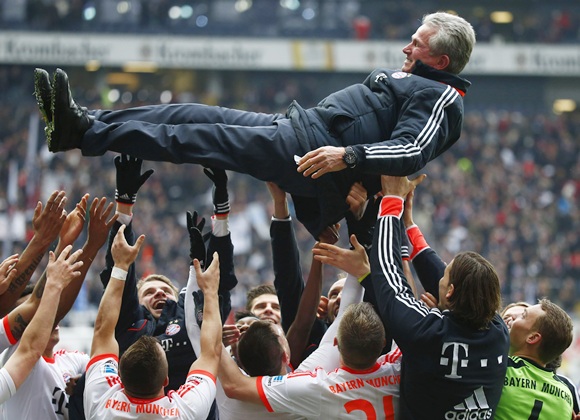
Showing posts with label Borussia Dortmund. Show all posts

Tuesday, December 23, 2014

Why Christmas brings no cheer to players and clubs in the Premier League

Even Jesus Christ can’t seem to get Premier League players and managers a break


The snow’s falling down, kids are enjoying their holidays, offices take an extended break and homes swell with festive cheer and celebration as Europe looks forward to Christmas and the impending New Year. Footballers too get a break, to put their feet up a bit and get some rest and relaxation while also getting time to spend with family and friends. After all, when the rest of the world’s celebrating, why shouldn’t they?

However, Diego Costa, Filipe Luis, Alexis Sanchez, Angel di Maria and the rest of the players in England’s top flight – are not sharing the same sentiments as they find themselves embroiled in the yearly rigmarole that is the ‘bonus’ fixture pile-up that the Premier League is associated with usually at this point in the season.

Unlike during their time in Spain in the last few years, the above quartet is not going to be enjoying a winter break this time around. A cluster of games are the presents that the league throws up to its teams, and their players and managers, who must curse their luck when they look at what their pals in the other leagues are up to.

It’s been a long-running debate on whether the Football Association (FA) should cease with this annual fixture congestion in keeping with what Spain, Germany, Italy and the rest of Europe’s top leagues do in order to aid English teams in the long run.

So far though, it hasn’t cut any slack with the powers to be as profit, viewership and cash, continue to ensure that players will be in their team strips four times in a span of 10 days between December 26 and January 5.

The rest of Europe

In contrast, the winter break is on after this weekend’s round of matches in the other leagues. The La Liga will resume on January 3rd, the Serie A on January 5th and the Ligue 1 on January 7th. That’s 14 days off for those teams at the minimum. The Bundesliga is even better, and reopens only on January 30th, resulting in a month of rest and recuperation for the likes of Bayern Munich and Borussia Dortmund.

Of course, Germany has only 18 teams and as a result has 40 matches lesser in its calendar, due to which they can afford a whole month off. But the other three big leagues have the same number of teams as the Premier League and get 14 days off. Ironically, despite that, the La Liga, Bundesliga, Ligue 1 and Premier League all conclude on the weekend of May 23/24; Serie A closes a week later.

So, the situation in England is great for television, great for some sections of fans who do enjoy the added football during the holidays, but how about the players and what effect does it have in the longer run, say for teams in the UEFA Champions League?

English teams in the Champions League knockout rounds

One trend that has been observed on an almost annual basis is that teams from the other leagues seem to almost fare better in the Champions League than those from England. Real Madrid, Barcelona, Bayern Munich, Borussia Dortmund seem to be able to find another gear as the competition moves into March and April.

Last year Manchester City, the eventual champions, were eliminated in the first knockout round by Barcelona, Arsenal likewise by Bayern Munich. Chelsea got to the semi-finals before being beaten by Atletico Madrid.

Last year’s Chelsea are in fact a classic case; they were going well in the Premier League and looking likely for a title run until their resources got stretched with a deep run in Europe. Manchester City benefited from having a deeper squad as well as bowing out early, allowing them to fully concentrate on the league.

This explains how they became champions last year despite being top of the table for a mere 14 days. And Liverpool had no distractions from the get go, a challenge they could not cope with this year, not being able to get past the group stage even.

The top three teams in England over the past five seasons (based on how they finished that season)


Looking at how the top English teams (in reference to order of finish that season) have gone in Europe in the last five years, it doesn’t make for good reading.

Of the eventual champions, Manchester United went the furthest in 2010-11 finishing runners-up to Barcelona. No runner-up has gone beyond the quarter-finals and likewise for the third-best team. The top Spanish and German teams are however, constantly making the quarters and the semis in Europe’s premier club competition.

Last year, it was an all-Spanish affair in the final and the year before that, an all-German one. Each of the top three Spanish teams last year made the quarter-finals while two German teams did. Chelsea were England’s only representative.

You might say that those stats merely state the obvious, which is that the Premier League isn’t ‘the best in the world’ as those ‘pundits’ would have you believe and that the players in Spain and Germany are so much better than the ones in England. While that isn’t entirely a faulty line of debate, all players, including the very best ones, need their rest and time to recuperate and when viewed in that context a 14-day period of no competitive action is gold dust.

Chelsea may be amongst the best in Europe this term, but the lack of time off could hurt them when they take on Europe’s big boys.

World Cup exertions

Like those layers of cake that you get around Christmas when you step into feasts, certain footballers this year had to deal with the exertions of playing at the quadrennial showpiece before returning to their clubs.

It wasn’t for no reason that players such as Eden Hazard, Robin van Persie and Pablo Zabaleta took some time to get going this season. Also, players associated with the Brazil team, the World Cup hosts, seem to suffering from a serious dip in form after their underwhelming campaign that ended in a humiliating exit at the hands of eventual winners Germany.

Fernandinho is a prime example of a player whose form has dipped this year over last season, while Oscar and Willian looked to be carrying a hangover for some time as well.
What would really irk the players is that even during such years, there is no exception made by the FA.

Is there any respite?

The fact that the Premier League is an extremely profitable money-spinning offering now probably means that the end to this hectic schedule is nowhere in sight in the near future. When Premier Leagues can charge upto £600 for children to become mascots, you know that its money over anything else.

Also, the fact that as a product it is being lapped up by audiences outside of England who are in fact the main drivers of television revenue probably means that the Christmas festivities for the players will continue to remain on the pitch.
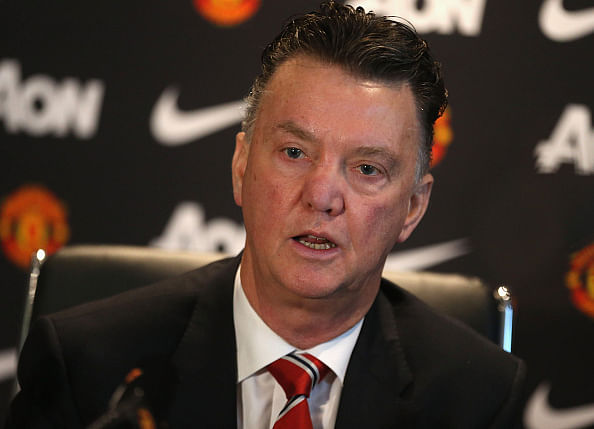
Louis van Gaal is the latest manager to criticize the Christmas scheduling


As Louis van Gaal said recently critiquing this, "I am not happy - but I cannot change it - because I don't think it is good for the players that they play within two days of a (previous) match - two matches in two days.”

"In December it shall be like that. We also have family. I have a wife and kids, and grandchildren, and I cannot see them this Christmas. But I want to work in the Premier League, so I have to adapt, and I shall adapt. But I don't think it is good. It is not good for the players, nor for the family."

Perhaps it’s about time ‘the best league in the world’ lent a caring ear to its primary stakeholders in order to further the interests of its clubs in the long run and not just its coffers.

Monday, November 11, 2013

European football: Zeroes of the weekend featuring Ramires, Dortmund and Manuel Pellegrini

They say a moment of brilliance can decide close games, but so can some horrific blunders, moments of madness that tend to change the game for the worse.

Along with its collection of heroes, the game throws up its fair share of villains who did their best to help their team in a losing cause or at worst leave a bad taste in the mouth with their actions.

Here are this week’s candidates:

Andre Marriner and Robert Madley
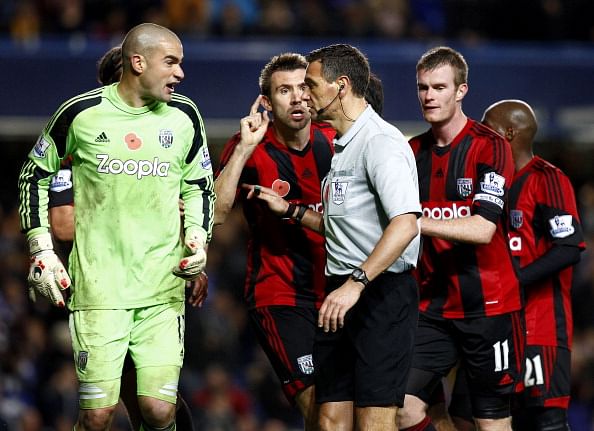
West Brom pair Boaz Myhill and Gareth McAuley appeal to referee Andre Marriner after he awards a late penalty to Chelsea during the Barclays Premier League match between Chelsea and West Bromwich Albion at Stamford Bridge on November 09, 2013 in London, England.


The two gentlemen Andre Mariner and Robert Madley were put on the spot, quite literally, as another week of Premier League action came to a close with two games being talked about for the referees and the decisions they made.

On Saturday, Mariner awarded the controversial last gasp penalty when he deemed that Ramires had been fouled in the box. West Brom were on the verge of a famous win at Stamford Bridge leading 2-1, before the penalty incident and Eden Hazard stepped up to slot home and keep intact Jose Mourinho’s record of never having lost a league game at home as Chelsea manager.

On Sunday, Madley was in the spotlight for similar reasons when he acted equally late in the game to award a rather harsh penalty to Stoke City when the ball brushed the hands of Wayne Routledge on its way out.

In Chelsea’s case, it was a clear dive from Ramires, who went down under the challenge of a normal shoulder dash. It was a harsh decision on West Brom, as even after conceding the second goal, Chelsea really had not looked very threatening.

The other game was in a very similar situation. An entertaining game at the Liberty Stadium had seen Swansea fight back from going a goal down to lead 3-2 going into the final minutes thanks to Wilfried Bony’s well taken double. The ball did brush Routledge’s hand, but he did not have his arms up in an unnatural position and the contact was merely  the consequence of the winger being in the way of the shot.

Charlie Adam converted the spot kick and Swansea were denied the full three points, just like West Brom.

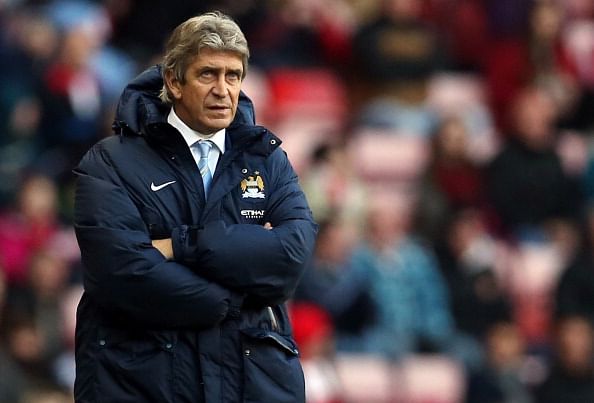
Manuel Pellegrini
Manchester City’s Chilean manager Manuel Pellegrini looks on from the touchline during the English Premier League football match between Sunderland and Manchester City at Stadium of Light in Sunderland, northeast England on November 10, 2013. Sunderland won 1-0


City have been woeful away from home this term; they have won just one of their five games, drawn another and lost three.

The pattern is getting a little worrisome for City fans as they see their team resplendent at home, putting away opponents with minimal fuss, yet the same sort of magic has not been replicated away.

Manuel Pellegrini will be asked some serious questions after his team selection left plenty of room for introspection. He fielded a back-four which has never played together before in Aleksandr Kolarov, Micah Richards, Joleon Lescott and Martin Demichelis.

He left out experienced heads Pablo Zabaleta and Matija Nastasic and played Javi Garcia in midfield ahead of Fernandinho. Did he think that Sunderland, being bottom of the table, afforded him that opportunity? Was it a case of complacency from City’s manager?

If yes, it did come back to bite them, especially so in the absence of their most creative player, David Silva, through injury.

Against Aston Villa, where they lost 2-3 at Villa Park, Garcia was played at centre-back ahead of Lescott.

Some of Pellegrini’s decisions have been baffling and a fair share of criticism for their away form could be apportioned to the Chilean.

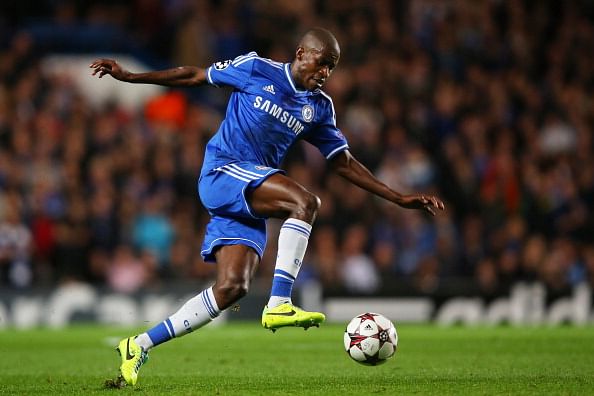
Ramires
Ramires of Chelsea runs with the ball during the UEFA Champions League Group E match between Chelsea and FC Schalke 04 at Stamford Bridge on November 6, 2013 in London, England


Chelsea’s Brazilian midfielder Ramires hit the headlines for his Ashley Young-esque dive on Saturday that earned his side a crucial last gasp penalty which was converted by Hazard to help them draw the game.
It was a blatant dive from the Brazilian and as much as Jose Mourinho ranted on about it being a knock-down penalty, he’s not fooling anyone.

The video replays clearly show that Ramires goes down under the most minimalist of shoulder brushes from Steven Reid.

The referee was at fault for not spotting the act from Ramires, but it was an ugly incident that Chelsea and the Brazilian could have done without.

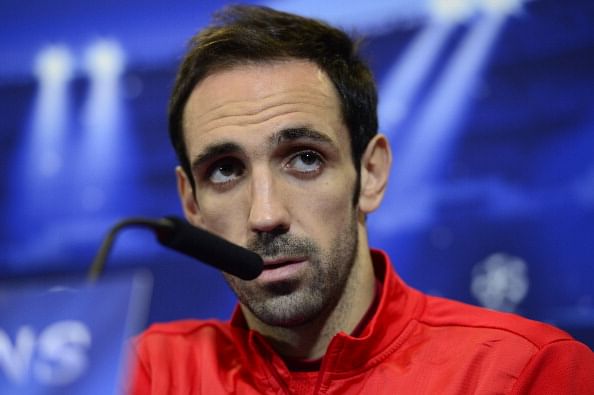
Juanfran

Atletico Madrid were held by Villareal to a 1-1 draw in an exciting clash at the El Madrigal. And the result meant that the one point lead to league leaders Barcelona is now three points.

Atletico had quite fortuitously taken the lead with an own goal, but Diego Simeone’s side returned the favour when Juanfran put through his own net with about 15 minutes to go to give the game a 1-1 ending.

Real Madrid also closed the gap to their city rivals with a thumping 5-1 win over Sociedad.

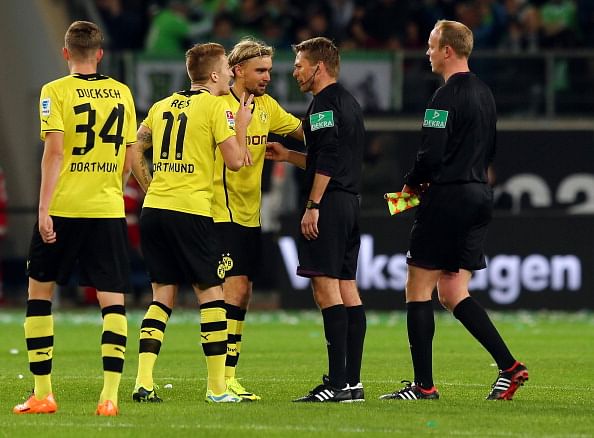
Borussia Dortmund
Marco Reus (#11) of Dortmund argues with referee Jochen Drees (R) after the Bundesliga match between VfL Wolfsburg and Borussia Dortmund at Volkswagen Arena on November 9, 2013 in Wolfsburg, Germany.


Having lost their midweek game to Arsenal, Dortmund suffered a second successive loss when they were beaten by Wolfsburg 1-2.

And on a day when Bayern Munich created a new record unbeaten streak with 37 games to further strengthen their position at the top of the table, it was lost ground for Dortmund.

Dortmund also suffered a major setback as Serbian defender Neven Subotic suffered torn ligaments and has been ruled out for an extended period, said to be a minimum of six weeks.

Klopp’s side were beaten by a wonder strike from Croatian striker Ivica Olic that sailed past the reach of Roman Weidenfeller.

You can’t really blame Dortmund for making any callous mistakes that cost them the game, but they were guilty of not finishing off some of the chances in both their games, against Wolfsburg as well as Arsenal.

As the home side, they did have good control of the game against Arsenal in the opening one hour, but failed to make the most of it. At one stage, the match stats read 14 attempts from Dortmund with 3 on target, while Arsenal’s was one attempt with one on target.

The goal made it two attempts with both on target.

These missed chances could have a larger implication in the larger scheme of things. Their loss to Arsenal pushed them back to third place in the group in the Champions League, and though they can still qualify, it would require a perfect performance in their remaining games.

In the Bundesliga, they have lost further ground to Bayern, who are still unbeaten. The gap is now four points with Dortmund set to welcome the champions to the Signal Iduna Park when hostilities resume on November 23 after the international break.

Saturday, May 25, 2013

Talking Tactics: How Bayern Munich have wrestled back some of the advantage from their rivals this season


The all-German final awaits us at Wembley tonight when Borussia Dortmund will meet Bayern Munich to decide who gets to take home this season’s UEFA Champions League crown.

SEASON HEAD TO HEAD
Games: 4 |Dortmund: 0 | Bayern: 2 | Draws: 2
In their successful Bundesliga run this year, Bayern pretty much obliterated every side in the league. Dortmund though defied them forcing draws in both of their encounters. Yet, Bayern have managed to wrest the advantage slightly from their rivals this term.

Bayern beat Dortmund 2-1 in the DFL Supercup (equivalent of the English Community Shield) right at the beginning of the season. Mario Mandzukic and Thomas Müller were the scorers on that occasion. Bayern also dumped them out of the DFB Pokal Cup in the quarterfinals, a superb Arjen Robben strike taking care of business. Both league meetings ended 1-1; the first was in December in which Mario Götze cancelled out Toni Kroos’ strike to earn a point for his current team. The second was a dead rubber in May, with the league title already wrapped up and both teams fielding reserves ahead of the big clash in the Champions League final.

This is a match up that the Black and Yellow have had the upper hand in during recent seasons. Ever since Jürgen Klopp’s arrival at the Signal Iduna Park, Dortmund have enjoyed much success against their more illustrious counterparts. Of the last 10 meetings between the 2 clubs, Dortmund have won 5 of them while losing just 2. Last season, they secured 1-0 wins home and away in the league, while dishing out a 5-2 thrashing, that included a Robert Lewandowski hat-trick, in the final of the DFB Pokal Cup (German Cup). In 2010-11 too, their first title winning season under Klopp, they did the double over Bayern winning 2-0 at home and 3-1 at the Allianz with Nuri Sahin having an outstanding game on both occasions.

CHANGE OF PERSONNEL & LEARNING FROM MISTAKES
So what did the trick for Bayern? How have they managed to get better against Dortmund while also becoming a more dominant force in the league?

Three reasons – Javi Martinez, Mario Mandzukic and Dante.

You have to appreciate how Bayern went about their summer transfer business. All buys were strategic in nature executed with a specific objective in mind and to cover up major weaknesses. And these 3 players have fitted in as the missing pieces of the Bayern puzzle in their respective roles.

JAVI MARTINEZ
There were gasps of breath that went around Germany including Bavaria when news broke that Bayern Munich have activated the release clause of Athletic Bilbao midfielder Javi Martinez. The Spaniard is a World Cup & European championship winner, but €40 million was an exorbitant sum, and was met with mixed feelings. His immense contribution in this Bayern team’s success will no doubt have pleased those 
Bayern fans while being a source of consternation for the rest of the Bundesliga and Europe.

Martinez plays as the holding midfielder along with club vice-captain Bastian Schweinsteiger. Previously, Schweinsteiger used to partner with Luiz Gustavo and at times, Anatoliy Tymoshchuk. Schweinsteiger is easily one of the best in his position in the world, but when they played Dortmund, he would end up facing the potent combination of Nuri Sahin/Lars Bender and afterwards Lars Bender/Ilkay Gundogan, after Sahin 
left for Real Madrid in 2011.
Dortmund’s high tempo attacking game with high energy pressing has caught the everyone's eyes. Up against them, Schweinsteiger used to get swamped by the yellow shirts because neither of Tymoshchuk or Gustavo could ever keep up with them. As a result, the German international spent a lot of time combating that midfield engine room of Dortmund’s which limited his participation in Bayern’s attacks.

Now he has a riding partner in Martinez, and the guy is an absolute terrier. At your heels all the time, the Spaniard has a terrific work rate and does not afford time and space to opposition midfielders when they have the ball at their feet. We got to witness this in both the semis and quarters, during Bayern’s games with Barcelona and Juventus respectively.
Lionel Messi was not 100%, true, but there was still the threat of Andres Iniesta to be met with. Even in games where Messi is well-marked, Iniesta has often popped up with the goods for them. Iniesta didn’t even have so much of a sniff as Martinez and Schweinsteiger cleaned crop. Against Juve, he did such a stellar job on Claudio Marchisio, that the Italian merely ghosted through the 2 legs as failed to get anything going for his team. The 2 together along with Ribery, Robben and Muller outworked and out-hustled Juve’s industrious midfield which is no easy task.The duo work very well in tandem as Martinez predominantly goes about winning the ball back and providing it to the German, who then recycles it and initiates a Bayern attack. So, now Schweinsteiger does not get overrun anymore and Bayern are able to combat Gundogan and Bender.

DANTE
Holger Badstuber, Jerome Boateng and Daniel Van Buyten used to take care of centre-back duties for Bayern in previous seasons. All 3 are good in the air, but neither was really a top level defender; Badstuber is essentially a left-back who started playing at centre, Boateng while good with aerial ability, is slow off the ground and lacks the pace to keep up with quick forwards. Van Buyten, now a veteran falls pretty much in the same category. In addition, Badstuber and Boateng were not the best in keeping their defensive shape, be it playing for offside or sitting deep with zonal marking. Dortmund with Mats Hummels and Neven Subotic held the upper hand here.

The Afro sporting Brazilian Dante was bought for €4.5 million from Borussia Mönchengladbach. Dante has come in and provided a ready fix to all of Bayern’s teething problems in defence. Thanks to him, the Bavarian giants have new found solidity at the back. Very good in organizing the defence, Dante is superb in the air, always a threat from set pieces and reads the game very well. He also has the quickness to deal with pacy strikers. In the past, Robert Lewandowski and Lucas Barrio have had the better of the Bayern defence often bullying them into submission. Last year’s Champions League final too was a fine example as we saw Didier Drogba boss Boateng, Van Buyten and Badstuber.
Finally, as is the case with most Brazilians, Dante is an excellent ball playing defender like David Luiz and Thiago Silva. And that’s an added quality which none of the other three can provide Jupp Heynckes with. With excellent full-backs on either side, Dante has plugged a major loophole that previously existed in the middle of defence.

MARIO MANDZUKIC
Croatian striker Mandzukic is the other major signing that has had an impact in the change of fortune for Bayern. Bought from Wolfsburg for €13 million, the striker has had a remarkable debut season with 21 goals. But more than his goals, it is the way he attacks the centre-backs of the opponent that often leads to stray passes and Bayern winning the ball back in dangerous areas of the field. Relentless and tireless is how the Croatian can be described. He does not boast of any extraordinary skill, but he is a top notch poacher. He is very good in the air, can win most aerial duels and makes fine runs to get into good positions in the box.
One would say that in Mario Gomez, Bayern already had that 20-goals-a-season striker. But, Gomez was never really active on defence and committed to pressing. Also, the Croatian can make his own shot, while Gomez used to rely on service into the box. In short, in Mandzukic, they have a striker who replicates the work that Lewandowski puts in for Dortmund. Against Juventus and Arsenal, Mandzukic constantly kept harrying and harassing the defenders and sums up how Bayern have adopted Dortmund’s ‘gegenpressing’ style, from front to back.

THE FULL BACKS & WINGERS
For Bayern Munich, their predominant outlet of attack is the wings, where Franck Ribery, Arjen Robben and Thomas Müller can use their pace and guile to good use. Their full-backs Philip Lahm and David Alaba make for one of the best pairings in the world and they constantly bombard forward to support their wingers.
What’s changed is that the 2 wingers, Robben and Ribery, are now tracking back to help out their colleagues in defence. Müller has always been committed on defence, but the dedication of the other 2 to Heynckes’ system has just made Munich that much harder to beat.

Again, they have taken a leaf out of Dortmund’s book, because that is exactly what Jakub ‘Kuba’ Blaszczykowski and Kevin Grosskreutz used to do for their defence and something which newcomer Marco Reus has continued. They are by no means, defensive-minded; ‘Kuba’ has 14 goals and 12 assists this season, Reus has 19 goals and 11 assists. But, their double-teaming on defence meant that Robben and Ribery were kept quiet in previous seasons and on the defensive end, Lahm and Alaba often found themselves with a 2-on-1 mismatch as Lukasz Piszczek and Marcel Schmelzer joined the attacks.
And that’s how Jupp Heynckes has managed to get his side to match up with Dortmund. As Jürgen Klopp pointed out, his team are still one of the few in the continent who can hurt Bayern. But, that gap has been bridged, with smart buys and by adopting some of their rival’s best practices. Together, the combination has worked wonders for Bayern and victory tonight will cement that shift of power that they have managed to achieve in the past 12 months. 

Friday, May 24, 2013

Borussia Dortmund vs. Bayern Munich: The showdown between ‘Kloppo’ and ‘Osram’


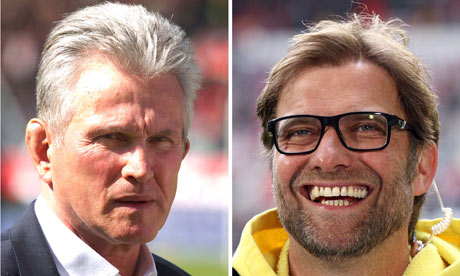
Germany’s top 2 clubs will face off in the UEFA Champions League final at Wembley tomorrow. Guiding them to the finals have been 2 managers who stand at opposite ends of the spectrum. Jupp Heynckes and Jürgen Klopp have masterminded their team’s successful runs to the showpiece final each with his own unique style.

The final is as much about the 2 managers as their teams; Heynckes is 68 and into his 25th and final managerial season and coming to the end of a highly successful career as coach. Klopp is 45, into his 10th season in management, is one of the finest young managers around and has a long way to go in his career. Both managers are hard task masters, but while Heynckes represents a more sullen, traditional serious approach, Klopp has a more modernistic, exuberant side to his management. It’s a battle of contrasting styles on the touchline in Wembley tomorrow night.

‘Kloppo’
Jürgen Klopp and his Borussia Dortmund side have become the darlings of the footballing world. Part of it is down to the brand of football that has been on display and part of it due to the charismatic nature of their manager. ‘Kloppo’ as he is affectionately called by his players has become an object of fascination for the media with his open and informal approach, especially at interviews. With his rugged looks, goofy smile & light-hearted humour, Klopp is a manager with something of a ‘rockstar’ image. He even resembles a stand-up comedian at times in his discussions with the press and has received as much attention and coverage as his team, perhaps even more.

Dortmund was Klopp’s first ever club outside of Mainz where he spent 19 years - 12 as a player and after retirement went on to serve as manager of Mainz for another 7 years. From 2005-2008, before he took the Dortmund job, Klopp was in a media role with German television network ZDF as an expert commentator for games involving the German national football team. In his 6 years at Dortmund, he has won 2 Bundesliga titles back to back and 2 German Cups. Wolfgang Frank, Klopp’s coach at Mainz is his role model and inspiration. Frank himself imbibed a lot from the work of Arrigo Sacchi at AC Milan and Klopp holds the Italian in high regard.

The ‘gegenpressing’ style of play, as it has come to be known, is what Klopp brought to the Ruhr valley club after he took over in 2008 and in the 5 years since, it has brought the club up the ladder to reach the very top. With a high work rate Dortmund work tirelessly with and without the ball and rapidly press and close down the opposition to try to regain possession all the way from centre-forward to centre-back. Although their pressing style resembles that of Barcelona, they attack with greater speed and intensity than the Catalan side whose priority is to retain possession of the ball and build up attacks in a more measured way. Klopp believes that open, exciting, attacking football is what Dortmund's loyal fans expect and deserve.
Klopp is never overly concerned about being politically correct. Of late, he has engaged in a bitter battle with Bayern Munich over the Bavarian giants poaching his best players and copying their style. "What can I say?" Klopp said with a shrug when asked about Bayern poaching his best players. “We are not a supermarket but they want our players because they know we cannot pay them the same money. If that's what Bayern wants... It's like James Bond – except they are the villain." He also compared them to China in their quest to be the best saying, “Right now, it’s a bit like what the Chinese do in economics or industry. Watch the others and plagiarize what they do. Take the same path, only with more money and other players. And for the moment, you will be better again.”

Captain Kloppo is on a mission as he looks to inflict a damaging loss on his bitter rivals to leave them with a third final defeat in 4 years as a means of some retribution after being forced to part with not only their Bundesliga and German Cup titles, but also their talismanic playmaker in Mario Götze, whose services he will be without in tomorrow’s final.

‘Osram’
As much coverage that Jürgen Klopp has received from the electronic and print media, Jupp Heynckes has received zilch. It is not exactly Klopp’s fault for he is not an attention seeking man, unlike the ‘Special One’, but it’s just got to do with the media houses who tend to be a little unfair in shutting out the unglamorous characters of the footballing world.

The nickname for Heynckes, borrowed from the German lighting company, came about for the way in which his face tends to redden or bear a reddish glow when he gets agitated on the sidelines. It was first used by Rudi Gores, a former German footballer and coach. That’s about all the emotion the veteran German coach exhibits during a game as opposed to the myriad expressions that one can see from Klopp. A stoic, low profile man, Heynckes is one of the most decorated coaches in German football.

A well-travelled man, the wily German has managed clubs in Germany, Spain and Portugal and is one of the most experienced hands around. He has won 3 Bundesliga titles, 3 German Cups (all with Bayern Munich) and 1 Champions League (with Real Madrid) in his long tenure, this is his 27th season in management. The silverware maybe less when compared to some others, but that’s not accounting for the work that he has done at some of the smaller teams in Spain and Germany such as Athletic Bilbao and Schalke, where he led them from mid-table obscurity to qualifying for European competition.

He was also a predator of a forward in his playing days and has both a European Championship (1972) and World Cup (1974) winners medal to his name. At club level he won 4 Bundesliga titles, 1 German cup and 1 UEFA Cup with Borussia Monchengladbach, a club where he played 12 of his 15 seasons as a professional footballer. And yet, despite all that he has done, Heynckes has never received the credit due to him.

Heynckes of course has not let any of that affect his performances on the field, be it as player or manager. There has been untoward criticism hurled at him by fans and media in the various countries that he has been, yet the man has managed to keep his head and continue doing what he does best – deliver results.
When he came back to Bayern for a third stint in 2011, the team was in a shambles ridden with internal squabble and indiscipline and also defensive frailties. Heynckes has gone about carefully rebuilding this team since then and after being outgunned to the Bundesliga title the last two years by Borussia Dortmund, Bayern have returned with a bang conquering all in their path as they romped to the title this year.

Bayern too under Heynckes are pressing the ball a lot better allowing teams very little time on the ball. During their 7-0 mauling of Barcelona in the semis, Xavi, Andres Iniesta and Lionel Messi constantly found themselves shackled and harassed by a player in a red shirt and the various channels that Barca constantly use were expertly cut out.

“You have got to analyse how an opponent plays, where they run, how they attack. Then find something you can hold against that.” – said Bayern’s coach after the Barca win. That is vintage Heynckes; who is known to be a master tactician and a manager who spends an incredible amount of time in meticulously preparing for a game.

A FINAL TO RELISH
Borussia Dortmund are in uncharted territory, most of this season's Champions League campaign has been. It has been 16 years since they won their only European Cup in 1997 and this run marks a return to prominence for Borussia on the European stage. For Bayern Munich, it is an opportunity to right the wrongs of previous finals. The pain of those 2 finals losses still lingers, especially the one last year in front of their home crowd, and Heynckes will be keen to set that record straight. 

Dortmund have come to dominate this rivalry in the past few years - Bayern have won only 2 of their last 10 meetings, losing 5 and drawing the remainder. This season, Bayern brushed past every other club in the Bundesliga save for Dortmund. The one win they did have was a narrow 1-0 victory in the DFB Pokal Cup. 

If he wins tomorrow night, he will become only the 4th manager to win the Champions League with different clubs – after Ernst Happel, Ottmar Hitzfeld and Jose Mourinho. And if Bayern follow that up, as they are widely expected to, with winning the German Cup, he will have achieved an unprecedented treble, something never done before by a German club and achieved only thrice previously in history – PSV Eindhoven in 1988, Manchester United in 1999 and Barcelona in 2009.
History beckons for Heynckes as he looks to leave Bayern Munich on the highest pedestal possible. While the man in the opposing dugout, Jürgen Klopp, is looking to challenge the dominance of mighty Bayern on the European stage, Heynckes knows that victory tomorrow could well be the starting point of a new era of dominance for Bayern Munich, not just over Dortmund, but the whole of Europe.


Borussia Dortmund vs Bayern Munich.

Klopp’s ‘Band of Merry Men’ vs Heynckes’ ‘Mean Machine’!

It is truly an occasion to savour!

Thursday, May 23, 2013

The 3 previous Intra-national UEFA Champions League finals


Tomorrow’s UEFA Champions League final showdown between Borussia Dortmund and Bayern Munich will be the 4th instance of an intra-national final, where 2 teams from the same country have met in the championship clash. Each of the 4 instances has belonged to a different country with Spain, Italy and England represented on the previous 3 occasions. Germany will make its bow tomorrow. 

            Real Madrid 3-0 Valencia, 1999-2000 Final @ the Stade de France, Saint-Denis

The very first instance was when Real Madrid met Valencia in the 2000 final. This edition saw the introduction of the second group phase, where the top 2 teams from the 8 groups would again be divided into 4 groups and another run of round-robin matches.

This was the pre-Galacticos era at Real under Vicente Del Bosque and they had a fine team made up of a lot of Spanish talent led by the likes of Raul, Fernando Morientes, Michel Salgado and Iker Casillas. Current Real Madrid assistant manager Aitor Karanka was also part of this team. Real Madrid topped their group suffering just one loss and in the second group phase finished runners-up behind Bayern Munich. They finished strongly though as they got past 2 very strong teams en route to the final - Manchester United, who were the defending champions, in the Quarterfinals and then Bayern Munich in the semi-finals.

Valencia weren't doing so badly themselves with arguably their ‘Golden Generation’ of Gaizka Mendieta, Miguel Angulo, Claudio Lopez and Santiago Canizares. Just like Real, they would win the first group phase, ahead of Bayern Munich and finish runners-up in the second, behind Manchester United. They trounced Lazio and Barcelona in the quarters and semis respectively scoring 5 goals against both over the 2 legs.

The final had a tight beginning before Madrid began to exert themselves on the game and took the lead through Morientes. Steve McManaman had a marvelous game for Los Blancos and he scored the 2nd with a spectacular volley. Raul then rounded it off with a 3rd goal on 75 minutes when Real caught Valencia napping on the counter. It was Real’s 8th European Cup.

Steve McManaman was voted the Man of the Match. Incidentally, he became the first Englishman to win the tournament with a foreign club. Raul finished joint top scorer with 10 goals. Valencia finished runners-up again the next year when they lost on penalties to Bayern Munich after it ended 1-1 in regulation and extra time.

AC Milan 0-0 Juventus, 2002-03 Final @ Old Trafford, Manchester
Juventus came into the final fresh from being crowned Serie A champions; Milan on the other hand had finished 4th, 16 points behind the Turin club. In the season head-to-head, Juve had won the home game while drawing away at the San Siro. They had also beaten Milan in the Coppa Italia semi-finals.

The 2-group phases structure was still on; Juventus topped their first group while finishing runners-up to Manchester United in the second. They ended Spanish hopes in the competition as they beat Barcelona in the quarters and Real Madrid in the semis. Influential midfielder Pavel Nedved though would miss the final after picking up a booking in the 2nd leg against Real.

Milan came in winning both the groups including a strong second group phase pitted with Real Madrid and Borussia Dortmund. After beating Ajax, they had to contend with neighbours Inter in a Milan derby semi-final. It ended level 1-1 on aggregate with Milan progressing on the away goals rule.

The final was a game of few chances and one of the dullest of the last decade and a half. Both teams had excellent defences which ensured that chances were at a premium. Andriy Shevchenko had a goal disallowed in the first half though replays showed that Rui Costa had not been in an offside position. 
Current Juve manager Antonio Conte came on as a sub and saw a header clatter the crossbar in what was Juve’s best chance of the game. Andrea Pirlo too struck the post for Milan.

With no result even after extra time, the match went to penalties and It was a tense, tense affair. Juventus only made 1 of their first 4 penalties as Dida saved the efforts of David Trezeguet, Marcelo Zalayeta and Paolo Montero. Gigi Buffon was doing his best to keep Juve in the game as he saved from Clarence Seedorf and Kakhaber Kaladze. Alessandro Del Piero converted the 5th spot kick for Juve, but so did Shevchenko to clinch the trophy for the Rossoneri. It was Milan’s 6th European Cup.

Paolo Maldini was named the Man of the Match for the final. Filippo Inzaghi was the 2nd highest goal scorer with 10 goals behind Ruud Van Nistelrooy who bagged 12 for Manchester United. Shevchenko became the first Ukrainian footballer to take home a European Cup winners medal. 

Manchester United 1-1 Chelsea, 2007-08 final @ Luzhniki Stadium, Moscow
England’s top 2 teams met in the Moscow final of 2008. Manchester United had just won their 17th league title finishing 2 points ahead of their final opponents Chelsea. Each team had won their home game in the league, while Chelsea had the latest win after beating United 1-0 in the FA Cup final days earlier.

Man United went unbeaten the whole tournament. They drew just 1 game in winning their group comfortably. They then beat Lyon in the Round of 16, which had now replaced the previous format and Roma in the quarters. Frank Rijkaard’s Barcelona stood between United and their 3rd European Cup final. The teams had identical records going into the semi-final, each having won eight and drawn two of their ten games, scoring 18 goals and conceding just 5. Cristiano Ronaldo missed an early penalty in the 1st leg at the Camp Nou and that leg ended 0-0. United edged into the finals with a tight 1-0 home win thanks to Paul Scholes’ long range stunner.

Chelsea had seen a change of manager after Jose Mourinho parted ways in between the season. Interim manager Avram Grant did a good job though as he kept the Blues in the title hunt in the league and guided them to the FA Cup and Champions League finals. Chelsea lost just the one game in the tournament, against Fenerbahce in the quarterfinals. After getting past Olympiacos and Fenerbahce, Chelsea took on Rafa Benitez and his defending champions Liverpool. This was the fourth year in succession that these teams had met in the Champions League. After drawing the first leg 1-1 away, the Blues won a tense 2nd leg 3-2 after extra time to make the team’s first visit to the Champions League final.

After taking time to feel each other out, the final picked up pace with Ronaldo’s opener on 26 minutes. United had 2 good chances to extend the lead, but Petr Cech came to Chelsea’s rescue with some magnificent saves. Frank Lampard equalized for Chelsea in the closing minutes of the first half after Michael Essien’s initial shot had deflected off Rio Ferdinand and Nemanja Vidic.

The goal swung the momentum in Chelsea’s favour and the Blues dominated for much of the second half. Drogba went close to giving them the lead when his effort hit the post. Ryan Giggs had a chance to get the winner for United, but John Terry made a last ditch tackle to prevent it. It was end –to-end in extra time as both teams went looking for the winner. Late in extra time, Drogba was sent off for a slap on United’s Vidic.

In the shootout, Ronaldo missed his penalty which gave Chelsea the advantage. Blues captain John Terry stepped up to take the 5th penalty, but he would miss as he lost his footing which saw his mis-hit shot hit the outside of the right post and go wide. In sudden death, Edwin Van der Sar saved Nicolas Anelka’s shot to win it for United.

Van Der Sar took the Man of the Match award. Cristiano Ronaldo finished top scorer with 8 goals.

Borussia Dortmund  vs Bayern Munich, 2012-13 final @ Wembley, London
One-sided final like the 2000 edition or nail biters like the other two? We will find out on Saturday. The 2 league meetings between the sides both ended 1-1 and Bayern beat Dortmund 1-0 in the quarterfinals of the DFB Pokal Cup.

Dortmund will be without star play-maker Mario Götze due to injury which means he has already played his last game for Dortmund; he will be joining Bayern Munich in the summer.

Tuesday, April 30, 2013

BORUSSIA DORTMUND: From the brink of bankruptcy to Bundesliga Champions and more...


Real Madrid will take the field at the Santiago Bernabeu tonight on the verge of making their third consecutive exit at the semi-final stage of the UEFA Champions League. The reason for their current predicament is a team from North-West Germany adorned in Black and Yellow. They trail 1-4 from the 1st leg to their semi-final opponents Borussia Dortmund and while it would be foolhardy to discount any hopes of a comeback, the task in front of them is an arduous one.

For Dortmund, this stage represents a culmination of the club’s efforts to get back on track following a tumultuous few years in the past decade. BVB 09 as a club almost ceased to exist, but they have managed to climb out of the depths of battling for relegation into once again pulling their weight at the top of the Bundesliga.

‘Borussia’ for Beer
On 19 December, 1909, a group of 17 young men, mostly steelworkers and miners, founded the club of Ballspielverein Borussia 09 e.V. Dortmund; the name ‘Borussia’ is Latin for Prussia, but the youth actually went for that name in honour of their favourite beer served in the pub where they used to frequently gather. That’s how one ‘Borussia’ of the alcoholic kind lent its name to another one of the sporting kind.

Dortmund’s financial troubles in the early 2000’s are well documented. However, that wasn’t the first instance of the club being bailed out of trouble. Way back in 1929, the club had its first taste of bankruptcy when an attempt to sign professionally paid footballers fell flat on its face and left the team deep in debt.  A local supporter of the club eventually managed to cover the team’s losses out of his own pocket and that ensured the continued existence of the football club.

Enjoying modest success before the war, Borussia really came into their own during the formative years following the end of World War II. They managed to win 3 National titles before the Bundesliga as a concept came into existence. The inaugural season of the Bundesliga saw them finish fourth. In 1966, the club became the first German team to win European honours (yes, even before Bayern Munich) when they beat Liverpool to lift the European Cup Winners’ Cup.

THE ROLLER-COASTER RIDE

For much of the next 2 decades, Dortmund enjoyed limited to moderate success, encountering a few relegation battles, some failed and some successful, along the way. Their return to prominence began with their 1989 DFB Cup final victory over Werder Bremen, which happened to be their first trophy in 23 long years.
What followed was perhaps one of the most successful periods in the club’s history; in a span of little over 10 years, Dortmund won the Intercontinental Cup (1997), the UEFA Champions League (1997) and 3 Bundesliga titles (1995, 1996 and 2002). This phase in their history has come to be known as the ‘Golden Age’ of Borussia Dortmund.

But, Borussia’s history has often resembled a sine curve, high one moment followed by massive lows. The fall from grace began with Dortmund becoming the first, and so far only, publicly traded club to be listed on the German stock market.  After securing their 3rd Bundesliga title on the final day of the 2001-02 season things began to go south.

The next few years saw a steady decline in Dortmund’s fortunes plagued by poor financial management that led to the club becoming steeped in debt. It forced the sale of their Westfalenstadion ground to try and pay off some of that debt. €2 million was loaned from Bayern Munich in order to pay off the players’ wages for a couple of months in 2003. Part of the reason for their stadium being called the ‘Signal Iduna Park’ is the sponsorship agreement the signed with a local insurance company in an attempt to arrest rising debt.
2005-2008 caused more angst to Dortmund fans. Top players such as Tomas Rosicky, David Odonkor and Christoph Metzelder all exited and in the 2006-07 season saw them teeter perilously close to relegation.
The current phase that has seen the club claim back-to-back Bundesliga titles and currently challenge for honours in the Champions League is the most positive one after the ‘Golden Age’. Both phases have been overseen by managers whose appointments at the time were viewed as risky, but turned out to be excellent choices going forward.

THE GENERAL
A man who can be credited with overseeing most of the success in the ‘Golden Age’ is legendary German coach Ottmar Hitzfeld. Hitzfeld is one of only 3 managers, Ernst Happel and Jose Mourinho being the other two, to have won the Champions League with 2 different clubs.

In 1991, the Borussia board decided to entrust Hitzfeld, at that time still relatively inexperienced, with the responsibility of bringing Dortmund back into the big league. In his very first year in charge, he took the team to second spot in the league managing to secure a UEFA Cup place in the process. The following season Dortmund reached the finals of that very tournament, but they would finish 2nd best to Juventus losing both games of a two-legged final. In 1995, Dortmund claimed their first Bundesliga title (4th national title overall). They went on to do a repeat the next season successfully defending the title. The greatest night though in Borussia Dortmund’s history was to come the following season.
The 1996-97 saw Dortmund finish third in the league, but Hitzfeld’s team managed to reach the Champions League final where an old foe in Juventus lay in wait. This time Borussia prevailed 3–1 in the final at Munich’s Olympic Stadium. This was no ordinary team as it featured the likes of Zinedine Zidane, Didier Deschamps, Alessandro Del Piero and Christian Vieri amongst others. That made the victory all the more special and Hitzfeld was rewarded for the first time with the "World Coach of the Year" award.
That would be Hitzfeld’s final contribution as manager of Borussia Dortmund as he would go on to take a job upstairs as Sports Manager with the club.

CAPTAIN ‘KLOPPO’
Jürgen Klopp was summoned at the end of the 2007-08 season to take charge. This was to be Klopp’s first stint outside of Mainz as he spent 19 years at the club – 12 as player and when he retired went on to serve as manager of Mainz for another 7 years. A squad of players costing somewhere in the range of €15-€20 million Euros in its entirety was put together. 

A 6th place finish in the very first season, followed by 5th a year later, showed positive signs for the Rhine valley club. But, what caught everybody’s attention is their defeat of Bayern Munich in the DFL Super Cup in his first year. That was an upset and a sign of things to come as Dortmund would go on to win successive league titles in 2010-11 and 2011-12 completing a first double with their cup win to boot last season.
‘Kloppo’ since his arrival has got the team playing with a renewed charisma and passion and he has had young players who have been able to carry off his high work rate, slick passing brand of high octane football. Many of that motley crew assembled for around €20 million are now superstars in their own right.

COPING WITH EXITS

A large part of the current squad has been together since Klopp took over with a few additions to replace outgoing stars along the way. What has been remarkable is the team’s failure to cope with the departure of some of its star names.
Nuri Sahin was lured away by the temptation of Real Madrid; since then he has had 2 ineffectual seasons, one with Real and the second half a season on loan with Liverpool. He is now back at Dortmund having re-joined in January.

Meanwhile, his club did not too fare too badly as they went on win the title yet again. Ilkay Gundogan was brought in from FC Nuremberg to fill the vacancy and the German midfielder’s influence since signing for Dortmund has been spectacular. He was imperious in the first leg against Madrid and along with Sven Bender completely too control of the midfield leaving Sami Khedira and Xabi Alonso to feed off scraps.
The next season, Shinji Kagawa left for English shores as Manchester United came calling. Marko Reus, one of the hottest young players around, was signed from Borussia Monchengladbach as a replacement and he has had a stellar season. After a slow start, Dortmund have managed to get back to 2nd position and stand 1 step away from a possible final appearance in this year’s UEFA Champions League.

A STRONG CORE
Part of the reason why they have managed to cope so well is the retention of a strong core of players. Mario Götze, Robert Lewandowski, Mats Hummels, Neven Subotic, Lukasz Piszczek, Jakub Blaszczykowski have provided a strong base for Klopp to be able to deal with the loss of 1 or 2 players. Dortmund’s ‘Golden Age’ was driven by the trio of Mathias Sammer, Andreas Möller and Lars Ricken.

After almost a decade since that trio last played, another impressive quartet of players has engineered the club’s more recent successes. Lewandowski, Götze, Reus and Blaszczykowski are easily one of the best attacking quartets around capable of punching a hole in any opposition defence.

KLOPP & HIS BAND OF MERRY MEN
Just like Robin Hood and his band, Jürgen Klopp and his band of players have caught the footballing world by storm. Much like the famous brew that the club derives its name from, watching Borussia Dortmund in action guarantees fun and excitement and brings a smile to your lips, just like a good mug of beer.
Reflecting Klopp's strong commitment to playing fast, free-flowing football, Dortmund work hard and press teams high up the pitch. Although their pressing style resembles that of Barcelona, they attack with greater speed and intensity than the Catalan side whose priority is to retain possession of the ball and build up attacks in a more measured way. Klopp believes that open, exciting, attacking football is what Dortmund's loyal fans expect and deserve. How refreshing to hear such a positive attitude towards football and fans.
And the clubs fans have showed their support through thick and thin. Even when in the depths of despair during their financial struggles, Dortmund still managed to rake in average attendances in excess of 70,000. And with the new ‘Yellow Stand’ as it is called, where fans are allowed to stand with a mug of beer in hand and singing and dancing away in their numerous bands, the Signal Iduna Park swells to over 80,000.


ROAD TO WEMBLEY

Borussia Dortmund have relinquished their Bundesliga title to an all-conquering Bayern Munich side. Their late show against Malaga that took them into the semi-finals and the supremely confident performance in last week’s 1st leg versus Real exemplifies the spirit within this squad and the kind of passion and confidence that Jürgen Klopp has instilled at the club. Though the 2nd leg remains, the Germans are expected to progress barring a miraculous Real turnaround. 

After that, a potentially lip-smacking clash with rivals Bayern Munich awaits. With Mario Götze already signing for Bayern and Lewandowski set to follow his mate out of the club, it represents a last chance for a final hurrah for this group of players.
2 games away from repeating the heroics of the Class of ’97, Klopp and his players have come a long way in putting Borussia Dortmund back on the European footballing map. Going all the way and winning the final in Wembley will just about be the exclamation mark on their efforts!