Showing posts with label Lionel Messi. Show all posts

Tuesday, October 14, 2014

From Barcelona to Bayern Munich: The evolution of Pep Guardiola’s intriguing formations

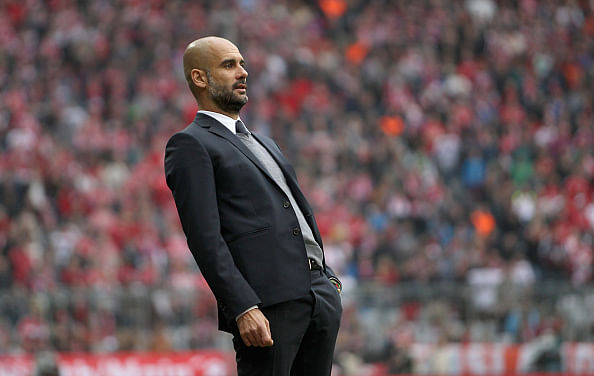
Pep Guardiola
"I give you my word that we will put in an effort. I don't know if we'll win, but we'll persist. Put on your seat belts, because we're going to have fun."

Two trophy-less seasons had passed at the Nou Camp when ‘Pep’ Guardiola was appointed manager of FC Barcelona ahead of the 2008/09 season; the above were his words during his presentation to the fans. He was tasked with resurrecting the fortunes of one of the most famous European clubs in football and bringing back the glory days to Catalonia.

Six full seasons on, he stands out as one of the best managers in world football, the reputation of both Barcelona and his own personal brand greatly enhanced.

The name Guardiola does not merely represent a man any more; it has come to represent a faith, a belief, a philosophy; one that has delivered success on a consistent basis at the highest level. Whether you love his tactics or hate them, there is no disputing the fact that ‘talking tactics’ and ‘formation fiddling’ just went up to a whole new level with his coaching in play. And if there’s one word that would aptly sum up all of Guardiola’s coaching adventures so far, it would be ‘dynamism’.

With Europe’s top leagues on hold due to the international break, it’s a good time to take a look at the evolution of Pep’s formations from Barcelona to Bayern Munich. For ever so quietly, away from the main stories making the rounds in the continent, Guardiola’s Bayern have made another impressive start and are looking the best amongst all the reigning league champions. That’s not all; Guardiola has thrown in another new tweak in the Bavarian giants’ strategy, which has been quite fascinating.

Pep’s Barcelona and the 4-3-3

Even before we get to talking about the actual formations, I think it is essential that we fully recognize Pep’s philosophy – the philosophy to build teams on the foundations of unison, work rate, patience, ball movement, zonal play, positional play and finally dynamism, both in formations as well as personnel. Each of Guardiola’s acquisitions was done with a specific goal in mind.

In his all-conquering first season, when Barcelona won the treble, Guardiola operated predominantly with a 4-3-3 formation. While many critics believe that all he did was put together a group of some of the most talented players around, that is not necessarily true. Guardiola had a plan and a reason for putting in each of the players that he inserted regularly into his line-ups.

Holding possession by moving the ball both laterally and forward with crisp, short passes was the principle that they religiously stuck to. And they would wait for their opportunities when the opposing defence would get unhinged to strike the final blow. This early version though played slightly quicker, largely due to the presence of forwards Thierry Henry, who played wide left, Samuel Eto’o, who played through the middle, and Lionel Messi, who started wide right.

Behind that trio was Sergio Busquets, promoted from the B team, in the holding role, with Xavi and Andres Iniesta to his right and left respectively. Eto’o at the time was at the height of his powers, while Messi had still not reached his magical peak yet. So utilizing the pace and power of Henry and Eto’o, while relying on Messi’s ability to dribble and draw defenders, was essential.

Xavi played behind the front three as the deep-lying playmaker and Busquets played the roles of anchor-man and Xavi’s wingman, always moving with him, protecting him from opposing defenders and acting as a foil to receive and spray passes. He was also the added cover for the backline, slotting in for one of the centre-backs, notably Gerard Pique, whenever he ventured forward.

Iniesta would venture further forward as the advanced playmaker, either going central to support the forward trio or taking up the space out wide vacated by Henry or Messi. This also required a very hard-working central striker and Eto’o did just that, sometimes falling back to receive the ball and actually allowing Henry and Messi to work as a front two.
Messi’s conversion into a striker opened up a world of possibilities for Barca
Subsequently, Guardiola converted Messi into a full-fledged striker from a winger, and Eto’o and Henry would depart. Zlatan Ibrahimovic was bought in as Guardiola wanted to find a different way of scoring goals, but that experiment didn’t go very well and he used him sparingly.

This was when the triangle offense really came into its own, as Barca’s players would move forward with the ball, triangulating their passing with almost geometric precision to unseat teams. Can you believe that 2008-09 was the last time that Messi scored less than 49 goals in all competitions?

David Villa would take up Henry’s role out wide on the left after the Frenchman’s departure, and Pedro would take up the wide right position. However, Pedro wasn’t a regular in the team and Guardiola would go quite a few games with Iniesta/Villa/Messi as the front three.
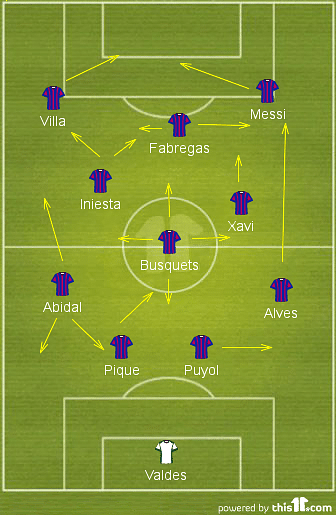
Fabregas playing as a false forward
Then came the acquisition of Cesc Fabregas and the introduction of the false nine concept. With Fabregas and also Alexis Sanchez in the side, Guardiola had a new level of freedom and dexterity with which to operate. Both Fabregas and Sanchez could play in a multitude of positions, which is why they were bought. Fabregas enabled Pep to play the striker-less formations, the conventional 4-4-2 with Messi and Pedro/Sanchez up front, and the 4-1-3-2 with him playing in a midfield three with Iniesta and Xavi and Pedro, and Sanchez either side of Messi up front.

Defensively, Alves would bomb forward on the right with Puyol covering for him. That would result in Abidal falling back into the left side of a back three, with Pique and Puyol. Also, the long balls were sparingly employed by Pep’s Barca sides as they lacked the height and physicality up front and also because their defenders were more comfortable playing the ball out on the ground as Pique continuously did. Pique’s forays forward also meant a covering job for Busquets to drop back and aid Puyol and Abidal.

Throughout his time at Barca, there were two players outside of Messi that were of utmost importance to make the formation work and make it dynamic – Alves and Abidal.

Alves was key in the attacking areas of the right flank. His intricate interchanges with Messi in the opposition half were among Barcelona’s biggest threats. When Messi moved into the middle as a false nine, Alves continued to play high up the pitch, importantly stretching the play, especially since both Villa and Pedro too were more inclined to move in from out wide.

Alves’ ability to go up and down so regularly and with such frightening results made up for the lack of a right winger or right midfielder. His forward menace also managed to keep the opposition left-back pinned down in his own half.
Eric Abidal (left) celebrates scoring a goal with Dani Alves (right) in a Copa del Rey match against Real Madrid at the Santigao Bernabeu in January 2012
Abidal was hugely important in compensating for Alves. He would push forward when necessary, but his ability to sense danger and drop deep to operate as an additional third centre-back when required were irreplaceable. He also covered for Busquets and Pique in their respective roles whenever Barca were in pursuit of a goal and pushed more bodies forward. Abidal was the guy who made the formation tick at the back with his amazing ability to play left-back, centre-back and defensive midfield to perfection.

All in all, Guardiola’s formula at Barca for much of his stay was built on the full-backs, dribbling centre-backs, the wide forwards who would dart in and the midfield duo of Iniesta and Xavi and later the concept of the ‘false forward’.

Bayern 1.0 – Beginnings with 4-1-4-1

German giants Bayern Munich came calling for Guardiola’s services and he agreed to take over the reins from the 2013-14 season onwards in what was a tough act to follow as his predecessor Jupp Heynckes signed off in some style leading the Bavarians to a historic treble with a team that was devastatingly destructive.

Bayern 1.0 saw Guardiola employ a 4-1-4-1 formation. This formation was built to explore Bayern’s depth in midfield especially around the ability of Toni Kroos to distribute, move up and down the middle of the pitch and also play as a playmaker. While at Barca, Guardiola had players of short stature at his disposal who were very good in possession; at Bayern he had more direct players in the likes of Thomas Müller, Arjen Robben and Franck Ribery and he tried to cater to their strengths by banking on the influential Kroos.
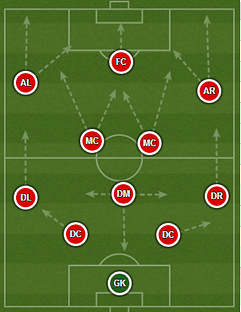
The 4-1-4-1
Philip Lahm, possibly the best right-back in the world was given a new role by Guardiola as a holding midfielder breaking up the erstwhile duo of Bastian Schweinsteiger and Javi Martinez that his predecessor used to telling effect. His need for a more mobile holding player with good passing range saw him make the shift and that meant Rafinha would take Lahm’s place at right-back.

However, the full-backs under this system were part of a mobile triumvirate that would move up and down with Lahm and would more often than not join up with the two central midfielders to make a four in the middle occupying the space vacated by the two wingers who’ve joined up in attack. The use of ‘false full-backs’ was made possible by the presence of Ribery and Robben, who provided the width with their forays out wide to reduce the necessity for advanced full-backs. In the absence of one or both, Alaba and Rafinha tended to play in a more traditional full-back role.

And it was that versatility that got them off to such a flying start last season, eventually helping them win the Bundesliga at a canter. Opposing teams simply could not handle the many different attacking formations in the form of an attacking double-pivot of either Götze/Robben, Götze/Müller or Müller/Robben. Also, unlike at Barca, this Guardiola team played a good number of good long balls because – a. their defenders weren’t the dribbly kind like Pique and b. the presence of aerially gifted players such as Müller and Mario Mandzukic.

The presence of multiple playmakers ensured that they could swap roles freely and the ones not on the ball could then run the channels effectively, complementarily opening up space for each other to operate in.
The overlying emphasis of this formation was to always have three central midfielders on the pitch at any point of time. That’s why Pep went out and bought Thiago Alcantara, not for old time’s sake. Lahm explained as much in an interview last year:

“Also, outwardly it appears as if we’ve changed our system, but if you look more closely we still have three central midfielders on the pitch. Whether there’s one No.6 [a primarily defensive holding midfielder] and two No.10s [offensive midfielders], or one No.6 and two No.8s [more creative holding midfielders] or maybe one No.8, one No.6 and one No.10 – there are three players in central midfield. To give you an example, last season Toni Kroos [a typical No.10] sometimes played in the No.6 position alongside Bastian Schweinsteiger. It’s open to debate whether or not you could have spoken of two No. 6 players in those moments. So each of the three players fills the position with his own identity and his characteristics. That is what counts.”
 
The attacking pivots also helped in pressing from the front and while not as intense and harrying as they were under Heynckes, Bayern were still very effective doing their version of the Barca press to dispossess opponents.
The difference in Guardiola’s triangle systems at Barca (above) and Bayern (below)
This formation was another continuation in the triangle system of Guardiola, except that instead of widening the pitch to stretch the defence like at Barca, here the system was about overloading the centre of the park with triangles formed all around the centremost midfielder, usually either Kroos, Lahm or Schweinsteiger.
And this system also kept up the bargain of tactical flexibility for Guardiola as it could morph into a 3-4-1-2, 4-4-2, 4-3-3, even a 2-4-4 at times if chasing a game.

The 4-1-4-1 for all its tactical nuances had some weaknesses. It involved the full-backs playing almost as midfielders and with Lahm’s solidity no longer present at right-back, it exposed Bayern, who played a high defensive line, to individual mistakes and long passes. And as brilliant a sweeper-keeper as Manuel Neuer is, he could not always save the day for them, especially against quality opposition.

When used ineffectively the overload of playmakers in the centre muddled the midfield and made their attack look toothless and the build-up slow. Also, they could almost never capitalize on quick counter-attacking opportunities.
Bayern wore a dejected look as they were taken apart by Real Madrid
All of this came to a head in their semi-final tie against Real Madrid in last year’s UEFA Champions League. Madrid were a side perfectly built to expose each and every flaw of this system and it was a matchup nightmare for the German side. A front six of Cristiano Ronaldo, Karim Benzema, Gareth Bale, Angel di Maria, Luka Modric and Xabi Alonso had too much pace, power, and on-ball ability to be contained by the 4-1-4-1. Ronaldo and Bale ran roughshod over the two ‘false full-backs’ and Benzema’s movement in combination with one of the two plus di Maria took the two centre-backs out of the equation as well.

Also a few players such as Mandzukic suffered as he was forced to make runs out wide and become a provider at times instead of a goal threat and that saw him lose his starting spot to a midfielder with Guardiola preferring to play Müller as the lone striker instead. Ribery and Robben were forced to make the unnatural shift to receiving the ball and quickly giving it back, instead of venturing forward to take on the defenders which took the destructive nature out of Bayern’s attacks.

Bayern 2.0 – A 3-4-3 

With all that had gone by and seeing the limitations that the 4-1-4-1 caused, Guardiola introduced a 3-4-3 system against Borussia Dortmund in the DFB Pokal final of last year to redeem himself after the chastening defeat to Madrid. And he has continued with it this season.
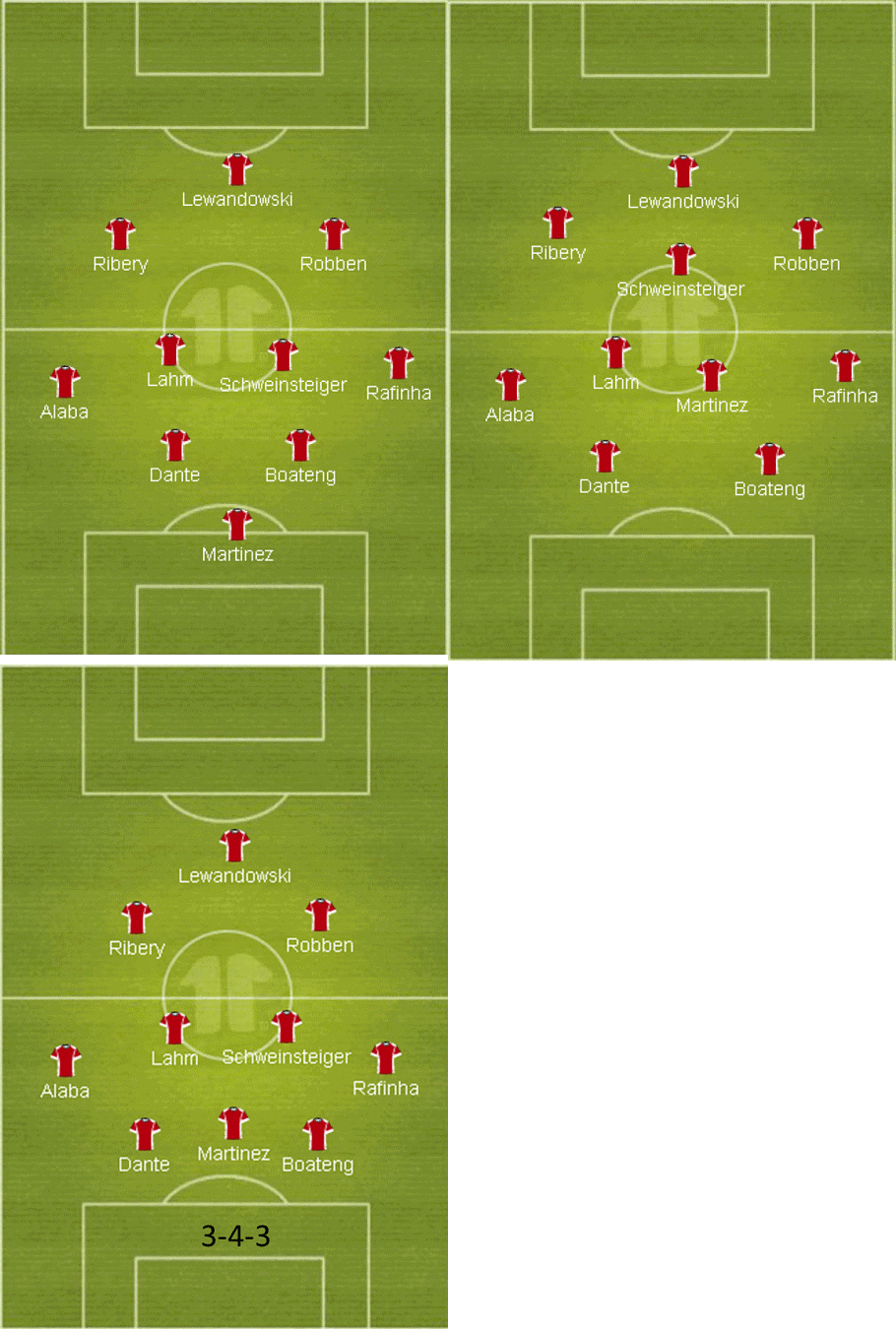
The backline movement in the 3-4-3
The 3-man backline sacrifices width for numerical superiority in dealing with opposing attackers while providing a man advantage in midfield.

In defence, it relies on the 3-man backline and the 4-man midfield, which includes the two wingbacks. And in attack, the formation moulds into a 3-4-1-2 or 3-4-2-1 using either one attacking midfielder (Götze/Kroos) behind two strikers (Mandzukic/Robben and Müller) or two attacking midfielders (Kroos/Müller, Kroos/Götze) and the lone striker (Robben/Müller/Mandzukic).

The 3-4-2-1 has been the one that Bayern have gone with more often and it is a very demanding formation. The two withdrawn strikers or attacking mids play a critical role as they alternate between shifting wide or tucking in behind the main striker. Due to only one striker up top and a lack of wingers, the role of the wingbacks becomes more important. Without their inputs, Bayern can't maintain their superiority when attacking. While being aggressive though, they have to remain disciplined, as they are the sole defensive cover on the wings. So even one slip-up can be costly.

However, the 3-man backline does provide an extra target against teams whose forwards press hard, like Dortmund. The extra man enables them to pass the ball out smoother. The central centre-back often functions as a key distributor, much like Pique did at Barca while the two guys either side of him push wide almost in a full-back-like position to use and cover the space.

Someone like Javi Martinez and Holger Badstuber, both of whom have played as defensive midfielders, can play centre-back better in this formation as it helps them break up play, even at the cost of leaving their position thanks to added protection from the sides and also helps in their distribution. If need be they can even step in to join the midfield to provide extra impetus in attack as the other two centre-backs would then converge to form a back-two.

Till now, Guardiola has used six different players in the full-back roles this season – Pierre Hoijberg, Juan Bernat, Philip Lahm, David Alaba, Rafinha and Sebastian Rode. Each of them offers him something different;  Bernat is more of a traditional full-back and more or less parks himself along the touchline; Alaba and Rafinha are capable of not just playing as full-backs, but also tucking into midfield while Rode and Hoijberg are more inclined to drop inwards as defensive midfielders.

Depending on what weakness a certain opponent has and what he wants to guard against regards his own team, Guardiola can pick his personnel. To top that, you have Lahm, who can play any of those positions on either side. And hence the dynamic fluidity of the wingbacks will be something to look forward to this season.

Thursday, July 17, 2014

Argentina's true MVP at the World Cup: Javier Mascherano


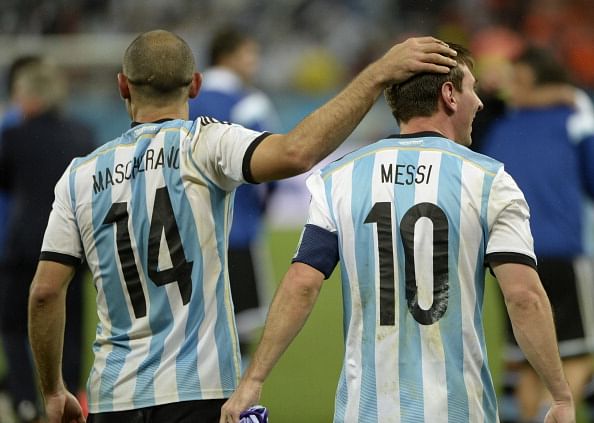
Argentina’s Javier Mascherano and Lionel Messi
In the end, it was not to be for Argentina.

Mario Goetze’s goal in extra time clinched the 2014 FIFA World Cup for the Germans, netting them their fourth trophy, putting them level with Italy and just one behind Brazil.

For the many Brazilians inside the Maracana, there was satisfaction that their neighbours and arch rivals hadn’t managed to get their hands on the coveted trophy, an achievement that would have certainly rubbed salt into their wounds after having witnessed their own team getting dumped out of the tournament in acrimonious fashion.

Argentina had a fine run to the final. They started off slowly and barring the games against Bosnia and Herzegovina and Belgium, they were truly pushed to the limits in each of their games. But they held their own and managed to get the job done, getting over their opponents to eventually make it to the grand finale. The 2014 run to the final was a rather unconventional one for the Argentines. Unlike in the past, this campaign wasn’t highlighted by superb, silken attacking play that their opponents found too much to handle.

True, Argentina had in their ranks, and as captain, arguably the best player in the world in Lionel Messi. He did win the Golden Ball, which was FIFA’s way of pandering to popular opinion and ensuring their commercial interests. But Messi wasn’t even the best player on his team. While he did show his class in leading the way in the group stages, as the tournament progressed, Argentina became more effective than effervescent.

Mascherano wasn’t captain but led from the front

And the leader of this effective pack and Argentina’s MVP during the tournament was Javier Mascherano, who truly had a spectacular World Cup for the Albiceleste. Messi wore the armband, but Mascherano was the vocal leader on the pitch, marshaling the troops, and helping keep the Argentine unit tight and compact. He was, in fact, the incumbent before Alejandro Sabella handed the captaincy to Messi, so the midfielder was just continuing on in his leadership role sans the armband.

Having been witness to watching the midfield enforcer play centre-back for Barcelona the last few seasons, it was an absolute joy to watch Mascherano at this World Cup operating in his favoured deep-lying midfielder role. His marking, tackling and retrieval of the ball were all superb and his distribution once he obtained possession was fantastic, in a throwback to his Liverpool days and his initial years at Barcelona. Acting as the pivot, he helped protect Martin Demichelis, a pronounced liability at the back at club level the last season, and Ezequiel Garay, not the quickest of defenders.

He was crucial in keeping the Argentines organized and disciplined while defending, an aspect that their neighbours Brazil ended up paying a heavy price for not addressing. For long the shortcoming of South American teams, even the best of them, Mascherano ensured that it would not be their Achilles heel this time around.

Mascherano was amongst the leaders in tackles, balls recovered and distance covered among midfielders at Brazil 2014. And while it was his possibly game-saving tackle against Arjen Robben in the semi-finals that made people look up and take notice, efforts like those were what Mascherano routinely put out through the course of the tournament.

After conceding two goals against Nigeria in their final group game, Argentina went three full games without conceding another, only to be breached by Gӧtze’s superbly taken volley in the summit clash. And while he was excellent throughout the tournament, he reserved his finest showing for the semis and the final. While everybody spoke about how well Nigel de Jong man-marked Messi in the semi-finals, Mascherano’s equally lock-in defence against Robben and Wesley Sneijder was overlooked.

In fact, as the match wore on, and the Dutch began to enjoy possession and embarked on a late charge, it was Mascherano who the entire Argentine team suddenly looked up to. And in the team huddle before extra time and penalties, it was once again Mascherano, and not Messi, who was giving the team talk, motivating and inspiring his troops.


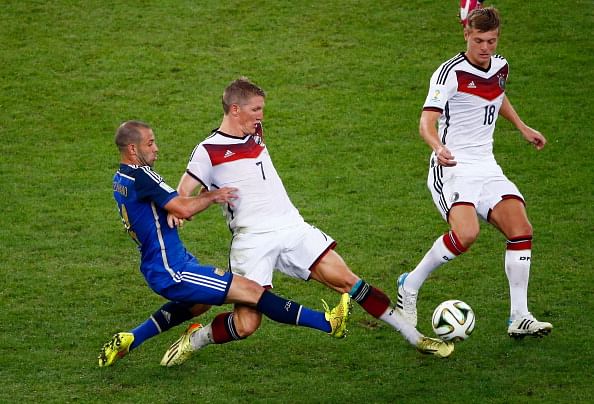
Javier Mascherano of Argentina challenges Bastian Schweinsteiger of Germany during the 2014 FIFA World Cup Final

The unsung hero – recognized by his opponents

Going into the final, Germany’s Bastian Schweinsteiger singled out Mascherano’s importance to the Argentine side calling him “the leader of a pack of wolves”. And Germany found it tough to get past that wolfpack in the final as Mascherano went toe-to-toe with perhaps the best midfield pairing in the competition in Schweinsteiger and Toni Kroos. 

He may not be the big, bad wolf, but through his performances at Brazil 2014, the diminutive Argentine’s reputation as one of the best holding midfielders in the world has been restored. He led his side to their first final in 24 years, and they came close, really close.

But the loss in the final notwithstanding, when the dust settles around the 20th FIFA World Cup, and people begin to look back at the names that stood out, the names that shone the brightest, most of the talk may still revolve around Messi, but Mascherano’s huge contribution to the cause will not be lost on them.

Tuesday, April 23, 2013

Brilliant Bayern crush Barcelona at the Allianz Arena

A quite brilliant team performance from Bayern Munich saw them deliver a seemingly knock-out blow to Barcelona as they beat them 4-0 in the 1st leg of their UEFA Champions League semi-final at the Allianz Arena.

It is not often that Barcelona get mauled by that margin in a game, but it was a special night in Munich, one that belonged to Bayern from start to finish. A double from Thomas Mueller, who was outstanding on the night, and a goal a piece for Mario Gomez and Arjen Robben left Barca needing nothing short of a miracle in the return leg in 8 days time to overturn this deficit.

Gomez came in for suspended striker Mario Mandzukic while Jerome Boateng replaced Daniel Van Buyten in defence in the only 2 changes made by Jupp Heynckes from the team that beat Juventus. Barcelona were missing the services of Carles Puyol and Javier Mascherano through injury, and that meant a start for youngster Marc Bartra alongside Gerard Pique. Lionel Messi was passed fit to play, but through his performance in the game gave the impression that he wasn't exactly a 100%.

Bayern got off the blocks quickly; after scoring a 2nd minute goal against Juve, they once again fashioned a scoring opportunity after just 4 minutes when Robben after some good work with captain Philip Lahm found himself in the box and stabbed a shot at goal that was saved by Victor Valdes. After the initial flurry, Bayern were quite content to give the ball to Barcelona, but ensured that they didn't get much beyond the half-way line as they pressed and harried the Catalan side when on the ball.

And, after retrieving it, they used it to devastating effect by playing balls into the space left behind by Barca's full-backs - Alves and Jordi Alba as Robben and Franck Ribery were let loose on the visitors. Bayern looked threatening every time they went forward and were unlucky to be denied a penalty early on when Pique looked to have stuck his arm out to keep out a Lahm effort.


Bayern broke through in the 23rd minute from a corner, 1 of 8 corners that they earned in the first half. After Barca failed to effectively clear Ribery's delivery, the ball fell to Robben who put in an uncharacteristic right-footed cross that was met by the head of Dante to guide it to Mueller who scored with a diving header of his own.

Every time the ball was lifted into the box, Bayern looked capable of scoring with Barcelona looking susceptible to a long known weakness. Bayern created a few more good openings but couldn't muster a second goal and proceeded to half-time with a 1-0 lead.

Barcelona did not have a single shot on target in the first half with Bayern keeper Manuel Neuer hardly called into action. Bayern's defence and midfield did such an excellent job of shackling Barcelona, not allowing them any time on the ball, that they ensured the visitors created next to nothing with limited forward passing.
In the second half, Bayern came out firing, looking to pick up from where they left off and Gomez soon doubled their advantage. From another corner, Robben's delivery was headed across goal by Mueller, and Gomez lashed in a left-footed finish from close range as Barca were undone once again by a ball into the box. Gomez did look marginally offside though.

Two goals to the good, Bayern afforded to sit back a bit deeper and hand Barcelona some more possession. It was an exercise in futility for Tito Vilanova's side who could not get anything going against an organized and well-drilled Munich side. Messi ghosted through much of the game and even when he got the ball at his feet, he was met with swift tackles and challenges from the Bayern players. Javi Martinez and Bastian Schweinsteiger had a colossal game in the heart of that Bayern midfield.
By now Barcelona were growing frustrated and it increasingly looked like Bayern would score a third rather than the 'Blaugrana' snatching a goal back as Mueller, Ribery and Robben were swamping all over Barca. Robben scored on 73 minutes after one of his trademark mazy runs and went on to finish from a tight angle on the right to make it 3-0; he was helped by a rather generous screen by Mueller on Jordi Alba before the Dutchman composed a cool finish past Valdes.
The Allianz Arena was delirious by now and Barcelona weren't able to find any answers to the threat that Bayern posed downt he flanks with David Alaba and Lahm also joining in towards the latter stages. That produced a fourth on 82 minutes, when Alaba and Robben combined to devastating effect with the Austrian lashing in a devilish low cross that was turned in by Mueller for his second and to enlarge the scoreline to 4-0.

Frustration boiled over for some of the Barcelona players towards the end and Jordi Alba was lucky to get just a yellow as he threw the ball onto Robben's face in an unsportsmanlike gesture. He will miss the second leg at the Camp Nou.

Just like the game, Bayern Munich were headline makers through the day. They began the morning with the news that they have acquired the talented Mario Gotze from rivals Borussia Dortmund, and they ended the night with a performance that lit up the Allianz Arena as they put Barcelona to the sword in a 4-0 thrashing.

Jupp Heynckes before the game told reporters that they had a plan. He mentioned that it wasn't the same as the one against Juventus, but they did have a plan. Bayern executed their plan to perfection and looked like a team set to dominate the European scene for a few years to come. Heynckes and his men after tonight are well on the Road to Wembley.


PLAYER OF THE MATCH

Thomas Mueller/Arjen Robben - Mueller normally reserves his best for the big games and showed his class tonight with a superb performance. Bayern's leading scorer in the tournament bagged a brace and ran the Barca defence ragged with his well-timed runs and link play as the 2nd striker at times.

Arjen Robben has just gotten better as the tournament has progressed and never stopped running like an Energizer bunny. His forays down the right flank kept Alba pegged back and he was a constant thorn in Barcelona's flesh. Was involved in all the goals on the night and displayed great commitment to team ethic by even getting back to defend and sharing the ball well.

Sunday, February 24, 2013

LA LIGA Results: Sat, Feb 23

Barcelona 2-1 Sevilla

The Catalans fought back from a first half deficit to come through the game with goals from David Villa and Lionel Messi. Sevilla took the lead in the very first minute of the match from Alberto Botia's header. Possibly still carrying a hangover from their midweek loss against AC Milan, the hosts looked ineffectual even with all the possession they enjoyed and there was a predictability to their play that helped Sevilla see out the half without too many dangers. In the second half, Barca upped the tempo a bit and brought on Cristian Tello for Alexis Sanchez who had had a quiet night. The more direct Tello seemed to have an effect as he helped inject some much needed pace into the hosts' play. Villa, back in the team after recovering from kidney stones, got the equalizer as he ran onto Dani Alves' cross from the right to slot home. Messi then grabbed the winner with a cool finish in front of goal from Tello's assist. The win takes Barca 15 points ahead from second placed Atletico Madrid who are in action on Sunday.

Deportivo La Coruna 1-2 Real Madrid

Jose Mourinho fielded an under-strength team for the game, with the midweek clash against arch rivals Barcelona in the Copa del Ray in mind. And, the move almost back-fired as Real scrapped their way to a 2-1 win at the Stadio Riazor. The home side went into half-time a goal to the good thanks to Riki's first half strike. The visitor's had a torrid time dealing with the threat from Depor's Rikki and Pizzi as they took the attack to Madrid. With his side hardly threatening, Mourinho rang the changes just after half time, as he brought on Cristiano Ronaldo, Mesut Ozil and Sami Khedira to try and salvage the game. And the changes worked as Real went on to lay siege to the Depor goal. With 17 minutes left, Kaka curled one into the right hand corner to draw Real level before Ronaldo found an unmarked Higuain who was left with a simple tap in for the winner. With the game won, Angel Di Maria displayed some immature petulance and refused to back up at 2 free-kicks earning him 2 yellow cards in no time and a dismissal from the game. He is now out of the second El Clasico clash against Barca next Saturday.

Other results
Real Zaragoza 2-2 Valencia
Mallorca 1-3 Getafe

Sunday, February 17, 2013

Magical Messi scores his 300th Goal

 Lionel Messi's brace helped Barcelona push their lead at the top of La Liga to 15 points with a 2-1 win away at Granada. With both the Madrid clubs, Atletico and Real, in action on Sunday, the Catalans had the opportunity to widen their lead.

It was Granada who took the lead, against the run of play, through Odion Ighalo in the 26th minute. Barca put on a passing masterclass in the first half with Thiago Alcantara running the show in the absence of the injured Xavi. However, a rare attack from the hosts saw them go behind when Ighalo cushioned the ball into goal off a cross from the right. 

Barca however stayed patient and were rewarded in the second half when Cesc Fabregas' intial shot was parried by the Granada keeper, only for Messi to pounce on the rebound to score his 300th goal for the Blaugrana. Then in the 73rd minute, Barca earned a free-kick 30 yards out which the Argentine beautifully curled in to the far post to seal the points for the Catalans. 

Barcelona travel to the San Siro midweek to take on AC Milan in the 1st leg of their UEFA Champions League Round of 16 tie.

Malaga and Sevilla also post Wins
Messi wasn't the only Argentine on target yesterday as former Madrid and Barca striker Javier Saviola scored the only goal of the game to help Malaga to a 1-0 win over struggling Athletic Bilbao. Saviola's 7th goal of the season helped the Malaga consolidate their 4th place standing in La Liga. Like Barcelona, Malaga too will travel away to Porto for their 1st leg tie in the UEFA Champions League Round of 16 midweek.

A double from Gary Medel gave Sevilla a 3-1 home win over bottom club Deportivo La Coruna. The win provides a significant boost to Sevilla in their push for European qualification places next season.

Tonight's key games:
Valencia vs Mallorca
Real Valladolid vs Atletico Madrid
Real Madrid vs Rayo Vallecano